Go To Table of Contents
|
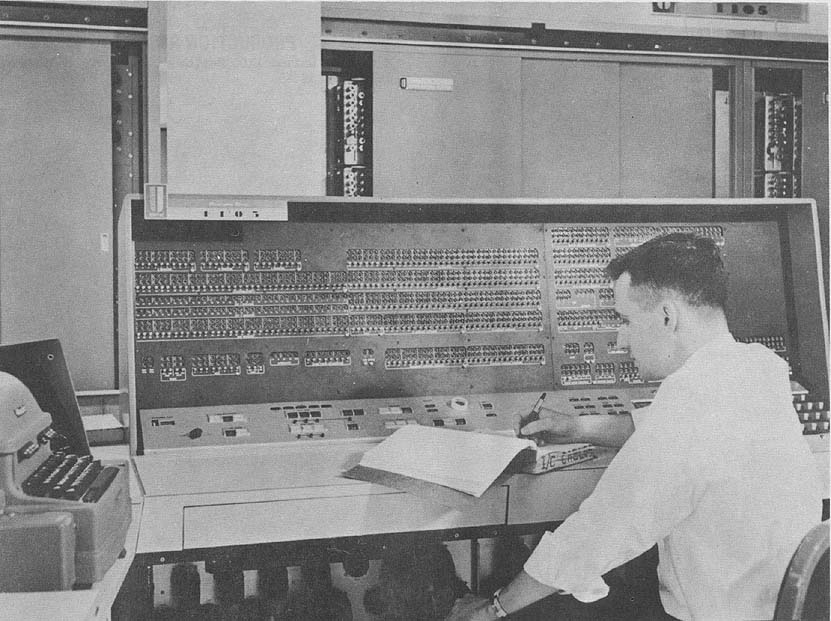
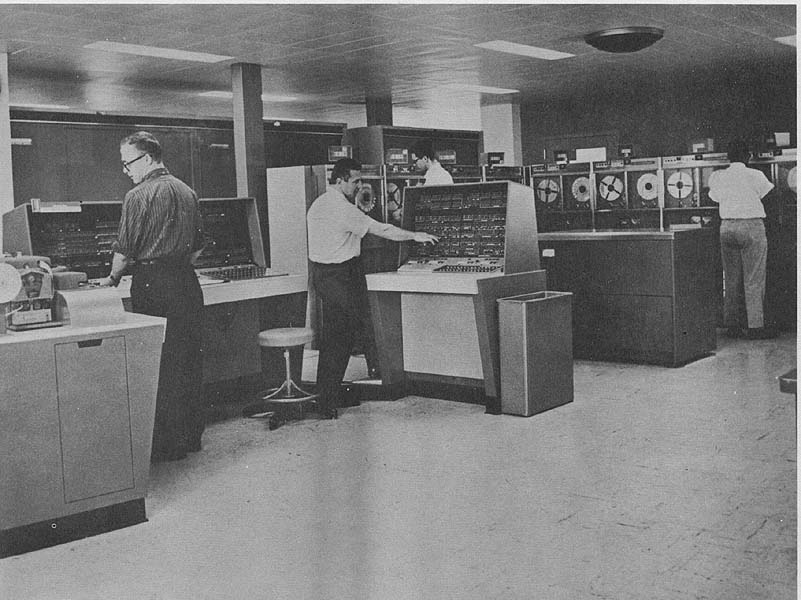
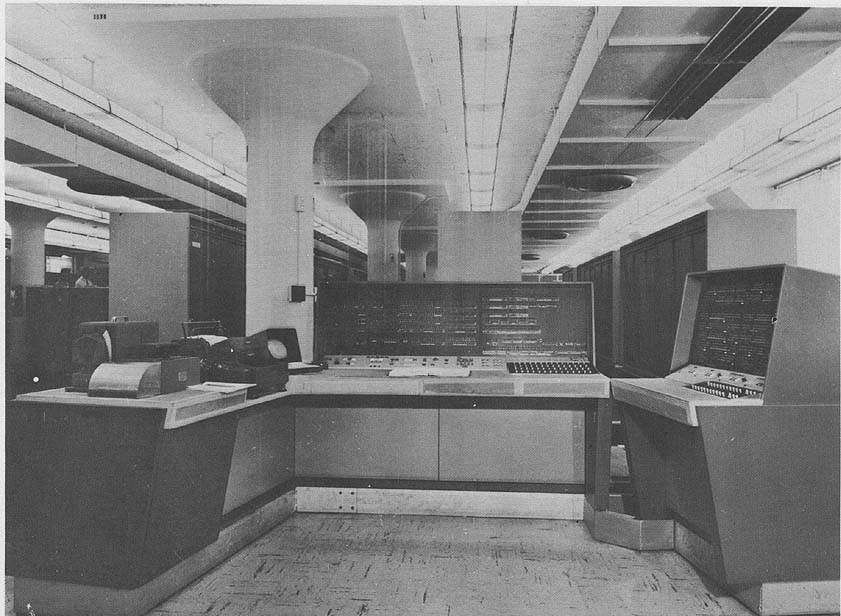
BRL 1961, UDEC I II III, start page 0884
|
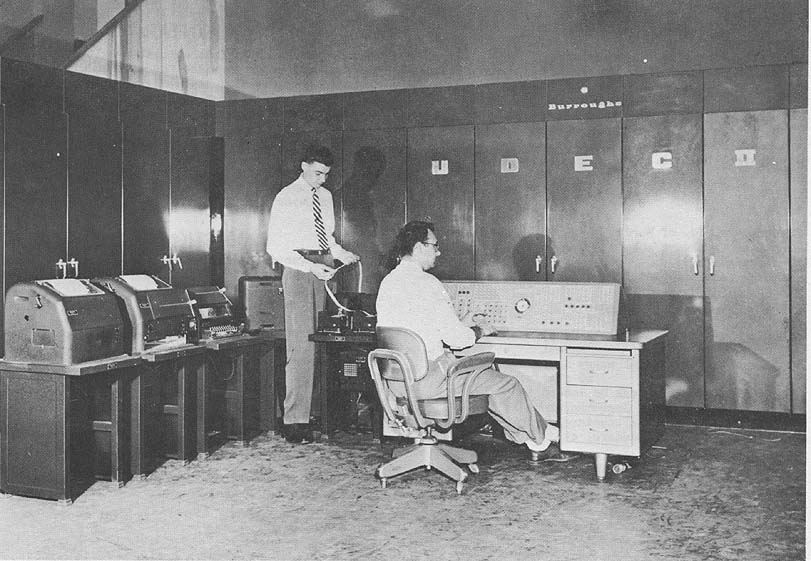
UDEC I II III
Unitized Digital Electronic Calculator Models I II and III
MANUFACTURER
The Burroughs Corporation
Electronic Instrument Division
Photo by Burroughs Corporation
APPLICATIONS
Scientific computing and commercial data processing
PROGRAMMING AND NUMERICAL SYSTEM
UDEC I
Internal number system Binary coded decimal
Decimal digits/word 10
Decimal digits/instruction 5
Instructions per word 2
Instructions decoded 34
Instructions used 34
Arithmetic system Fixed point
Instruction type One or two address
Number range 10-9 <= n <= 109
Program selection permits one- or two-address modes
of operation. The decimal point may be manually set
at any desired location. Two address operation is
optional for optimum programming.
UDEC II III
Internal number system Excess-three bin coded
dec
Decimal digits/word 9 plus sign digit
Decimal digits/instruction 5
Instructions per word 2
Instructions decoded 40
Instructions used 32
Arithmetic system Fixed point
Instruction type One address
Number range Movable decimal point
Two address word possible if second instruction in each word
is unconditional transfer. Each instruction is one half word, i.e.
5 digits. Of these, 3 digits specify address and 2 digits the
command.
ARITHMETIC UNIT
UDEC I
Incl Stor Access Exclud Stor Access
Microsec Microsec
Add time 176-264 88-176
Mult 4,000 3.912
Div 6,000 5,912
Construction
Vacuum tubes 3,000
Magnetic cores 320
�
|
BRL 1961, UDEC I II III, start page 0885
|
Rapid access word registers 2
Basic pulse repetition rate 125 Kc/sec
Arithmetic mode Serial-parallel
Timing Synchronous
UDEC II III
Exclud Stor Access
Microsec
Add time 680
Mult time 30,000
Div time 30,000
Construction Vacuum tubes
Basic pulse repetition rate 125 Kc/sec
Arithmetic mode Serio parallel
Timing Synchronous
Operation Sequential
STORAGE
UDEC I
Access
Media Words Digits Microsec
Magnetic Drum 5,300 53,000 8,000(avg)
Magnetic Cores 100 1,000 88
UDEC II III
Magnetic Core 1,000 20/5 digits
Magnetic Drum 10,000 8,500(avg)
53,000 decimal digits total drum storage. Drum
information contained in blocks of 200 words for
transfer to and from core storage.
INPUT
UDEC I
media speed
Paper Tape (Ferranti Photoelectric) 400 char/sec
Keyboard Manual
UDEC II III
Paper Tape (Ferranti Photoelectric) 120 char/sec
Paper Tape (Potter magnetic tape handler modified far
photoelectric input) Magnetic Tape (Potter)
OUTPUT
UDEC I
Media Speed
Printer 6 char/sec
Paper Tape 60 char/sec
UDEC II III
Paper Tape Teletype (2)(5-level) 60 char/sec
Paper Tape Teletype;(7-level) 60 char/sec
Magnetic Tape (Potter)
CIRCUIT ELEMENTS OF ENTIRE SYSTEM
UDEC I
Tubes 3,000
Tube types 8
Crystal diodes 6,000
Magnetic cores 4,700
Separate cabinets28 standard, 19 in x 7 ft, ea
Tube types include 6CL6, 5687, 7AK7, 6197, 12AU7,
12AT7, 6BC5, 12BH7.
System is constructed of standard Burroughs pulse control
equipment and interconnected with R662U coaxial cable.
UDEC II III
Tubes 3,000
Machine consists of Burroughs Pulse Control Equipment,
approximately 600 units in all.
CHECKING FEATURES
UDEC I
Modulo 3 arithmetic check
Modulo 3 check on each word transferred to and from storage.
Forbidden combination multiply and divide check.
POWER, SPACE, WEIGHT, AND SITE PREPARATION
UDEC I
Power, computer 30 Kw 32 KVA
Space, computer 400 sq ft area, floor space
part of machine
Capacity, air condit Blower-exhaust type
System arranged in form of an almost closed rectangle.
UDEC II III
Power, computer 33 Kw
Space, computer 31 racks
Capacity, air cond. 15 Tons
PRODUCTION RECORD
Number produced 2 (Incl UDEC I)
Number in current operation 2
Delivery time 6 months
UDEC I located at Wayne University, Detroit, Michigan.
UDEC II III located at Burroughs Corporation,
Philadelphia, Pennsylvania.
COST, PRICE AND RENTAL RATES
UDEC I
Approximate cost of basic system $500,000.
Approximate cost of modifications and additions
$200,000.
UDEC II III
Approximate cost of basic system $200,000.
Additional equipment 100,000.
RELIABILITY, OPERATING EXPERIENCE,
AND TIME AVAILABILITY
UDEC I
Average error-free running period 7 Hours/8 Hour/shift
Good time 8.5 Hours
Attempted to run time 10 Hours
Operating ratio (Good/Attempted to run time) 0.85
Figures based on period May 53 to Nov 56.
Passed Customer Acceptance TestDee 53.
Decimal-binary automatic conversion is utilized.
UDEC II III
Average error-free running period 6 Hours
Operating ratio 0.85
Passed Customer Acceptance Test Oct 53
ADDITIONAL FEATURES AND REMARKS
UDEC II III Burroughs UDEC III is a general modification
of UDEC II. UDEC III will consist of Burroughs pulse control
equipment which has been used in UDEC II. The basic flexibility
of this equipment provides for a maximum of modification with
respect to special instructions and special input-output equipment
which must be added as required.
INSTALLATIONS
Wayne University (UDEC I)
Computational laboratory
Detroit 1, Michigan
Burroughs Corporation (UDEC II III)
Electronic Instrument Division 1209 Vine
Street Philadelphia, Pennsylvania
�
|
BRL 1961, UNIVAC 60, start page 0886
|
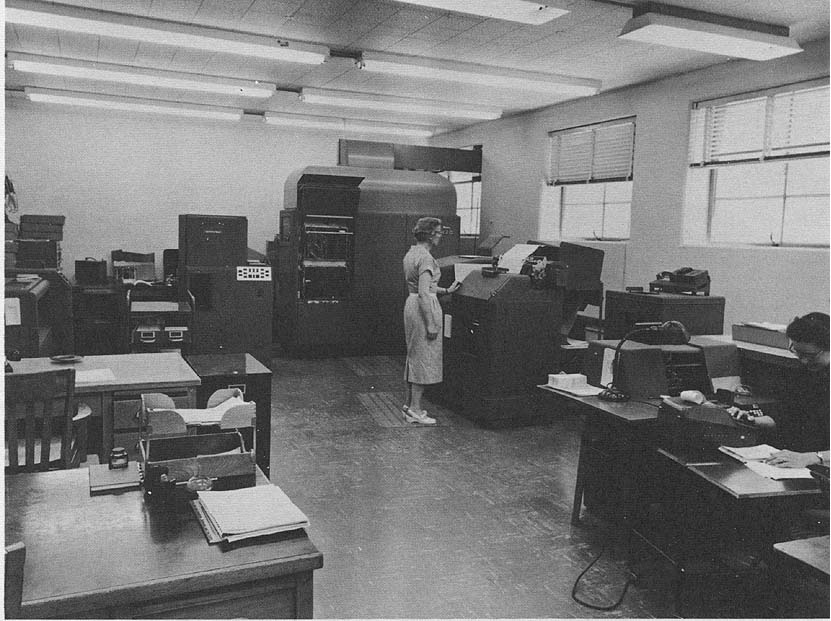
UNIVAC 60
Universal Automatic Computer Model 60
MANUFACTURER
Remington Rand Univac Division Sperry
Rand Corporation
APPLICATIONS
Manufacturer Business and scientific data
processing.
Joliet Arsenal, Comptroller, E.A.M. Systems Branch
Located at Joliet
Arsenal, Joliet, Illinois, the system is used for civilian payroll, civilian
personnel statistics, stock accounting, cost accounting, and procurement
accounting.
PROGRAMMING AND NUMERICAL SYSTEM
Internal number system Biquinary, decimal, and alphabetic
Decimal digits/word Variable from 1 to 10 digits plus sign
Digits/instruction Not internally programmed
Arithmetic system Fixed point, variable
Instruction type Three address
Number range Variable
ARITHMETIC UNIT
The timing is synchronous.
The operation is sequential.
One full cycle on the computer requires 400 milliseconds. 75 milliseconds
are required for feeding, sensing, and punching the card. 325 remain for
calculation. If the calculation requires more than 325 milliseconds, the
computer automatically waits until the end of calculation signal has been
given before punching, feeding and sensing the next card. Buffing is not
used.
The purpose of the electronic computing unit is:
To connect card columns for sensing, punching, and reproducing.
To set constant values.
To set the machine for the operations to be performed and the sequence
of the operations.
To perform all calculations with an electronic accumulator.
To store the values calculated.
To check each arithmetic step.
To visibly read all elements of all arithmetic steps. The arithmetic
unit uses floating point but storage uses a selected fixed point.
The biquinary code is as follows:
Digits Biquinary Code
0 0
1 1,0
2 2
4 4,2
5 1, 4
6 6
7 1,6
8 8
9 1,8
Alphabetic characters are wired to become two or three numeric
characters at the input level. For example, an A becomes 111, a C becomes
99. See Storage.
Negative numbers are carried as the tens complement of the number. A
negative sign indicates that the value is negative instead of positive.
The location of the decimal point is variable and may be arbitrarily
assigned
to .each input and storage location.
There is only one arithmetic register, called the accumulator. It has a
capacity of 22 digits. The computation of each program step takes place
within the accumulator. For example, an addition would be performed as
follows:
1) Clear the accumulator
2) Eater the first value according to its decimal location.
3) Enter the decimal location of the second value.
4) Shift the first value to align with the decimal of the second value.
5) Enter the second value, performing the process of addition.
6) Enter the decimal location of the result storage and shift the result to
align with it.
7 Place the result in the result storage.
8) Subtract value two from the result.
9) Subtract value one from the result of 8).
10) Check to be certain that the accumulator is zero.
Each step is balanced to zero before the computer continues to the next step.
The four possible steps and the method used to check each are:
Step Proof
Value 1 + Value 2 = Result Result - Value 2 - Value 1 = 0
Value 1 - Value 2 = Result Result + Value 2 - Value 1 = 0
Value 1 x Value 2 = Result Result/Value 2 - Value 1 = 0
Value l/Value 2 = Result Result x Value 2 - Value 1 = 0
The computer will not continue unless the step checks to zero.
The computer has automatic decimal alignment. Programs have been
developed which use a floating point method, although the computer is
operating with automatic alignment.
Scaling may be accomplished by multiplying or dividing the number by a
factor, or changing the decimal location by a selector.
An overflow stops the computer.
The remainder is dropped off in the final result, although it is used
during the proof of the step.
The round-off of sums, differences, products and quotients depends on
the decimal location of the result storage. The accumulator unit has 22
positions, as follows:
M Sections
1 2 3 4 5 6 7 8 9 10 11
A Sections
11 to 9 8 7 6 5 4 3 2 1
All results are placed in storage from positions 10-1 of the A Section. Each
storage is assigned a decimal location for the program involved. A location
|
BRL 1961, UNIVAC 60, start page 0887
|
of 4/3 would mean that three places are to be retained in the result
following the decimal. If the result of any step-addition, subtraction,
multiplication, or division contains more places than those allowed in the
result storage, the additional digits will be located in the M Section,
beginning in column 11. When the result is placed in the storage unit, they
are thereby rounded off. Rounding off requires an addition step.
Comparisons are made by two subtraction steps.
Each step has two branchings, plus and minus. Zero
is always considered plus. The first step of the
two value 1 minus value 2. If the result is minus,
value 2 is greater than value 1. If the result is
plus, value 1 is equal to or greater than value 2.
The second step would be value 2 minus value 1. If
the result is minus, value 1 is greater than value 2.
If the result is plus, value 1 and value 2 are equal.
Control Unit
The computer has no stored program.
The input-output panel indicates the card fields to be sensed, punched
and reproduced. The constant program panel indicates the program to be
followed, step by step, and the constant value which will be used.
The computer operates on a three address system. Each program step, which
is externally wired, contains the following six instructions,
in the following form:
V1 Pr V2 = R - BR + BR
V1 The storage, constant, or card-read field to be used as value 1.
Pr The process (+, -, x, /)
V2 The storage, constant, or card-read field to be used as value 2.
R The storage into which the result is to be placed.
-BR The next step or operational function to be
performed if the sign of the result is minus
+BR The next step or operational function to be
performed if the sign of the result is plus.
Breakpoint stops may be included in the program. At the plus or minus
branching of any step an instruc tion requiring a division of 0 by 0 or a
number by 0 may be given. Both of these steps cause the computer to stop, and a
corresponding light is lit.
The electronic computing unit contains a control panel with a dial. Each
step may be dialed in turn. For each step value 1, value 2, the result, the
process, the branching, all decimal locations and whether the step checks
may be read from the panel.
The computer will stop under the following conditions:
1) Empty feeding magazine.
2) Full receiving magazine or chip pan.
3) Sensing of alpha.
4) Zero divided by zero.
5) Number divided by zero.
6) Incorrect voltage.
7) Temperature too high.
8) Overflow condition on a step.
9) Failure to check.
STORAGE
Medium Words Digits
Vacuum tube 6 60
The storage system used is biquinary. Each column
of storage contains 5 tubes, representing the digits
1, 3, 5, 7, and 9. There is no tube for zero, which
is represented by the fact that none of the tubes
are lit. An odd digit is represented by the corres-
ponding tube 1, 3, 5, 7, or 9. An even digit is
represented by the odd digit which is immediately
lower in value, plus the 9. Therefore, a 2 is 1 plus 9, a 4 is 3 plus 9, a
6 is 5 plus 9 and an 8 is 7 plus 9.
The word length in storage is ten digits (columns) plus sign.
Alphabetic characters require five columns of storage for two characters,
three columns for a single character. A single word can therefore contain 4
columns of alphabetic characters as opposed to 10 columns of numeric
characters.
Storage is actually part of the computing unit. There is no buffing unit.
INPUT
Medium
Card Sensing-Punching Unit
The purpose of the Card Sensing-Punching unit is to sense and punch
tabulating cards and to indicate and control general machine operation.
A maximum of 36 words (card read fields) may be used in one program. Up to
60 digits may be divided as necessary among 36 words. The sign of each
field is in addition to the 60 digits.
A 90 column punched card code is used. This is the same biquinary code as
is used in the storage unit. All 36 words are sensed simultaneously on one
cycle. Five columns are required to sense two columns of alphabetic
information; three columns are required to sense one column of alphabetic
information.
Joliet Arsenal
Medium Speed
Cards 150 cards/min
OUTPUT
Medium
Card Sensing-Punching Unit
Joliet Arsenal
Medium Speed
Cards 150 cards/min
POWER, SPACE, WEIGHT, AND SITE. PREPARATION
Card Sensing-Punching Unit
The Card Sensing-Punching Unit measures 2 ft. 11 in. long, 2 ft. 6 in. wide,
5 ft. 9 in. high, and weighs 1,020 lbs. This unit may operate from any of
the following power services:
a) 208 volt single phase, 4 wire, 60 cycles
b) 230 volt single phase, 3 wire, 60 cycles
c) 220 volt single phase, 3 wire, 60 cycles
d) 120 volt three phase, 4 wire, 60 cycles
e) 220 volt three phase, 3 wire, 60 cycles
f) 220 volt three phase wye system, 50 cycles.
The Electronic Computing Unit measures 7 ft. 2 in. wide, 2 ft. 6 in. deep, 5
ft. 9 in, high and weighs 2,210 lbs.
The unit operates from the same power sources as the Card Sensing-Punching Unit.
The unit is ventilated by fan forced room air.
Joliet Arsenal
Power, air conditioner 5 Kw 0.90 pf
Volume, computer 145 cu ft
Volume, air conditioner 31.5 cu ft
Area, computer 43 sq ft
Area, air conditioner 4.75 sq ft
Room size 16 ft x 10 ft 6 in
Floor loading 80 lbs/sq ft
Weight, computer 3,230 lbs
Weight, air conditioner 500 lbs
|
BRL 1961, UNIVAC 60, start page 0888
|
COST, PRICE AND RENTAL RATES
Approximate cost of basic system $75,000.
Rental rate for basic system, standard shift $690$1,050/month.
Second shift operation charge is an additional 50,% of the Standard Rate.
Third shift operation charge is an additional 50% of the Standard Rate.
Maintenance, including cost of parts, except due to customer negligence,
is included in the rental rates above.
The charge for maintenance to a customer who purchases,
rather than leases, but who requires maintenance operations is $3,750
per year for a machine less than 6 years old and $4,500 for a
machine 6 to 11 years old.
Customer's personnel are trained at no extra charge.
Joliet Arsenal
Basic system rents at $740.
4 Key punches, 3 tabulators, 1 auto-verifier, 3 summary
punches, 1 collator, 2 interpreters, 1 reproducer, and 3
sorters rents at $2,594/month.
PERSONNEL REQUIREMENTS
Joliet Arsenal
One 8-Hour Shift
Supervisors 3
Programmers 2
Clerks 1
Operators u
Operation tends toward open shop.
Methods of training used includes formal training furnished
by the manufacturer and on-the-job training.
RELIABILITY, OPERATING EXPERIENCE,
AND TIME AVAILABILITY
Joliet Arsenal
Good time 15 Hours/Week (Average)
Attempted to run time 18 Hours/Week (Average)
Above figures based on period from Jun 59 to Jun 60
Time is not available for rent to outside organiza-
tions.
ADDITIONAL FEATURES AND REMARKS
The Univac 60 and Univac 120 Systems are similar, except with
regard to such items as storage capacity, price, rental rate, and
service costs.
FUTURE PLANS
Joliet Arsenal Continuation of improvements and
refinement of present applications.
INSTALLATIONS
Joliet Arsenal
Comptroller, E. A. M. Systems Branch
Joliet, Illinois
PRODUCTION RECORD
Total number of Univac 60 and 120 Systems 1,000
|
BRL 1961, UNIVAC 60, start page 0889
|
[ blank page ]
|
BRL 1961, UNIVAC 120, start page 0890
|
UNIVAC 120
Universal Autometic Computer Model 120
MANUFACTURER
Remington Rand Univac
Division of Sperry Rand Corporation
Photo by Department of Interior, Bureau of Mines
APPLICATIONS
Manufacturer Business and scientific data processing. U. S. Bureau of
Reclamation Located at Ephrata, Washington, system is used for the solution
of engineering, e.g., earthwork and subdivision of sections, and administrative
problems, e.g. irrigation accounts, crop census, land owership records, payroll,
accounts receivable and payable, stock records, personnel roster, and vehicle
utilization and costs.
U. S. Army Chemical Corps Proving Ground, Dugway
Located in the Computer Section, Test Design & Anal-
ysis Office, the system is used for calculation of
results of various chemical and biological field
tests, statistical and mathematical analysis of field
test results, meteorological research, and cost
accounting, payroll, property inventory, and other
standard commercial type applications.
U. S. Bureau of Mines
Located at the Central Experiment Station, Bureau of
Mines, Pittsburgh 13, Pennsylvania, the system is
used in the Computation Laboratory. The Computation
Laboratory is an internal service bureau whose facil-
ities are made available to all organizational seg-
ments of the Bureau of Mines. These services can be
divided into three major categories: technical,
statistical and accounting. The technical calcula-
tions encompass many areas in the general field of
numerical analysis such as determination of curves
ofbest fit, rational approximations of a variety of
functions, numerical integration and differentiation,
matrix operations, interpolation and the solution of
algebraic and transcendental equations. These cal-
culations result from the desire for numerical solu-
tions of some of the problems encountered by technical
personnel in the Bureau's programs in combustion,
explosive and mineral research, statistical services
include those rendered to the film library and dis-
tributing group, Coal Analysis Section, and in basic
data reduction and correlation studies for some of
the Bureau's major canvasses. Accounting services
include payroll and cost distribution, property inven-
tory and transactions, and employee personnel records.
AiResearch Manufacturing Company of Arizona
Located at 402 South 36th Street, Phoenix, Arizona,
the two systems are used for computation of payroll,
earnings to date, accrual of vacation and sick leave
hours and money, extension of labor charges and bur-
den, production planning, production parts scheduling,
parts issue, accounts payable, inventory accounting,
|
BRL 1961, UNIVAC 120, start page 0891
|
Photo by Department of Interior, Bureau of Reclamation
cost accounting, laboratory facility burden, quality control, and assets
depreciation.
PROGRAMMING AND NUMERICAL SYSTEM
Internal number system Biquinary, decimal, and
alphabetic
Decimal digits/word Variable from 1 to 10
digits plus sign
Number of digits/instruction Not internally programmed
Arithmetic system Fixed point, variable
Instruction type Three address
Number range Variable
ARITHMETIC UNIT
The timing is synchronous.
The operation is sequential.
One full cycle on the computer requires 400 milliseconds. 75 milliseconds
are required for feeding, sensing, and punching the card. 325 remain for
calculation. If the calculation requires more than 325 milliseconds, the
computer automatically waits until the end of calculation signal has been
given before punching, feeding and sensing the next card. Buffing is not used.
The purpose of the electronic computing unit is: To connect card columns for
sensing, punching, and reproducing. To set constant values. To set the machine
for the operations to be performed and the sequence of the operations. To
perform all calculations with an electronic accumulator. To store the values
calculated. To check each arithmetic step. To visibly read all elements of all
arithmetic steps. The arithmetic unit uses floating point but storage uses a
selected fixed point.
The biquinary code is as follows:
Digits Biquinary code
0 0
1 1,0
2 2
3 1,2
4 4
5 1,4
6 6
7 1,6
8 8
9 1,8
|
BRL 1961, UNIVAC 120, start page 0892
|
Photo by U. S. Array Chemical Corps Proving Ground
(Dugway)
Alphabetic characters are wired to become two or three numeric
characters at the input level. For example, an A becomes 111, a C becomes
99. See Storage.
Negative numbers are carried as the tens complement of the number. A
negative sign indicates that the value is negative instead of positive.
The location of the decimal point is variable and may be arbitrarily assigned
to each input and storage location.
There is only one arithmetic register, called the accumulator. It has a
capacity of 22 digits. The computation of each program step takes place
within the accumulator. For example, an addition would be performed as
follows:
1) Clear the accumulator.
2) Enter the first value according to its decimal location.
3) Enter the decimal location of the second value.
4) Shift the first value to align with the decimal of the second value.
5) Enter the second value, performing the process of addition.
6) Enter the decimal location of the result storage and shift the result to
align with it.
7) Place the result in the result storage.
8) Subtract value two from the result.
9) Subtract value one from the result of 8).
10) Check to be certain that the accumulator is zero.
Each step is balanced to zero before the computer continues to the next
step. The four possible steps and the method used to check each are:
Step Proof
Value 1 + Value .2 = ResultResult - Value 2 -
Value 1 = 0
Value 1 - Value 2 = ResultResult + Value 2 -
Value 1 + 0
Value 1 x Value 2 = ResultResult = Value 2 -
Value 1 = 0
Value 1 : Value 2 = ResultResult x Value 2 -
Value 1 = 0
The computer will not continue unless the step checks to zero.
The computer has automatic decimal alignment. Programs have been
developed which use a floating point method, although the computer is
operating with automatic alignment.
Scaling may be accomplished by multiplying or dividing the number by a
factor, or changing the decimal
|
BRL 1961, UNIVAC 120, start page 0893
|
location by a selector.
An overflow stops the computer.
The remainder is dropped off in the final result, although it is used during
the proof of the step.
The round--off of sums, differences, products and quotients depends on the
decimal location of the result storage. The accumulator unit has 22 positions,
as follows:
M Sections
1 2 3 4 5 6 7 8 9 to 11
A Sections
11 l0 98 7 6 5 4 3 2 1
All results are placed in storage from positions 10-1 of the A Section. Each
storage is assigned a decimal location for the program involved. A location of
4/3 would mean that three places are to be retained in the result following the
decimal. If the result of any step-addition, subtraction, multiplication, or
division contains more places than those allowed in the result storage, the
additional digits will be located in the M Section, beginning in column 11.
When the result is placed in the storage unit, they are thereby rounded off.
Rounding off requires an addition step.
Comparisons are made by two subtraction steps. Each step has two
branchings, plus and minus. Zero is always considered plus. The first step of
the two would be value 1 minus value 2. If the result is minus, value 2 is
greater than value 1. If the result is plus, value 1 is equal to or greater than
value 2. The second step would be value 2 minus value 1. If the result is minus,
value 1 is greater than value 2. If the result is plus, value 1 and value 2 are
equal.
Control Unit
The computer has no stored program.
The input-output panel indicates the card fields to be sensed, punched
and reproduced. The constant program panel indicates the program to be
followed, step by step, and the constant values which will be used.
The computer operates on a three address system. Each program step,
which is externally wired, contains the following six instructions, in the
following form:
V1 Pr V2 = R - Br. + Br.
V1 The storage, constant, or card-read field to
be used as value 1.
Pr The process (+, -, x, :)
V2 The storage, constant, or card-read field to
be used as value 2.
R The storage into which the result is to be
placed.
-Br The next step or operational function to be
performed if the sign of the result is minus.
+Br The next step or operational function to be
performed if the sign of the result is plus.
Breakpoint stops may be included in the program. At the plus or minus
branching of any step an instruction requiring a division of 0 by 0 or a number
by 0 may be given. Both of these steps cause the computer to stop, and a
corresponding light is lit.
The electronic computing unit contains a control panel with a dial. Each step
may be dialed in turn. For each step value 1, value 2, the result, the process, the
branching, all decimal locations and whether the step checks may be read from
the panel.
The computer will stop under the following conditions:
1) Empty feeding magazine
2) Full receiving magazine or chip pan
3) Sensing of alpha
4) Zero divided by zero
5) Number divided by zero
6) Incorrect voltage
7) Temperature too high
8) Overflow condition on a step
9) Failure to check.
STORAGE
Manufacturer
Medium Words
Vacuum Tube 12
The code system used is biquinary. Each column of storage contains 5 tubes,
representing the digits 1, 3, 5, 7, and 9. There is no tube for zero, which is
represented by the fact that none of the tubes are lit. An odd digit is
represented by the corresponding tube 1, 3, 5, 7, and 9. An even digit is
represented by the odd digit which is immediately lower in value, plus the 9.
Therefore, a 2 is 1 plus 9, a 4 is 3 plus 9, a 6 is 5 plus 9 and an 8 is 7 plus
9.
The word length in storage is ten digits (columns) plus sign.
Alphabetic characters require five columns of storage for two characters,
three columns for a singe character. A single word can therefore contain 4 colas
of alphabetic characters as opposed to 10 columns of numeric characters.
Storage is actually part of the computing unit. There is no buffing unit.
Bureau of Reclamation
Constant Storage l08 Digits
These digits may be grouped into as many as 36 ele-
ments or individual constant values from 1 to 10
digits.
Intermediate Storage 12 units of 10 columns each
Each unit related to accumulator columns 1 through 10.
INPUT
Manufacturer
Medium
Card Sensing-Punching Unit
The purpose of the Card Sensing-Punching Unit is to sense and punch
tabulating cards and to indicate and control general machine operation.
A maximum of 36 words (card read fields) may be used in one program. Up to
120 digits may be divided as necessary among 36 words. The sign of each field
is in addition to the 120 digits.
A 90 column punched card code is used. This is the same biquinary code as
is used in the storage unit. All 36 words are sensed simultaneously on one
cycle. Five columns are required to sense two columns of alphabetic
information; three columns are required to sense one column of alphabetic
information. Bureau of Reclamation Input Storage - 90 columns: one for each
column of a 90 column card. Input - 120 columns from the 90 columns of input
storage. Speed is 125 cards/min.
The input is grouped into 12 identical units of 10 columns each. Each unit
is related to accumulator columns 1 through 10.
These 120 columns of input will accommodate as many as 36 elements or
individual input values varying in size from one to 10 digits.
|
BRL 1961, UNIVAC 120, start page 0894
|
Dugway P. G.
Medium Speed
Cards 150 cards/min
AiResearch
Cards 150 cards/min
OUTPUT
Manufacturer
Card Sensing-Punching Unit The Card Sensing-Punching Unit
measures 2 ft. 11 in. long, 2 ft. 6 in. wide, 5 ft. 9 in. high, and
weighs 1,020 lbs. This unit may operate from any of the
following power services:
a) 208 volt single phase, 4 wire, 60
cycles
b) 230 volt single phase, 3 wire, 60 cycles
c) 220 volt single phase, 3 wire, 60 cycles
d) 120 volt three phase, 4 wire, 60 cycles
e) 220 volt three phase, 3 wire, 60 cycles
f) 220 volt three phase wye system, 50 cycles
The Electronic Computing Unit measures 7 ft. 2 in. wide, 2 ft.
6 in. deep, 5 ft. 9 in. high and weighs 2,210 lbs.
The unit operates from the same power sources as
the Card Sensing-Punching Unit.
The unit is ventilated by fan forced room air.
Bureau of Reclamation
Output Storage - 90 columns: one for
each column of a 90 column card. Speed is 125 cards/min.
Output - 120 columns for the 90 columns of output storage. The
output is from the twelve, 10 column Intermediate Storage
Units, for the punching of the
10-digit maximum results.
Dugway P. G.
Medium Speed
Cards 150 cards/min
AiResearch
Cards 150 cards/min
This machine has only one card input/output device,
therefore, the input and output cards are the same
or must be interfiled prior to computing. The ma-
chine normally operates at the 150 cards/min speed,
but does not have a post sensing station for verifi-
cation. Two passes of the cards are required for
verification.
POWER, SPACE, WEIGHT, AND SITE. PREPARATION
Bureau of Reclamation
Power, computer 10 Kw 8.0 KVA
Volume, computer 142.5 cu ft
Area, computer 43 sq ft
Room size, computer 143 sq ft (working area)
168 sq ft (rectangular area)
Floor loading 75.1 lbs/sq ft
Weight, computer 3,230 lbs
Site preparation: Installation of 220-volt power junction box,
acoustical tile (ceiling of EDP room only) and ventilating hood
for the Univac 120. The building is of reinforced concrete
construction with the EDP unit located in the basement.
The Univac 120 may be adjusted at the time of installation to
operate from 208, 220, or 230 volts, alternating current,
providing the regulation of the power source can be held to plus
or minus 5,% of any of the above voltages. This voltage must be
measured at the junction of the power supply line and computer
power line, and under normal line load conditions. In the event
the regulation is not within the 5%,, plus or minus, a voltage
regulator is necessary.
The air conditioner is included in the Electronic
Computing Unit of the Univac 120 to assist in maintaining
that unit at the most desirable operating temperature.
The air conditioner consists of four 15 inch fans in the base
located above air filters. These fans operate at 1750 rpm to
force air through the inside of the unit.
The heat dissipation is approximately 400 BTU/min. The air
flow through the machine to affect cooling
is 2500 cubic feet per minute.
Dugway P. G.
Power, computer 10.3 Kw 8 KVA 0.777 pf
Volume, computer 142.5 cu ft
Volume, sir conditioner61.25 cu ft
Area, computer 25 sq ft
Area, air conditioner 8.75 sq ft
Room size, computer22 ft x 27 ft
Room size, air conditioner 22 ft x 27 ft
Floor loading 75 lbs/sq ft
Capacity, air conditioner3 Tons
Weight, computer 3,230 lbs
Weight, air conditioner 700 lbs
The basic design of the building provided for a computer
room and no special preparations were required.
Bureau of Mines Power, computer 8 KVA 0.95 Pf
w/voltage regulator
Volume, computer 142.5 cu ft
Area, computer 43 sq ft
Room size, computer145 sq ft min.
Floor loading 75.1 lbs/sq ft
303.1 lbs concen max
Capacity, air conditioner 17 Tons
Weight, computer3,230 lbs
Special voltage regulator and transformer required for
efficient operation. Also, the 17 ton air conditioner cools the
entire area.
AiResearch
Power, computer8.3 KVA 208v at 38 amps
Volume, computer 517.5 cu ft
Area, computer 43 sq ft
Room size, computer16 ft x 10 ft
Floor loading 75 lbs/sq ft
267 lbs concen max
Weight, computer 3,230 lbs
No special preparation except power requirements and
voltage regulators.
COST, PRICE AND RENTAL RATES
Manufacturer
Approximate cost of basic system $97,500.
Rental rate of basic system, standard shift $1,000-$1,275.
Second shift operation charge is an additional 50% of the
standard rate.
Third shift operation charge is an additional 50',% of the
standard rate.
Maintenance, including cost of parts, except due to customer
negligence, is included in the rental rates above.
The charge for maintenance to a customer who purchases,
rather than leases, but who requires maintenance operations is
$4,875 per year for a machine less than 6 years old and $5,850
per year for a machine 6 to 11 years old.
Customer's personnel are trained at no extra charge.
|
BRL 1961, UNIVAC 120, start page 0895
|
Bureau of Reclamation
Monthly
Quantity Rental
Univac 120 1 $1,170.00
Keypunch, Type 306-2 alpha- 3 120.00
betical w/visible automatic
feed, 90 column
Verifier, Type 313, 90 column 1 60.00
Sorter, Type 420, Electronic 1 87-50
Interpreter, Type 312-4 Posting 1 155.00
Collating Reproducer, Type 315-1 1 165.00
Alphabetical Tabulator, Series 1 475.00
3200 100 cards/min
Summary Punch, Type 311 1 85.00
Portable Card Punch, Type 102 2 20.00
Electronic Collator, Type 319-2 1 125.00
Maintenance service included.
Dugway P. G.
Calculating Unit and Reader-Punch Unit rent at
approximately $1,350 per month.
Tabulator, Interpreter, Sorter, 2 Collators, and 2 Keypunches
rent at approximately $900 per month.
Bureau of Mines
Basic system cost $95,783-53 + 5,850.00 excise tax
Minimum capacity system$1,125/month
Maximum capacity system1,350/month
Bureau of Mines system1,300/month
Maintenance service contract is included in rental
AiResearch
Qty Cost Monthly
Used Each Rental
Univac 120 Computer 2 $97,500 $1,350
Collators 2 10,000 125
Interpreters 2 6,945
Tab/Sum 6 31,968 535
Sorters 8 5,600 85
Reproducers 4 9,376 125
Above rentals are for one shift. Second shift are 50%
additional.
Maintenance service is included in rental.
PERSONNEL REQUIREMENTS
Bureau of Reclamation
one 8-Hour Shift
Used Recommended
Supervisors 1 1
Analysts 1 1
Operators 2 2
Keypunch Opera 2 2
Operation tends toward open shop.
Prior to installation of hardware at Ephrata, Sperry Rand
conducted training seminars for the selected operators. Since
installation, the training program has been on an on-the-job basis.
Dugway P. G.
One 8-Hour Shift
Used Recommended
Supervisors 1 1
Programmers 4 4
Clerks 1 1
Operators 1 1
Technicians 1 1
Operation tends toward closed shop.
On-the-job training and Remington Rand machine
operation and programming classes are utilized for
training.
Bureau of Mines
one 8-Hour shift
Used Recommended
Supervisors 1 2
Analysts 2 2
Technicians 1 2
Operation tends toward open shop.
Company sponsored and on-the-job training are
utilized.
AiResearch
Two 8-Hour Shifts
Used Recommended
Supervisors 2 2
Analysts 1 1
Programmers 1 1
Operators 2 2
Engineers 1 1
Technicians 2 2
The supervisors supervise the entire Tab Room and not just
the computer operations.
The analyst and the programmer are only part time for the
computer.
All Tab Room personnel are capable of operating this
equipment.
The engineer and technicians are furnished by the
manufacturer and are responsible for all equipment.
Operation tends toward open shop.
Methods of training used include training by manufacturer's
personnel and on-the-job training, closely supervised.
RELIABILITY, OPERATING EXPERIENCE,
AND TIME AVAILABILITY
Bureau of Reclamation
Good time 20 Hours/Week (Average)
Attempted to run time 21 Hours/Week (Average)
Operating ratio (Good/Attempted to run time) 0.95
Above figures based on period 1 Jan 60 to 30 Jun 60 Passed
Customer Acceptance Test 1 Apr 59
Time is available for rent to qualified outside organizations.
Since the volume of applications the unit now processes are
of accounting nature, we have some peak
periods that exceed the capacity of the machines.
However, we do have the capacity to absorb considerable more
work, provided the scheduling emphasis
could be placed on the non-peaking periods.
Dugway P. G.
Average error-free running period 24 machine hours
Good time15 Hours/Week (Average,
Attempted to run time20 Hours/Week (Average)
Operating ratio (Good/Attempted to run time) 0.75
Above figures based on period 1 Aug 59 to 1 Aug 60
Passed Customer Acceptance Test Nov 54
Time is available for rent to outside organizations.
Bureau of Mines
Good time36 Hours/Week (Average)
Attempted to run time40 Hours/Week (Average)
Operating ratio (Good/Attempted to run time) 0.90
Above figures based on period 1 Jan 60 to 30 Apr 60 Time is
not available for rent to outside organizations.
AiResearch
Good time58.5 Hours/Week (Average
Attempted to run time64.5 Hours/Week (Average
Operating ratio (Good/Attempted to run time) 0.92
Above figures based on period 1 Jan 60 to 29 Apr 60 Passed
Customer Acceptance Test Jan 56
Time is not available for rent to outside organizations.
ADDITIONAL FEATURES AND REMARKS
Manufacturer
The Univac 60 and Univac 120 Systems are similar, except with
regard to such items as storage capacity, price, rental rate, and
service costs.
|
BRL 1961, UNIVAC 120, start page 0896
|
Bureau of Reclamation
The Univac 120 automatically checks each arithmetical step of each
calculation before proceeding to the next step. Forty program steps of the
Univac 120 may be used in any numerical sequence desired. Furthermore, one
program step or series of steps can be reused or repeated as often as required in
any calculation. Sperry Rand machines require more careful programming. There
are dividends to this, though, in that often through more careful programming
we can realize much greater efficiency.
As far as commercial applications are concerned,
we find the size of a Univac 120 to be almost ideal.
It is not so large as to lure us into over-program-
ming an application; nor is it so small that we have
to make repeated runs. Rather it seems to break our
computations into sizes which can be effectively and
economically handled.
Dugway P. G.
Outstanding features include low cost with punched
card versatility. Although the present computer
system was adequate for its original purpose, the
problems being generated at Dugway are of such a
nature that a plugboard programmed computer does not
conveniently lend itself to their solution.
AiResearch
Outstanding features include internal checking of
all computations, branching on each step, address
instructions, and ample selectors give great versa-
tility.
FUTURE PLANS
Bureau of Reclamation
Feasibility studies are being conducted in
many areas of our Project Office to determine the applications that are necessary
for the EDP unit to be of greater value in reporting to management. With these
factors in mind, the equipment requirements could conceivably change.
However, additional equipment is not contemplated in the near future.
Dugway P. G.
A local Data Processing Committee is currently studying proposals
received from approximately 12 vendors with the view that a small stored
program computer would provide Dugway with the programming flexibility
that is required in statistical and mathematical research operations. A stored
program computer will allow us to solve problems that are not economically
feasible with our current system.
AiResearch
Our present system is over 4 years
old and has been expanded to the limit of punched cards. To further advance
our system, we now have on order two (2) Sperry Rand Univac Solid State Tape
Computers (one 80 Col., one 90 Col.) with 5 tape servos each. These are
scheduled for delivery in September and November 1960. Initially we are
considering these computers as a natural expansion to our present punched card
system. As soon as our present system (modified to take advantage of the
computers capabilities and magnetic tape) is "on the air", we will start to
integrate our runs into a more sophisticated system, but keeping the shock of a
new system to a minim.
INSTALLATIONS
U. S. Bureau of Reclamation
Region 1, Columbia Basin Project
Box 368
Ephrata, Washington
U. S. Army Chemical Proving Ground, Dugway
Test Design & Analysis Office
Dugway, Utah
U. S. Bureau of Mines
4800 Forbes Avenue
Pittsburgh 13, Pennsylvania
AiResearch Manufacturing Company of Arizona
402 South 36th Street
Phoenix, Arizona
PRODUCTION RECORD
Total number of Univac 60 and 120 Systems 1,000
|
BRL 1961, UNIVAC 120, start page 0897
|
[blank page]
|
BRL 1961, UNIVAC 490, start page 0898
|
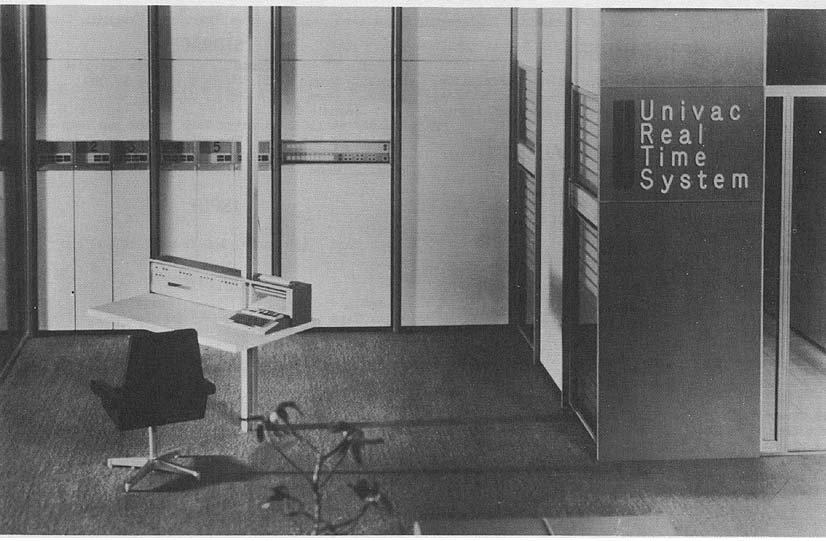
UNIVAC 490
UNIVAC 490 Real-Time System
MANUFACTURER
Sperry Rand Corporation
Remington Rand Univac Division
APPLICATIONS
UNIVAC 490 System is essentially a communicationscomputer network which
provides instantaneous inventory and production control data to companies
and government agencies having widely scattered offices, plants and
warehouses. Hundreds of transmitting and receiving devices strategically
located throughout the country can communicate directly with the central
processor. As a result, the computer can receive real-time data from a transaction
source, process the raw data and deliver the necessary answers in ample time to
complete the original transaction. A wide variety of input and output devices
are available to meet specialized requirements.
PROGRAMMING AND NUMERICAL SYSTEM
Internal number system Binary
Binary digits/word 30
Binary digits/instruc- 30
tion
Instructions/word 1
Instructions decoded 62 function code designators
Arithmetic system Fixed point
Instruction type One address
Number range - 536,870,911 to + 536,870,911 Decimal
Instruction word format
+----+----+----+----+----+
| 6 | 3 | 3 | 3 | 1 |
+----+----+----+----+----+
| f | j | k | b | y |
+----+----+----+----+----+
f - Function code designator
j - Branch condition designator
k - Operand-interpretation designator
b - Operand address modification designator
y - Operand designator
Automatic coding Compiler and assembly routines will be supplied to all
490 users.
Arithmetic Registers
Seven B-registers (Address modifying registers 15 bits each)
One A-register or accumulator 30 bits
One Q-register and auxiliary arithmetic register 30 bits
One P-register Program Address Counter 15 bits
Transient Registers
One X-register 30 bits
One K-register 6 bits
One S-register 15 bits
One Z-register 30 bits
One U-register 30 bits
One R-register 15 bits
One R'-register 15 bits
One D-register 30 bits
One Co-register (Communication Buffer Register)
One C'-register (Communication Buffer Register)
ARITHMETIC UNIT
Incl Stor Access Exclud Stor Access
Microsec Microsec
Add 7.2-12 4.8-12
Mult 19.2-8+ 7.2-72
Div 84 72
Construction (Arithmetic unit only)
Transistors 13,819
Diodes 37,543
Arithmetic mode Parallel
Parallel one's complement binary notation
Timing Synchronous
Operation Concurrent
STORAGE
No. of Access
Media No. of Words Dec Digits Microsec
Magnetic Core 16,384-32,768 491,520-983,040 1.9
Magnetic core cycle time is 6 microseconds.
Magnetic Drum 327,680 9,830,400 8,500 avg
Type FH 500
Magnetic Drum 786,432 23,592,960 17,000 avg
Type FH 880
Magnetic Tape UNIVAC Uniservo IIA
No. of units that can be connected As
many as 72 Uniservo Model IIA Tape Units may operate through a tape
control unit and a channel synchronizer connected to a single input-output
channel. The 490 System provides 12 input-output channels. Uniservo Model
III may also be used with 490 System.
No. of char/linear inch of tape 125 or 250 Char/inch
Channels or tracks on the tape 8 Tracks/tape
Tape speed 100 Inches/sec
Transfer rate 25,000 Char/sec
Start time 12 Millisec
Stop time 9 Millisec
Average time for experienced
operator to change reel of tape 30 Seconds
Physical properties of tape
Width 0.500 Inches
Length of reel 2,500 Feet
Composition Metallic or Mylar
INPUT
Media Speed
Magnetic Tape 125,000 Kilocycle/sec Model III
Card Reader 600 cards/min80 Column
Read-Punch Unit 150 cards/min 80 Column
Keyboard and PrinterPrinted-page output is 60, 75
or 100 words/minute depending
on telegraphic service.
12 Model IIA Units can be connected to one inputoutput channel. Can
be operated by remote control.
OUTPUT
Media Speed
Magnetic Tape 125,000 Kilocycle/sec
High Speed Printer 600 lines/min On-line
Read-Punch Unit 150 cards/min
Keyboard and PrinterBecause the central site
equipment can communicate directly with nearly any
type of external digital equipment, remote inquiry
answering devices of many -different designs can be
a part of a 490 System. Usually remote inquiry
answering units are especially designed to meet the
re uirements of a real-time ap lication.
CIRCUIT ELEMENTS OF ENTIRE SYSTEM
Type Quantity
Diodes 37,543 All types
Transistors 13,819 All types
|
BRL 1961, UNIVAC 490, start page 0899
|
POWER, SPACE, WEIGHT, AND SITE PREPARATION
Voltage = 208, 3 Phase, 60 cycle, Voltage Regulator +- 5%
Heat Dis- Air Re- Floor
sipation quirement ( I N C H E S ) Weight Loading
Unit KVA BTU/Hr Cu Ft/Min Width Depth Height Lbs. Lbs/Sq Ft
M490 Computer 4.0 20,000 1,000 120 36 96 - -
w/Memory
Flying Head Drum 0.25 1,000 50 24 30 21 180 36
Control Unit (FH
500 and FH 880)
Flying Read Drum 0.10 400 50 24 30 14 120 24
Synchronizer
Flying Head Drum 1.3 - - 36 30 40 400 55
Unit
Synchronizer, 0.10 400 50 24 30 14 120 24
Tape
Uniservo Con- 0.20 750 50 12 30 28 240 48
trol Unit
Uniservo IIA 2.0 6,500 350 30 33 66 750 109
Console (Double) 1,100 50 42 18 60 300 60
Receives from computer central processor -
PRODUCTION RECORD
Number produced to date Prototype 1
Time required for delivery 18 months
PERSONNEL REQUIREMENTS
Appropriate courses will be provided at no cost to the user.
ADDITIONAL FEATURES AND REMARKS
Specially designed for real-time use. Solid state components
with their inherent advantages. Large expandable capacity high
speed storage. Fast access - high density drum storage. High
internal speed. Utmost reliability. Flexible input/output
capabilities. Minimum space. Low power requirements. Minimum
air. conditioning requirements. Ease of maintenance. Real-time
and delta clocks.
Photo
|
BRL 1961, UNIVAC 1101, start page 0900
|
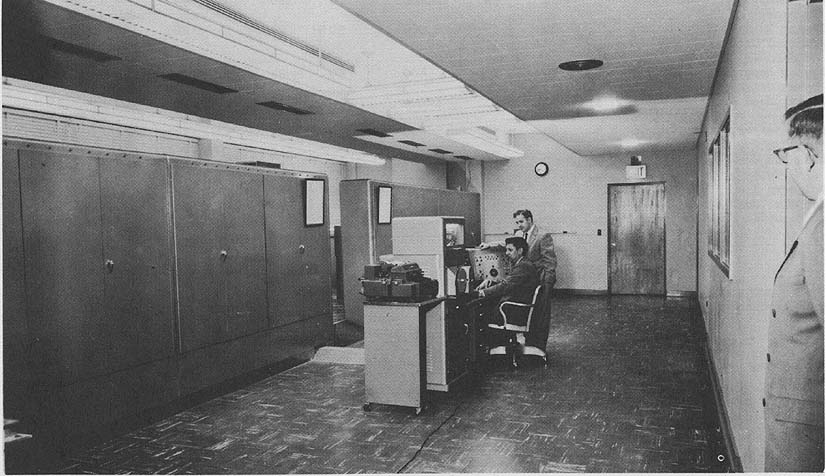
UNIVAC 1101
Universal Automatic Scientific Computer 1101
MANUFACTURER
Remington Rand Univac Division
Sperry-Rand Corporation
Photo by Georgia Institute of Technology Engineering Experiment Station, Rich Electronic Computer Center
APPLICATIONS
Georgia Tech
Commercial and scientific data processing.
Education and research in all fields of engineering and science.
Provides research assistance to commercial and industrial
sponsors.
PROGRAMMING AND NUMERICAL SYSTEM
Internal number system Binary
Binary digits/word 24
Binary digits/instruction 24
Instructions per word 1
Instructions decoded 48
Instructions used 43
Arithmetic system Fixed point
Instruction type One address
Number range 1-223 to 223-1
Negative numbers used are in the ones complement
arithmetic. +5 = 00000005 and-5 = 77777772 octal.
ARITHMETIC UNIT
Exclud Stor Access
Microsec
Add time 5
Mult time 260
Div time 324
Construction Vacuum tubes
Basic pulse repetition rate 400 Kc/sec
Arithmetic mode Parallel
Timing Asynchronous
Operation Sequential
STORAGE
Media Words Access Microsec
Magnetic Drum 16,384 32 - 17,000
Magnetic Core 4,096 10
Georgia Tech
A modified 1103A Magnetic Core System has been in-
stalled on the 1101. The computer has a 24 binary
digit word which is transferred and operated on in a
parallel mode.
INPUT
Medium
Paper Tape (35 words, 140 frames, 14 in)/sec
OUTPUT
Media Speed
Paper Tape (Teletype) 60 char/sec
Typewriter (Flexowriter) 10 char/sec
CIRCUIT ELEMENTS OF ENTIRE SYSTEM
Tubes 2,695 (18 types)
Diodes 2,385
CHECKING FEATURES
Improper command stops the machine.
PRODUCTION RECORD
Total number of Univac 1100 Series (all models) deliv-
ered is 45.
|
BRL 1961, UNIVAC 1101, start page 0901
|
Photo by Georgia Institute of Technology Engineering Experiment Station, Rich Electronic Computer Center
POWER, SPACE, WEIGHT, AND SITE. PREPARATION
Power, computer 16 KVA 0.95 pf
Power, air conditioner 1.2 KVA (Gas operated)
Space, computer 2,880 cu ft, 360 sq ft
Space, air conditioner 384 cu ft, 48 sq ft
Room size, computer 720 sq ft
Room size, air conditioner 192 sq ft
Floor loading 44 lbs/sq ft
Capacity, air conditioner 5 Tons
Weight, computer 16,000 lbs
Weight, air conditioner 1,500 lbs
False floor (plenum for A.C.). Separate room for M. G. and A.C. Distribution
duct from A.C. to computer.
COST, PRICE AND RENTAL RATES
Machine donated to Georgia Institute of Technology (evaluated at
$500,000).
Magnetic Core System $39,000
Bull Equipment 4,000 (approx)
Maintenance performed by Georgia Tech staff.
PERSONNEL REQUIREMENTS
One 8-Hour Shift
Used Recommended
Supervisors 1 1
Analysts 2 2
Programmers, Coders 4 6
Librarians 1 1
Operators 1 1
Engineers 1 1
Technicians 2 2
Operation tends toward open shop.
Technician training is conducted at scheduled times and programming courses
are offered in the Mathematics Depart
RELIABILITY OPERATING EXPERIENCE.
AND TIME AVAILABILITY
Average error-free running period 5.6 Hours
Good time 34.5 Hours/Week (Average)
Attempted to run time 38.0 Hours/Week (Average)
Operating ratio (Good/Attempted to run time) 0.80
Above figures based on period 1 May 60 to 1 Aug 60
Passed Customer Acceptance Test Aug 55
Time is available for rent to outside organizations.
Rental is $75.00 per hour (including operator).
ADDITIONAL FEATURES AND REMARKS
Outstanding features include a large library of subroutines, including fixed
point, floating point, function evaluation, etc., and stop address interrupt
feature.
FUTURE PLANS
The addition of index registers and floating point hardware is being considered
and modifications are in progress to add punch card input-output with the Bull
Controlled Reproducer with independent input and output buffers.
INSTALLATIONS
Georgia Institute of Technology
Engineering Experimental Station
Rich Electronic Computing Center
Atlanta, Georgia
|
BRL 1961, UNIVAC 1102, start page 0902
|
UNIVAC 1102
Universal Automatic Scientific Computer 1102
MANUFACTURER
Sperry Rand Corporation
Remington Rand Univac Division
Photo by Arnold Engineering Development Center, ARDC, Tullahoma, Tennessee
APPLICATIONS
Arnold Engineering Development Center Data reduction in
Wind Tunnel and Engine Test Facilities. Three computers are
used on-line during windtunnel and aerodynamic testing.
PROGRAMMING AND NUMERICAL SYSTEM
Internal number system Binary
Binary digits per word 24
Binary digits/instruction 24
Instructions per word 1
Instructions decoded Depends upon program
Octal digits/instruction not decoded 8
Arithmetic system Left circular shift
Instruction type One address
Number range Accumulator holds 48
binary digits
ARITHMETIC UNIT
Exclud Stor Access
Microsec
Add time 17 max.
Mult time 264 max.
Div time 340 max.
Construction Vacuum tubes
Rapid access word registers 1
Basic pulse repetition rate 500 Kc/sec
Arithmetic mode Parallel
STORAGE
Media Words Access Microsec
Magnetic Drum 8,182 8,500 max.
INPUT
Media Speed
Tape Reader 200 lines/sec
Raw Data ScannerScans 252 channels in
12.5 sec or 20/sec.
The raw data scanner is connected to transducers measuring
test data.
|
BRL 1961, UNIVAC 1102, start page 0903
|
OUTPUT
Media Speed
Automatic Typewriter 10 char/sec
Automatic Plotter
CIRCUIT ELEMENTS OF ENTIRE SYSTEM
Tubes 2,700
Diodes 3,000
Magnetic elements 700 relays
Number of separate cabinets 3
Number of different kinds of plug-in units 47
CHECKING FEATURES
Accumulator overflow indicator
"Oversize quotient" check
Improper operation code check
Address check on tape loading
POWER, SPACE. WEIGHT, AND SITE. PREPARATION
Power, computer 22 Kw
Volume, computer 772 cu ft
Area, computer 122 sq ft
Weight, computer 14,000 lbs
Power, air conditioner 9 Kw
Volume, air conditioner 80 cu ft
Area, air conditioner 12 sq ft
Weight, air conditioner 3,000 lbs
Capacity, air conditioner 25 Tons
PRODUCTION RECORD
Number produced 3
Number in current operation 3
COST, PRICE AND RENTAL RATES
Three computing systems were developed and manufac
tured under contract. Total cost was approximately
$1,400,000.
PERSONNEL REQUIREMENTS
Daily Operation No. of Eng. No. of Tech.
One 8 Hour Shift 5 2
Above totals are for one computer.
RELIABILITY, OPERATING EXPERIENCE,
AND TIME AVAILABILITY
Arnold Engineering Development Center
The following performance figures are given for the three
computers for the period January through September 1956. The
last of the three computers was accepted on 1 March 1956. Each
column is for a separate engineering facility at the Arnold
Engineer
ing Development Center.
ETF PWT GDF
Manned Time 57.0% 25.6% 30.1%
Utilization 51.4% 20.3% 24.8%
Computer Efficiency 87.5% 89.3% 84.4%
Reliability 96.8% 99.3% 79.9%
Scheduled Maintenance 9.5% 10.0% 1.7%
Unscheduled Maintenance 3.0% 0.7% 1.7%
Maintenance Factor 0.331 0.301 0.388
Terms and Definitions of Computer Performance
0 - Operational Time - Productive computer hours used in data
reduction, engineering problems, program checking, or other
productive computations. It does not include hours used in running
of check problems for maintenance purposes.
I - Idle Time -
Computer hours during which the computer is manned and in
condition for productive operation but not in use for such
purposes.
U - Unused and Unmanned Time - Hours during which
personnel are not scheduled for computer operation.
C - Marginal
Checking - Daily routine testing prior to operation to determine
that the computer is in operable condition.
P - Preventive
Maintenance - Computer hours used for testing of the computer to
improve its performance and which does not detract from
scheduled operational time.
R - Unscheduled Maintenance - Hours
consumed in restoring the computer to operating condition when
failure occurs.
C. M. - Concurrent Maintenance - Hours spent in
repair and testing of computer components which does not
consume computer time.
E.M. - Engineering Modifications -
Computer hours used in accomplishing engineering modifications
to the computer and its circuitry.
T - Total Time = 0 + I + U + C
+ P + R + E. M. On a daily basis Total Time is twenty-four hours.
Manned Time
100 (T-U)/T
Utilization 100 (O+E.M.)/(O+I+U+E.M.)
Computer Efficiency
100 (O+I+E. M.)/(T-U)
Reliability 100
(O+I+E.M.)/(O+I+R+E.M.)
Scheduled Maintenance
100 (C+P)/(T-U)
Unscheduled Maintenance
100 R/(T-U)
Maintenance Factor
(C+P+C.M.+R)/T-U+C.M.)
|
BRL 1961, UNIVAC 1103 1103A, start page 0904
|
UNIVAC 1103 1103A
Universal Automatic Computer Model 1103 - 1103A
MANUFACTURER
Remington Rand Univac Division
Sperry Rand Corporation
Photo by Lockheed Aircraft Corporation
APPLICATIONS
Manufacturer
Scientific computation.
White Sands Missile Range
Integrated Range Mission-DRD, N. M. Located in Building 1512, White
Sands Missile Range, the primary use of the ERA 1103A, is for computations
incident to conversion of range flight test data to engineering formats and
computations of problems associated with flight simulation and a small amount
of general purpose computing for range customers.
3208th Test Gp (TF), APGC
(PGVMC) Eglin AFB, Florida Located in Building 625, Eglin AFB, Florida,
the 1103A is used for impact predictions (real time, slew testing of radars and
ballistics. Air Force Missile Development Center Holloman AFB, New Mexico
Both systems are used for reduction of data obtained during high speed track
tests of inertial guidance
systems, e.g. gyro error coefficients, vibration analysis, acceleration and
velocity translation to tangent plane coordinates, satellite orbit
calculations, and missile performance analysis. Systems are integrated into
the Real Time Data Assimilator.
Digital Computation Branch (WWDCD) WARD, W-P AFB
Located in Building 57, WADD, W-P AFB, Ohio, the sys-
tem is used in the solution of scientific and other
R&D problems, in conducting research in numerical
analysis and digital computer programming techniques.
National Aeronautics & Space Administration,
Lewis Research Center
Located at the NASA-Lewis Research Center, 21000
Brookpark Road, Cleveland 35, Ohio, the system is used
for reduction of experimental data from wind tunnels,
test stands, rocket stands, etc., engineering and
scientific analysis-type problems.
Experimental data is recorded on automatic recorders
of our own design. The punched paper tapes and/or
magnetic tapes are fed into the computer, calibrated,
|
BRL 1961, UNIVAC 1103 1103A, start page 0905
|
Photo by Lockheed Aircraft Corporation
and mathematical operations carried out to produce the
quantities specified by the test engineer. Scientific problems of
all types are punched into paper tapes by a Flexowriter, fed into
the computer, and the mathematical operations specified by the
programer are performed.
Lockheed Missile and Space Division Located at Palo
Alto, California, the 1103AF (2 computers) systems are
primarily used for trajectory calculations and real time orbital
predictions.
Johns Hopkins University, Applied Physics Lab. Located
at Johns Hopkins Road, Scaggaville, Howard County, Maryland,
the 1103A is used for scientific computations in support of the
laboratory's research and development programs.
Johns Hopkins Univ., Operating Research Office Located
at the Computing Laboratory Division, 6935 Arlington Road,
Bethesda 14, Md., the 1103A is used for operational
simulation, including war gaming, and scientific data
processing.
Computing Laboratory, Southern Methodist Univ.
Located at 3125 Yale, S. M. U. Campus, Dallas, the 1103 is
used for education and research.
Numerical Analysis Center, University of
Minnesota Located in Room 230, Exp. Engineering
Building, University of Minnesota, the 1103 is being used in statistical
work to do such things as factor analysis (16 variables), multiple regression,
analysis of variance, item analysis of tests, product moment
correlations, linear and quadratic discriminant finctions, reciprocal
average analysis, and several specialized projects. It is used in
crystallography to determine atomic structure of crystals from X-
ray diffraction data; in aerodynamics to analyse transonic flow
boundary layers, buckling of sandwich panels, detonation wave
structure; in electrical engineering to study acoustic coupling,
micromagnetics, and ferrmagnetic microstructure; in mathematics
to do continued fraction expansions, analyse the four-color map
problem; in mechanical engineering to study mass transfer cooling,
non-circular duct flow, to design a probe for measurement of flame
temperature, to study the transport properties of helium-air
mixtures; in chemistry to study the kinetics of chemical reactions,
light scattering, and energy levels of linear molecules; in chemical
engineering to study nuclear reactor simulation and control,
kinetics of polymerization, stability of loop processes, optimum
design of a chemical reactor, perturbation transients in a
distillation tower, kinetics of a nuclear reactor; in physics to
compute instrument corrections for data on
|
BRL 1961, UNIVAC 1103 1103A, start page 0906
|
Photo by NASA Lewis Research Center
black body radiation taken from numerous balloon flights, to
compute cosmic ray orbits in the earth's magnetic field and
proton trajectories in an optical potential, analysis of nuclear
stripping reactions, compute the IGY cosmic ray index, analyse
the Van Allen zones; in agronomy and plant genetics to analyse
hybrid corn performance; in animal husbandry to study
breeding programs involving large populations and generations;
and in physical chemistry to determine
normal coordinates of molecular vibration.
PROGRAMMING AND NUMERICAL SYSTEM
Internal number system Binary
Binary digits/word 36
Binary digits/instruction 36
Instructions per word 1
Instructions decoded Model 1103 41
Model 7103A 50
Arithmetic system Fixed and floating point
Instruction type Two address
Number range Fixed point (1-235) <= n <= (235-1)
Floating point -2127 <= n <= 2127
The instruction consists of a 2-character operating code
(command), a 5-character First Address and a 5-character'
Second Address. The floating point system utilizes nine
instructions. Fixed point operation utilizes 41 instructions.
There are two 15 bit addresses per word. This facilities writing of
programs, since less instructions are required, less storage is
consumed in storing
program, and a smaller repertoire of instructions has to be
learned by the programmer.
ARITHMETIC UNIT
Incl Stor Access Exclud Stor Access
Microsec Microsec
Add 32-60 12-28
Mult 116-410 92-386
Div 482-490 466-474
Construction Vacuum tubes
Basic pulse repetition rate 500 Kc/sec
Arithmetic mode Parallel
Timing Synchronous
Operation Sequential
Operation times given above are average values. Add time
includes transmitting result to V address. Multiply time is for
product to form in accumulator with multiplier in "0" register.
Divide time includes quotient in "0" register and positive
remainder in the accumulator. The arithmetic unit is constructed
of Eccles-Jordan flip-flop type circuits triggered by pulses from
pentode "gate" circuits which are "enabled" by either other flip
flops or signals from "AND" or "OR" circuits. The flip flops may
be manually controlled from the console. Although the arithmetic
mode is parallel, all operations pass through the exchange register
"X". The "X", "0", and "A" registers separately and in
combination are used to form eleven distinct logical and arithmetic
sequences.
|
BRL 1961, UNIVAC 1103 1103A, start page 0907
|
Photo by WWDCD Wright Air Development Division
STORAGE
Manufacturer
No. of No. of Access
Media Words Digits Microsec
Magnetic Core 4,096 147,456 8
Magnetic Core 4,096 147,456 8
Magnetic Core 4,096 147,456 8
Magnetic Drum 16,384 589,824 17,500
The magnetic core matrix is 64 x 64 bits. The
matrices are stacked in groups of 36. Up to three
stacks may be used as high speed storage. The mag-
netic drum is a medium speed storage system. The
magnetic tape Uniservos store 326,000 words of low
speed storage.Up to 10 Uniservos can be accommodated.
WSMR IRM
Magnetic Core 8,192 8
Magnetic Drum 16,384
0 to 34 milliseconds for 1st word, 32 microsec/word
thereafter.
Magnetic Tape 326,000 words/tape
Computer is equipped with 10 Uniservo I's up to 8 of which may be used
for information storage at programmer's discretion. Eglin AFB
Drum 16,384
Core 4,096
Holloman AFB
Magnetic Core 4,096 147,456 8
Magnetic Drum 16,384 589,824 17,500
No. of No. of Access
Media Words Digits Microsec
W-P AFB
Drum 16,384
Core 12,288
NASA Lewis
Magnetic Core 4,096 6.0
Magnetic Drum 16,384 17,000 avg.
Lockheed
Magnetic Core 8,192 294,912 8
Magnetic Drum 16,384 589,824 17,000
Magnetic Tape 1,500,00054,Ooo,000 20,000
Internal Registers 3 108 4
Tape access time depends on the position of the
tape. In most cases, however, the access time is 20
milliseconds.
Johns Hopkins APL
Core 8,192 284,912 8
Drum 16,384 589,824 17,500
Floating point a feature.
Johns Hopkins ORO
Magnetic Core 4,096
Magnetic Drum 16,384
Southern Methodist
Magnetic Core 1,024 8
Magnetic Drum 16,384 33,000
Magnetic Tape65,536
|
BRL 1961, UNIVAC 1103 1103A, start page 0908
|
Photo by Air Force Missile Development Center, Holloman AFB
No. of Access
Media Words Microsec
Electrostatic (CRT) 1,024 8
Magnetic Drum 16,384 17,000 (av )
Magnetic Tape 262,144 2 min (avg g)
INPUT
Manufacturer
Media Speed
Magnetic Tape 2,130 words/sec
Tape Reader 200 frames/sec
Card Reproducer 120 cards/min
The magnetic tape speed is given for the continuous
input mode. The tape reader senses 2 octal digits
frame. The card reproducer uses 80-column cards,
placing 24 words on a card.Special equipment, such
as analog-to-digital converters can be used as option-
al equipment. By means of input-output buffer reg-
isters, a variety of input or output equipment can
be accommodated by the computers.
WSMR IRM
Uniservos 1,800 words/sec
IBM Card Punch 48 words/sec
High Speed Paper Tape Reader 35 words/sec
BRL High/O Magnetic Tape555 words/sec
Reader
Media Speed
Eglin AFB
Control Reproducer 120 80 column IBM cards
min (on-line)
Uniservo Magnetic Tape2,137 words/min (on-line)
Ferranti Paper Tape Reader220 frames/sec (on-line)
Milgo
Holloman AFB
Magnetic Tape (Uniservo)2,130 words/sec
Continuous read.
Paper Tape 200 frames/sec
Punched Cards 120 cards/min
Magnetic Tape (IBM Format)5,000 words/sec
Continuous read.
Magnetic Tape 450,000 bits/sec
Ampex FR 316.
W-P AFB
Magnetic Tape 100 in/sec
12,000 char/sec
Paper Tape 200 frames/sec
400 char/sec octal
Punched Card 120 cards/min
NASA Lewis
Magnetic Tape (2 channel)320 char/sec (data tape)
Magnetic Tape (7 channel)8,000 32,000 char/sec
(data tapes)
Magnetic Tape (Buffered)33,000 char/sec
(I/O or intermediate tape)
Paper Tape 200 char/sec
(programs and/or data)
|
BRL 1961, UNIVAC 1103 1103A, start page 0909
|
Photo by White Sands Missile Range, New Mexico
Media Speed
Lockheed
Paper Tape 400 octal dig/sec
Magnetic Tape25,600 octal dig/sec
Punched Cards (80 column)120 cards/min
Johns Hopkins APL
Card 120 cards/min
Magnetic Tapes (8 units)12,500 char/sec
Paper Tape 200 char/sec
Johns Hopkins ORO
Punched Cards
Paper Tape
Magnetic Tape
Southern Methodist
Paper Tape (Ferranti)200 char/see
Card Reader (Bull)120 cards/min
U of Minn
Paper Tape (7 channel)200 frames/sec
(Ferranti Mark II Photoelectric)
Cards (80 col.)120 cards/min
(Bull controlled reproducer)
OUTPUT
Manufacturer
Media Speed
Magnetic Tape (Uniservo) 2,130 words/sec
Continuous write.
High Speed Printer 600 lines/min
130 char/line
High Speed Punch 60 frames/sec
2 char/frame
Card Reproducer (80 Col.) 120 cards/min
24 words/card
Flexowriter Supplied as monitor
WSMR IRM
Uniservo I Magnetic Tape1,800 words/sec
IBM Card Punch 48 words/sec
Paper Tape 10 words/sec
Eglin AFB
High Speed Punch120 frames/sec (on-line)
Charactron Display & 10,000 times/sec (on-line)
Manual Intervention Sys.
High Speed Printer 600 lines/sec (off-line)
Flexowriter 10 char/sec (on-line)
Variplotter
|
BRL 1961, UNIVAC 1103 1103A, start page 0910
|
Photo by White Sands Missile Range, New Mexico
Media Speed
Holloman AFB
Magnetic Tape (Uniservo) 2,130 words/sec
Continuous write.
Paper Tape 60 frames/sec
Punched Cards120 cards/min
Magnetic Tape (IBM Format) 5,000 words/sec
Continuous write.
The system contains special buffers, so-called loading platforms, for real
time input of test data, a common memory for communication between two
Univac Scientifics and on-line equipment for output, like digial, analog
converters, display.
Media Speed
W-P AFB
Magnetic Tape 100 in/sec
12,000 char/sec
Paper Tape 60 frames/sec
120 char/sec, octal
Punched Cards 120 cards/min
On Line Monitor Flex 10 char/sec
Off-line tape to printer is main output method us-
ing the Univac High Speed Printer (600 lines/min).
NASA Lewis
Paper Tape Punch (3)60 char/sec, each
Magnetic Tape (Buffered)33,000 char/sec
|
BRL 1961, UNIVAC 1103 1103A, start page 0911
|
Photo by Eglin Air Force Base, Florida (APGC)
Media Speed
Lockheed
Paper Tape 400 digits/sec
Magnetic Tape 25,600octal digits/sec
Punched Cards (80 Column)120 cards/min
Flexowriter 60 char/min
Johns Hopkins APL
Cards 100 cards/min
Magnetic Tape 12,500 char/sec
Paper Tape 60char/sec
On Line Printer 600 lines/min
120 char/line
Johns Hopkins ORO
Punched Cards
Paper Tape
Magnetic Tape
Off-line High Speed Printer
Southern Methodist
Paper Tape 3,500 char/min
Cards (Bull) 120 cards/min
Flexowriter (On-line)160 char/min
U of Minn
Paper Tape (7 channel)60 frames/sec
(Teletype Punch)
Cards (80 Col.) 120 cards/min
(Bull controlled reproducer)
CIRCUIT ELEMENTS OF ENTIRE SYSTEM
Tubes 3,907
Tube types 12
Crystal diodes 8,956
Magnetic cores 147,456
Uniservo Magnetic Tape Units 77 tubes, each add'1
Card Reproducer Unit211 tubes, add'1
POWER. SPACE, WEIGHT, AND SITE PREPARATION
Manufacturer
Power, computer 82 KVA 0.9 pf
220 volt, 3 phase, 100 KVA min, including cooling
blower.
Space, computer 946.3 sq ft
Minimum room size 58 ft
6 1/4 in x 30 ft 6 in
Weight, computer 38,53 lbs
Floor loading 40.7 lbs/sq ft
Capacity, air conditionerRequired equivalent capac-
ity is 20 Tons.
Two voltage regulators, 3 phase, 45 KVA, required.
Customer furnished cooling water 50oF 65 gal/min,
required.
Separate maintenance area approximately 14 x 24 ft, required.
|
BRL 1961, UNIVAC 1103 1103A, start page 0912
|
WSMR IRM
Power, computer & air 100 KVA 0.90 pf est.
conditioner
Area, computer & periph- 1,047 sq ft
eral equipment
Area, air conditioner 55 sq ft
Area does not include roof space for cooling towers
Room size, maint area & 40 ft x 80 ft (approx)
computer proper
Floor loading 35 lbs/sq ft
80 lbs concen max
Capacity, air conditioner 50 Tons
Weight, computer & 51,610 lbs
peripheral equipment
Air conditioner is water cooled type. Heat exchangers may be located
remotely from computer.
No special provision is required since plenums, false floors, etc. are included
as part of the system. Also motor alternator for providing constant voltage power
to pulsing circuits is provided. Preparation is confined to 2 inch pipe lines for
delivery of chilled water from computer to heat exchanger and from heat exchanger
to room cooling towers and provision for power distribution. Separate
transformer vaults are provided from post primary system for computer in order to
stabilize voltage. Separate voltage alternator is provided by manufacturer for
pulsing circuits. 50 hp. If newly designed room should provide a minimum of 30
ft clear span with no columns; however, machine can be installed around columns
if
required.
Eglin AFB
Power, computer 6o Kw 55 KVA 0.92 pf
Power, air cond 28 Kw 26.6 KVA 0.95 pf
Volume, computer 9,360 cu ft
Volume, air conditioner 432 cu ft
Area, computer 1,560 sq ft
Area, air conditioner 72 sq ft
Room size 10 ft (height)
60 ft (length)
33 ft (width)
Floor loading 21.5 lbs/sq ft
Capacity, air conditioner 30 Tons
Weight, computer 33,600 lbs
Weight, air conditioner 10,790 lbs
False floor 15 1/2 in. above sub-floor level. Requires a motor room to house
the motor-alternator which is supplied with 208 v, 60 cycles/sec, three phase,
four wire arrangement for power to the computer and air conditioning system.
Shielded room or screen room used to keep out the electromagnetic radiations
of nearby electronic equipment.
Holloman AFB
Power, computer approx 50 Kw 55 KVA 0.90 f
Volume, computer3,000 cu ft approx.
Area, computer925 sq ft (approx)
Room size56 ft 6 1/4 in x 31 ft 2 1/2 in min.
Floor loading 40.7 lbs/sq ft
500 lbs concen max
Chilled water supply: 65 gallon/minute maximum at 50OF maximum.
Condensation drain. Installation and wiring of motor alternator.
W-P AFB
Power, computer 100 KVA
Volume, computer10,700 cu ft
Volume, air conditioner575 cu ft
Area, computer1,780 sq ft
Area, air conditioner82.5 sq ft
Room size 70 ft x 40 ft
Floor loading 40.7 lbs/sq ft
Capacity, air conditioner30 Tons
Weight, computer38,540 lbs
Provided partitions to enclose room for humidity control.
NASA Lewis
Power, computer 50 KVA
Power, air conditioner18 KVA
Volume, computer12,500 cu ft
Volume, air conditioner3,000 cu ft
Area, computer 1,250 sq ft
Area, air conditioner300 sq ft
Room size, computer65 ft x 30 ft
Room size, air conditioner20 ft x 15 ft
Floor loading 100 lbs/sq ft
Capacity, air conditioner25 Tons
Platforms used as plenum chamber and cable space. Separate power feeder.
Insulated water lines from basement to second floor. Concrete pad for water
chiller. Existing building construction was rein
forced concrete.
Lockheed
Power, computer 60 Kw 60 KVA 1.0 pf
Power, air cond 4.05 Kw 5.05 KVA 0.8 pf
Volume, computer 9,000 cu ft
Area, computer 1,500 sq ft
Room size 6o ft x 26 ft
Capacity, air conditioner15 Tons
Weight, computer 34,000 lbs
False floor, motor generator and alternator for each computer, air
conditioning unit for each computer, and room air conditioning.
Johns Hopkins APL
Power, computer 130 Kw 130 KVA 0.9 pf
Power, air cond 60 Kw 60 KVA 0.9 pf
Volume, computer 10,500 cu ft
Vole, air conditioner1,500 cu ft
Area, computer 1,500 sq ft
Area, air conditioner 250 sq ft
Room size, computer 2,000 sq ft
Room size, air conditioner400 sq ft
Floor loading 36.6 lbs/sq ft
Capacity, air conditioner50 Tons
Weight, computer55,000 lbs
Weight, air conditioner 8,000 lbs
Prefabricated metal Butler building.
Johns Hopkins ORO
Power, computer 60 Kw 45 KVA 0.9 pf
Power, air cond 30 KVA
Area, computer 1,200 sq ft
Area, air conditioner 300 sq ft
Room size 58 ft x 30 ft
Floor loading 40.7 lbs/sq ft
Capacity, air conditioner 3 - 20 Ton units
40 Tons required
Weight, computer 38,543 lbs
Present 1103A Computing System replaced an ERA 1103 Computer; therefore,
installation costs and building modifications were minor - amounting only to
installing 2 additional 20 ton water chillers and additional electric power. Total
cost of present installation was less than $30,000. Cost of initial 1103
installation was also under $30,000 since the 1103 series equipment is provided
with a raised floor plenum and
air handler.
Southern Methodist
Power, computer 41.5 Kw 0.9 Lag pf
Volume, air conditioner 126 cu ft
Area, computer 755.5 sq ft
Area, air conditioner 21 sq ft
Room size, computer26 ft x 60 ft
Room size, air conditioner6 ft x 7 ft
Floor loading 46.1 lbs/sq ft
Capacity, air conditioner20 Tons
Weight, computer 34,747 lbs
3 phase, 220 volt, 60 cycle and 115, single phase, 60 cycle power to building.
Cooling tower is required with building to supply water for air conditioner.
�
|
BRL 1961, UNIVAC 1103 1103A, start page 0913
|
U of Minn
Power, computer 4.4.0 Kw 0.9 induct. pf
Power, air conditioner 22.0 Kw
Area, computer 710 sq ft
Area, air cond & motor gen.280 sq ft
Room size, computer58.5 ft x 25-75 ft min
Room size, air conditioner14 ft x 20 ft
Floor loading 4.6.1 lbs/sq ft
Capacity, air conditioner20 Tons min.
Weight, computer 34,747 lbs
The required space on the second floor of a laboratory building
was given a false ceiling and a strengthening sub-floor, and
partitions were erected to form three offices and an off-line input-
output preparation room for three Flexowriters and a card punch.
Partitions in the basement were erected to form a room for the
motor-generators and the air conditioning chiller and a room for
the air conditioning condenser.
COST, PRICE AND RENTAL RATES
WSMR IRM
Computer with card input output from 10 Uniservos and
floating point with two cores approx. cost $32,115.
Card-to-tape converter, tape-to-card converter, high-speed
printer (600 lines/min with plotting feature) $8,815.
Service is provided with basic rental rate.
Eglin AFB
Total cost $922,000. Magnetic Core Storage (4,096 words)
Magnetic Drum Storage (16,384 words) Magnetic Tape
Control Power Supply Desk Console Arithmetic Section
Main Control Section Air Conditioning Section The
direct connected input/output units are: (1) Photo-electric
punched paper tape reader
(2) High Speed Paper Tape Punch
(3) Monitoring Flexowriter
Additional Equipment Cost
Controlled Reproducer $ 55,000
High Speed Printer 185,000
Charactron Display & Manual Interven- 325,000
tion System
6 Uniservo Tape Units and 1 Unityper II (without
maintenance) rents for $27,000/year.
Vitro maintenance engineer plus spare parts is
$115,000.
Holloman AFB
Basic system Computer including one core bay (4,096 words, 5
Uniservos, one punched card input-output unit $1,029,500.
Additional equipment
One Uniservo $18,000
One additional core bay, approx. $200,000
High Speed Printer$3,890/month
$4,370.50/month for eight-hour shift.
W-P AFB
1103A w/float point, 12K core, 16K drum, 10 Uniservo I,
Bull Card I/0 (80 col), Univac HS Printer rent at
$41,000/month.
Maintenance service included in rental.
NASA Lewis
Basic system cost $920,094.
Additional equipment cost $313,939, including Flexowriters,
input-output equipment and circuitry, buffered tape installation,
new memory.
Lockheed
Type Unit Serial Monthly Hourly Extra Shift
No. Rental Rate per Hour
Univac 22 $20,980-00 $119.20 $59.60
Core Storage 4,500.00 25.57 12.79
Floating Point 1,545.oo 8.78 4.39
Variable Block 290.00 1.65 .83
Total Main Frame 27,315.00 155.20 77.61
Uniservo (10) 3,200.00 18.18 9.09
Read Punch 89o.oo 5.06 2.53
Total On Line 4,o9o.oo 23.24 71.62
Total EDP No. 22 31,405.00 178.44 89.23
Univac 27 20,98o.oo 119.20 56.60
Core Storage 4,500.00 25.57 12.79
Floating Point 1,545.00 8.78 4.39
Variable Block 290.00 1.65 .83
Total Main Frame 27,315-00 155.20 77.61
Uniservo (10) 3,200.00 18.18 9.09
Read Punch 890.00 5.06 2.53
Total On Line 4,090.00 23.24 11.62
Total EDP No. 2731,405.00 178.4+ 89.23
(C+D)
High Speed Printer 3,300.00 18.75 9.38
High Speed Printer 3,300.00 18.75 9.38
Card to Tape 2,605.00 14-.80 7.4-0
Total Off Line 9,205.00 52.30 26.16
Total EDP Systems 72,015.00 409.18 26.16
026 Key Punch 19133 77.00 .43 .22
026 Key Punch 30566 71.50 .41 .20
026 Key Punch 30624 71.50 .41 .21
056 Verifier 40595 60.50 37 .19
Total Key Punch 280.50 1.62 .82
077 Collator 36399 126-50 .72 .36
082 Sorter 36338 68.20 .39 .20
407 Acctg. Mach. 16001 915.75 5.20 2.60
519 Reproducer 17299 178.20 1.01 .51
552 Interpreter 25483 99.00 .56 .23
Total Auxiliary 1,387.65 7-98 3.90
Total EAM 1,668.15 9.60 4.72
Total system 73,683.15
Monthly rental includes 10,% F.E.T.where applicable. Hourly
rate is 1176th of monthly rental. Extra shift per hour is 50% of
1176th of monthly rate.
Johns Hopkins APL
$35,135 per month for basic system on prime shift and at
50% rate for extra shift use.
Maintenance service, included in monthly rental shown
above.
Johns Hopkins ORO
Basic system 4,096 magnetic core, 16,384 magnetic drum, 6
magnetic tape units, Fixed point arith., punched card in-out, and
high speed printer (off-line. Single shift cost $24,838/month.
Additional equipment Three 026, one 024, one 082, one
519, one 552, one 077, and one 4-07 rents for $1,709.00.
Maintenance service included in rental rates.
Southern Methodist Rental
traded for building space.
�
|
BRL 1961, UNIVAC 1103 1103A, start page 0914
|
U of Minn
$250,000 for complete 1103 (Serial 4).
$100,000 for installation and air conditioning.
$60,000 for REAC installation (Reeves Electronic Analog Computer).
$40,000 for ADDALINK Analog-Digital, Digital-Analog Converter.
PERSONNEL REQUIREMENTS
WSMR IRM
Two 8-Hour Shifts
UsedRecommended
Supervisors 5 5
Analysts 5 8
Programmers 8 12
Clerks 1 1
Operators 9 9
Engineers 6 6
Technicians 1 2
In-Output Oper 4 4
Operation tends toward closed shop.
Operators after a 90 day indoctrination assignment elsewhere within the
division are assigned to the computer with a combination of on-the-job and a
six week course taught periodically by our own personnel. Programmers are
normally hired as professional mathematicians with strong physics background
and are assigned initially in other sections of the organization to familiarize
themselves with the mathematical and physical problems which they are
concerned with. At the conclusion of approximately 1 year assignment in this
area programmer trainees are selected and after attending a six week training
course either taught in house or at the manufacturer's plant are given on-the-job
assignments. Six months to a year are required to provde proficient programmers
for our operation after selection and assignment to the computing laboratory.
Training of technicians and engineers is a responsibility of the manufacturer
and are provided by him.
Programmer training in this activity is more concerned with teaching new
employees the techniques and approaches used in solution of range
instrumentation problems. This is more difficult than teaching the art of
programming of computers. The period prior to assignment to computers is
used to screen out prospective programmers who do not have what our
management considers to be desirable qualities and traits for this particular
type of operation.
Eglin AFB
One 8-Hour shift
Used Recommended
Supervisors 1 1
Operators 2 2
In-Output Oper 1 1
Operation tends toward closed shop.
Methods of training used includes on-the-job training, organized
programming classes, and contractor courses.
Holloman AFB
One 8-Rour shift
Used Recommended
Supervisors 4 4
Analysts 4 6
Programmers12 20
Coders 0 2
Clerks 1 2
Librarians 2 3
Operators 3 5
Engineers 2 2
Technicians 5 5
In-Output Oper 1 2
Operation tends toward closed shop.
Methods of training used are for programmers: Remington Rand
programming course plus on-the-job training; and others: on-the-job training.
W-P AFB
Three 8-Hour Shifts
Used Recommended
Supervisors 5 5
Analysts 5 9
Programmers & Coders 25 30
Clerks 2 3
Librarians 0 1
Operators 8 8
In-Output Oper 4 6
Methods of training used includes formal classes by company
representatives and by operating installation and extensive "on-the-job"
training.
Open shop operation attempted with limited success, probably due to
training in machine coding. Plan to use FORTRAN extensively on open-shop
basis with the IBM 7090.
NASA Lewis
Three 8-Hour Shifts
Used Recommended
Supervisors 2 3
Analysts 2 4
Programmers 18 30
Coders 12 20
Clerks 0 1/2
Librarians 0 1/2
Operators 7 9
Engineers 2 4
Technicians 8 8
Operation tends toward closed shop.
Supervisors, analysts, programmers, engineers should have professional
degrees, then on-the-job training. All others can be subprofessional or wage
board, with on-the-job training.
Lockheed
Three 8-Hour Shifts
Used Recommended
Supervisors 1 1
Analysts 2 2
Programmers 15 15
Clerks 1 1
Librarians 1 1
Operators 11 11
Engineers 6 7
Technicians 3 4
In-output Oper 4 5
These systems are currently operating on production jobs, with little check
out on new programming. Above figures are for two computers.
Operation tends toward closed shop.
Operator training is primarily done on-the-job.
Johns Hopkins APL
One 8-Hour Two 8-Hour Three 8-Hour
Shift Shifts Shifts
Supervisors 3 4 5
Analysts 1 2 3
Programmers 15 20 25
Clerks 2 3 4
Librarians 1 1 2
Operators 4 6 9
In-Output Oper 3 4 6
Tape Handlers 1 1 1
Operation tends toward closed shop.
Methods of training used includes formal instruction, provided by
computer manufacturer, formal instruction provided by our training officer,
and onthe-job training at own installation.
�
|
BRL 1961, UNIVAC 1103 1103A, start page 0915
|
Johns Hopkins ORO
One 8-Hour Two 8-Hour Three 8-Hour
Shift Shifts Shifts
U R U R U R
Supervisors 1
Analysts 6 10
Programmers 20 30
Engineers 3 3 2 2 2 2
The personnel listed above reflect only the Computing Laboratory staff.
Throughout the organization there are approximately 60 persons classified as
analysts or research assistants who are highly competent programmers.
Personnel in the machine operating group perform 1103A operations, IBM
machine wiring and operations and key punching as required.
Operation tends toward open shop.
Allpersonnel hired by ORO are given a two-month
training assignment in the Computing Laboratory prior
to an assignment to a research task. The two-month
training is divided as follows: one month devoted
to 1103A characteristics and general programming
techniques, one month development of a practical prob-
lem. Operators, engineers and technicians are supplied
as required by Remington Rand.
Southern Methodist
One 8-Hour Shift
UsedRecommended
Supervisors 1 2
Analysts 6 10
Clerks 3 4
Engineers 1
Operation tends toward open shop.
Methods of training used includes credit courses in the university and
on-the-job training. U of Minn
Staff consists of: One department head One research fellow One
junior engineer (maintenance) One secretary Seven research
assistants (part time) Three maintenance technicians (part
time)
With this staff 12 to 14 hours of computing time is available daily, when
needed.
Clients are urged to do as much programming, coding, and operating as
possible with all non-routine problems. Any routine or standardized problem,
such as matrix inversion, is done by the staff (if a program is available for the
problem).
RELIABILITY, OPERATING EXPERIENCE,
AND TIME AVAILABILITY
WSMR IRM
Average error-free running period 4 Hours
Good time 60 Hours/Week (Average)
Attempted to run time 70 Hours/Week (Average)
Operating ratio (Good/Attempted to run time) 0.85
Above figures based on period 1 Jan 59 to 31 Mar 60
Passed Customer Acceptance Test17 Feb 58
Time is not available for rent to outside organiza-
tions.
Most difficulties account for the difference between good time and attempted
to run time were caused by mechanical malfunction of Uniservos. Until very
recently it was necessary to write programs utilizing all available Uniservos
and a malfunction of any one would result in an attempt to ran resulting in
failure. Recently the number of Uniservos have been increased to 10 which will
tend to eliminate this source of difficulty.
Holloman AFB
Good time57.34 Hours/Week (Average)
Attempted to run time60 Hours/Week (Average)
Operating ratio (Good/Attempted to run time) 0.95
Above figures based on period 1 Jan 60 to 30 APR 60
Passed Customer Acceptance Test (1) Mar 57 (2 Nov 57
Time is available for rent to qualified outside or-
ganizations.
W-P AFB
Good time101.58 Hours/Week (Average)
Attempted to run time103.66 Hours/Week (Average)
Operating ratio (Good/Attempted to run time) 0.979
Above figures based on period 1 Apr 60 to 1 Oct 60
Passed Customer Acceptance Test Jun 58
Time is available for rent to qualified outside or-
ganizations.
NASA Lewis
Good time77.5 Hours/Week (Average)
Attempted to run time93.0 Hours/Week (Average)
Operating ratio (Good/Attempted to run time) 0.834
Above figures based on period 1 Jan 59 to 1 Jan 60
Passed Customer Acceptance Test Sep 55
Time is not available for rent to outside organiza-
tions.
Lockheed
Average error-free running period 30 Hours
Good time272.4 Hours/Week (Average)
Attempted to run time280.2 Hours/Week (Average)
Operating ratio (Good/Attempted to run time) 0.966
Above figures based on period 1 Feb 60 to 27 Mar 60
Passed Customer Acceptance Test (1) Apr 58 (2) Jul 58
Time is available for rent to outside organizations.
The above figures are based on a two computer system.
Johns Hopkins APL
Average error-free running period 19.6 Hours
Operating ratio 0.98
Above figures based on period 20 May 57 to present
Passed Customer Acceptance Test 20 May 57
Time is available for rent to qualified outside or-
ganizations.
Johns Hopkins ORO
Good time to run time113-7 Hours/Week (Average)
Attempted5.7 Hours/Week (Average;
Attempted ratio (Good/Attempted to run time) 0.982
Above figures based on period 1 Apr 60 to Jul 60
Passed Customer Acceptance Test Sep 57
Time is available for rent to qualified outside or-
ganizations.
Southern Methodist
Good time45 Hours/Week (Average)
Attempted to run time45.5 Hours/Week (Average)
Operating ratio (Good/Attempted to run time) 0.99
Above figures based on period 1 Jul 59 to 1 Jul 60
Time is available for rent to qualified outside or-
ganizations.
U of Minn
Average error-free running period 18.67 Hours
Good time51.10 Hours/Week (Average)
Attempted to run time55.30 Hours/Week (Average)
Operating ratio (Good/Attempted to run time) 0.924
Above figures based on period 1 Jul 59 to 30 Jun 60
Passed Customer Acceptance Test Jun 58
Time is available for rent to outside organizations.
�
|
BRL 1961, UNIVAC 1103 1103A, start page 0916
|
ADDITIONAL FEATURES AND REMARKS
WSMR IRM
The water cooled design of this equipment virtually eliminates difficulties
associated with refrigeration and air conditioning. As a matter of actual fact the
computer room is cooler than is maintained in most offices.
Magnetic tapes are stored in wall cabinets within the computer room. The
number required is small as compared with most installations of this type.
Normal building conditioning provides adequate protection from humidity
temperature, etc. Security against loss of operating ability due to fire is
accomplished by providing duplicate tapes to other installations under this
command such that in case 1 tape is damaged it could be replaced within a matter
of an hour or two and by duplicate programming of problems on other machines
in the neighborhood, such as the IBM 704 located at DRD-N and the IBM 704
Computer operated by the Flight Simulation Laboratory at WSMR. For the
particular applications involved at WSMR loss of data tapes is not as critical as
the loss of programming tapes. No special care is taken to insure against loss of
data tapes.
Integrated Range Mission of White Sands Missile Range operates two
computing facilities. The 1103A reported in this questionnaire and an IBM 704
Computer physically located at Holloman Air Force Base are reported on
separately. Both computers are used for the same type of activity, namely the
conversion of raw range flight test measurements to engineering forms of data. It
is anticipated that about January 1962 it will become necessary to replace the
existing 1103A Computer with a solid state computer having much greater
internal speed and greater capacity. Machines of the CDC 1604, IBM 7090,
Philco 2000, etc. type are being considered. A feasibility study is under way to
ascertain whether at that time it will be feasible to replace the 704 Computer at
Holloman with a high speed data link and utilize the one high speed computing
facility in place of the two now in operation.
It is planned to replace the card-to-tape converter, the tape-to-card converter,
and the high speed printer with a USS 80 Computer. In so doing the overall
operation will be speeded up, economy in floor space will be achieved, and an
increase computing capacity will be provided while at the same time the cost of
operation will be reduced.
Eglin AFB Additional equipment can be connected by controlled
bits on a selector board (colloquially designated OR board).
NASA Lewis
Simultaneous input, output, and computing on problems. Concurrent
operation on two separate problems, each with its own input, output, and
computer.
The machine, its peripheral equipment and its programming aids are
tailored to do data reduction in the most efficient manner, with the lowest
level programmers possible.
Lockheed
A library system for reserved tapes is maintained. No particular protection
for tapes due to durability of metal tapes. Fireproof storage media is currently
undergoing evaluation.
The 1103AF system is composed of the following components: 2 Univac
Scientific 1103AF Computers each with floating point, variable block, 8,192
words of core storage and 16,384 words of drum storage. There are two
Remington Rand 600 lines/min printers,
and one Remington Rand Card-to-Tape Converter.
Johns Hopkins ORO Outstanding features are considerable memory
capacity, high internal operating speed, and great versatility in transferring
information to and from external equipment.
U of Minn
Electronic Associates DATALINK provides 6 channels of conversion from
analog to digital (13 bits/word) and 4 channels of conversion from digital to
analog. The DATALINK connects the 1103 with a REAC (Reeves Electronic
Analog Computer) containing two computer cabinets (20 amplifiers in each)
and a cabinet of four servos.
The ll03 has been modified to include two special instructions for work
with polynomials, an instruction for transmission of a word from the left half
of the accumulator, and an interrupt feature to increase system efficiency
when external equipment is used.
�
FUTURE PLANS
Holloman AFB An output platform is being designed which allows an
automatic recording, i.e. without computer control, of all real-time computer
outputs and a digital and analog display of real-time computer outputs.
W-P AFB The 1103A will be phased out by June 1961 due to the
installation of the IBM 7090 in November 1960.
NASA Lewis Additional tape handlers, floating-point arithmetic
hardware, high-speed line printer, compiler, and high-speed plotting are
planned.
Lockheed LMSD is in the process of converting all 1103AF work to
IBM 7090 and CDC 1604 Systems. Both 1103AF's will be released.
Johns Hopkins APL IBM 7090 Computer System with 1401 C3
planned for installation.
Southern Methodist
On line printer for 1103.
Addition of Solid State 90 with six tapes, computer and full complement of
Remington Rand tabulation equipment.
INSTALLATIONS
White Sands Missile Range
Integrated Range Mission-DRD
White Sands Missile Range, New Mexico
3208th Test Group (TF)
Computer Operations
APGC (PGVMC)
Eglin Air Force Base, Florida
Air Force Missile Development Center
Analysis and Computation Division (MDWC)
Holloman Air Force Base, New Mexico
Wright Air Development Division
Digital Computation Branch (WWDCD)
Wright-Patterson Air Force Base, Ohio
National Aeronautics & Space Administration
Lewis Research Center
21000 Brookpark Road
Cleveland 35, Ohio
|
BRL 1961, UNIVAC 1103 1103A, start page 0917
|
Lockheed Missile and Space Division
Digital Computer Operations
Sunnyvale, California
Johns Hopkins University
Applied Physics Laboratory
8621 Georgia Avenue
Silver Spring, Maryland
Johns Hopkins University
Operations Research Office
6935 Arlington Road
Bethesda 14, Maryland
Southern Methodist
Computing Laboratory
Dallas 22, Texas
University of Minnesota
Numerical Analysis Center
Minneapolis 14, Minnesota
PRODUCTION RECORD
Number of Univac 1100 Series Systems (all models)
delivered is 45.
|
BRL 1961, UNIVAC 1105, start page 0918
|
UNIVAC 1105
Univac 1105 Computing System
MANUFACTURER
Remington Rand Univac Division Sperry
Rand Corporation
Photo by Remington Rand Univac
APPLICATIONS
Manufacturer
System is used for both scientific and commercial
applications, for example, satellite tracking and
trajectory calculations, linear programming, logictic scheduling, inventory
control, and census.
The Univac 1105 Computing System is a synchronous, large scale, high
speed, general purpose, automatic data processing computing system. Programs
of internally stored instructions, capable of self-modification, determine the
sequence of operations. Internal storage is afforded by directly addressable
magnetic cores and drums. The system is designed to use magnetic tape,
punched cards, punched paper tape, electric typewriter, analog-to-digital and
digital-toanalog converters, visual displays, plotters and real
time instrumentation as input-output.
U. S. Air Force, Dayton AF Depot Located at Dayton Air Force
Depot, Wilmington Pike, Dayton, Ohio, the system is used for the
following fields of application:
Stock Control and Distribution - Inventory Management
Method of controlling and distributing material by Air Material Command
Supply Depots and AMA's to Air Force activities, maintenance contractors and
other military services world-wide. The system provides a data processing
technique which enables Aims to administer a timely, accurate and effective
supply logistics system. It provides item accounting, including inventory
position and various products for effective management of serviceable, reparable
and excess material. By-products which are the basis for dollar accounting and
Air Force assets management, inputs for requirements computation and other
stock control purposes are provided.
Management and Control of Due-In-Assets
Recording of assets due in from contractual procurement, Department of Defense
excesses or other Air Force activities. The depot having responsibility for a
commodity class or specified weapons system utilizes this data system to
administer a more timely and effective logistical support system. Item account
|
BRL 1961, UNIVAC 1105, start page 0919
|
Photo by Remington Rand Univac
ing providing due-in status data for utilization in material
distribution, requirements computation and buying programs,
are included in this system.
Requirements Computation - Replacement Type Items
The purpose of this application is to design, develop, and
implement a data flow and data processing system by which
various types of replacement item data products, required at
appropriate AMA/AFD, Hq AMC, and higher headquarters
management levels may be periodically computed on an AF
world-wide basis. The system as designed is to be capable of
promptly reacting to changes in the many elements which affect
AF requirements for items (e-g., program changes, authorization
changes support policy changes, funding limitations, etc.) is also
to be compatible with the latest data handling and processing
technological improvements. The system as presently
implemented is designed to provide the following major types of
replacement item requirements and related management data
summarized by weapons/support system, funds program/project;
program group, mission code, property class, AMA/AFD, or total
AMC, as appropriate for the products involved. Data now output
from the system are: time-phased projections of "gross" and
"net" item requirements; procurement program and budget
estimates item and/or dollar summaries of the above; contract
termination and retention/disposal level
data; consolidated asset and item information data summary
products; item-dollar inventory segmentation and requirements
support effectiveness data; end weapon and support systems.
Product Performance Analysis Airborne Armament and
Electronic Items
A data processing system that will measure the weapon and/or
commodity performance and meet the needs of the reliability and
the product improvement and USAF Acturial programs; provide
serviceability and reliability indicators, acturial life expectancies
and failure pattern; and correlate configuration data, reliability,
usage, failure and consumption data, and other historical data into
a data system for the air vehicle.
Covers the system that will measure the weapon's performance
and provide an early warning and ready reference master record
of failure trends by system and component within the weapon
system; provide maximum automatic analysis; provide for the
weapon managers, serviceability and reliability indicators such as
acturial usage data, service life factors, failure rate grpahs,
economic life factors, and condemnation rates that are essential
to product improvement, provisioning, and the computation of
requirements, and evaluation of periodic inspection intervals.
|
BRL 1961, UNIVAC 1105, start page 0920
|
Technology Center Photo by Remington Rand Univac
The following applications are scheduled to be production runs in the near
future.
IM/FSC Cataloging, Standardization and File Maintenanc This project is to
develop a system which will establish, maintain and distribute Federal Catalog
and re-
lated data applicable to all inventory manager items, including, but not limited
to, the following: Federal, Catalog, EAM Detail and Trailor Cards, Stock Control
Data Cards, Packaging and Transportation Data Cards, Interchangeability
Record Cards, and Family Group Publication EAM Cards. The system will
provide for the: initiation and distribution of stock list change, initiate suspense
and follow-up on request for Federal stock number, notification of stock number
assignment to Air Force contractors; publication of stock control data sections;
cross-reference sections; transportation and packaging data sections;
interchangeability and substitution data sections and possibly the
identification section of AF stock list. Initially, the ADP systems utilizing
outputs from this project for the updating of catalog data are restricted to:
Inventory Manager Stock Control and Distribution Management and control of
Due-in Assets, maintenance operating stock support; requirements computation
for consumption-type items. Weapons systems control and distribution; and
base support class stock control and distribution.
Master Material Support Record
This project will develop procedures to establish and maintain a master
material Support Record that will provide a complete source-coded range of parts
and materials with replacement rates required for all levels of repair support. This
record will be developed from initial provisioning source-coded documents and
up-dated based upon engineering changes, source code changes, stock list
changes, changes to replacement factors derived from improved methods of
computation, and changes to specialized repair activity material standards and
contractual material requirement lists. The record will serve as a basis for initial
SRA material standards and contractual MRL's and provide a means whereby the
Inventory Manager can analyze these documents and establish an acceptable
relationship between SRA and contractor material projections and the Master
Material Support Record. This project will furnish source data for computation of
the Buyers Guide for operations and maintenance parts and material.
Manpower Management (Personnel and Labor Accounting)
This project involves a recording of employee skills, abilities, education,
training, experience and test scores as a basis for selecting out of five (5) best
qualified personnel for a given position vacancy.
|
BRL 1961, UNIVAC 1105, start page 0921
|
Photo by McClellan Air Force Base
Normally, this process will occur within a single depot, but for
certain categories the entire command will serve as the selection
base. Related products, required periodically, would be Reduction
in Force Registers, data on skills losses (turn-over), skillsusage
trends, and on inventory of skills levels as a basis for determining
proper station assignment of new missions or functions.
Automation of Item Schedules for Procurement Docu-
ments
This project visualizes optional automation of the PR
coordination cycle as a continuous flow from generation of a
requirements to the subsequent automatic preparation of
IFB/RFP schedules. Areas to be incorporated within the project
include: the automatic grouping of items for procurement
purposes, automatic initiation of funds, standardization of
procurement data, precoordination of PR's, and automatic
preparation of item schedules.
Civilian Personnel and Labor Accounting
The objective of this project is to permit machine
preparation of the following in lieu of the present manual
systems:
SF 50's Personnel Action; periodic pay increases;
notification of automatic actions, i.e., age, retirement, service
awards, detail expirations, annual per
formance evaluations; Unit Manning Document; all statistical
reports; automatic print-out to indicate any condition reflected by
statistics, requiring administrative action, i.e., sick leave, turnover,
tardiness, unused annual leave, grade levels, jobshortage categories,
etc.; classification survey schedules; rosters of all persons who
have received training by s cific courses and rosters of all training
received tall. courses) by specific individuals; skills rosters, for
purposes of Merit Promotion Program, detailing employees,
reassignment, training, recruitment, etc.; profiles for merit
promotion program in rank order; print-out of entire service
history of any employee for any reason needed; payrolls; and
leave, bond, retirement records currently maintained manually
USAF ROAMA Griffiss AFB, N. Y. Located in Building No.
311, system is used for stock control and distribution,
requirements computation, and Ground C&E Management.
USAF Sacramento Air Materiel Comd, McClellan AFB
Located at McClellan AFB, California, the system is used for
weapons system inventory control and distribution and
requirements computation. Bureau of the Census Located in
Washington D.C., the system is used for statistical data
processing for current statistical
|
BRL 1961, UNIVAC 1105, start page 0922
|
Photo by University of North Carolina
surveys of population, trade, and industry, decennial censuses of
population and housing, and other major periodic censuses
involving editing and rearranging of input, sorting and merging of
records, tallying, tabulating, and summarizing data, computing
percentages, medians, means, weights, variances, etc. for data,
and arranging and preparing tables, listings, labels, etc. for high
speed printer.
Bureau of the Census - Armour Research Foundation of Illinois
Institute of Technology, Chicago, Ill. Same as for Bureau of
Census in Washington, D. C.
Bureau of Census - University of North Carolina,
Chapel Hill, North Carolina Same as Bureau of
Census in Washington, D. C.
University of North Carolina Located in Phillips H911,
University of North Carolina, Chapel Hill, North Carolina, the
system is used for data processing for the Bureau of the Census,
Washington, D. C., scientific research, statistical applications,
automatic programming research, and teaching.
PROGRAMMING AND NUMERICAL SYSTEM
Internal. number system Binary
Binary digits/word 36
Binary digits/instruction 36
Instructions per word 1
Instructions decoded 41 fixed point and
9 floating point
Arithmetic system Fixed and floating point
1 bit sign, 35 bit number
1 bit sign, 8 bit characteristic, 27 bit mantissa
Instruction type Two address
6 bit operation code and two 15-bit operand addresse
Number range Fixed point 235 - 1 >= X >= 0
Floating point 2127 > x >= 2-129 and 0
Instruction word format
+----------------+---------------+----------------+
| Operation Code | 1st Address | 2nd Address |
+----------------+---------------+----------------+
| 35 30 | 29 15 | 14 0 |
+----------------+---------------+----------------+
Automatic built-in subroutines include automatic interrupt
feature, external function instructions, repeat instruction, floating
point polynomial multiply and inner product instructions.
Automatic coding includes UNICODE algebraic compiler, USE
compiler, IT algebraic compiler, GAT compiler, AIMACO business
compiler, and 650 Simulator.
Registers include a 72 bit directly addressable accumulator, a 36
bit directly addressable multiplier-quotient register, a 36 bit input-
output register, and an 8 bit input/output register.
ARITHMETIC UNIT
Incl Stor Access Exclud Stor Access
Microsec Microsec
Add 32-60 12-28
Mult 116-410 92-386
Div 482-490 466-474
Arithmetic mode Parallel
Timing Synchronous
Operation Sequential
|
BRL 1961, UNIVAC 1105, start page 0923
|
STORAGE
Manufacturer
No. of No. of Access
Media Words Binary/Digits Microsec
Magnetic Core 4,096 147,456 8
8,192 294,912
12,288 442,368
Magnetic Drum 16,384 589,824 17,000
32 768 1,179,648
Magnetic Tape
No. of units that can be connected 24 Units
No. of char/linear inch of tape 250 Char/inch
Channels or tracks on the tape 8 Tracks/tape
Blank tape separating each record 1.2 or 2.4 Inches
Tape speed 100 Inches/sec
Transfer rate 25,000 Char/sec
Start time 3.5 Millisec
Stop time 3.5 Millisec
Average time for experienced
operator to change reel of tape 10-15 Seconds
Physical properties of tape
Width 0.5 Inches
Length of reel 2,400 Feet
Composition Mylar or metallic
USAF DAFD
No. of No. of Access
Media Words Digits/Word Microsec
Magnetic Core 12,28872 Octal 8
Magnetic Drum 32,76812 Octal17,000
Magnetic Tapes Up to 12 Octal50,000
720,000 (120 words)
(95%free for computation)
USAF ROAMA
No. of No. of Access
Media WordsBinary/DigMicrosec
Magnetic Core 0 4,09636 8
Magnetic Core 1 4,09636 8
Magnetic Core 2 4,09636 8
Magnetic Drum 32,768 36 17,000
Magnetic Tape Unlimited
USAF SAME
No. of No. ofAccess
Media Words DigitsMicrosec
Magnetic Core 12,288 73,748 12
Magnetic Drum 32,768 196,608 17,000
Magnetic Tape
Census Washington; Census-Armour; Census U of NC
Magnetic Core 8,192 49,152 6
Magnetic Drum 16,384 98,304 2-34,000
U of NC
No. of Access
Media Words Microsec
Magnetic Cores (2) 8,192 8
Magnetic Drum (Double) 32,7680-34,000
17 buffered tape units in the system
INPUT
Manufacturer
Media Speed
Cards 120 cards/min
Magnetic Tape 25, 000 char/sec
Paper Tape 200 char/sec
�
Magnetic tape block length is variable. Tape may be read
backward. Six bit characters are used on both paper and
magnetic tape. Paper tape is seven channel tape. 80 column
cards are used.
USAF DAFD
Media Speed
Punch Cards120 cards/min
Punch Paper Tapes17 words/sec
Magnetic Tape3,300 words/sec
ROAMA
Photoelectric Reader 12,000 char/min
Magnetic Tape 100 inches/sec
Magnetic tape reading any density.
USAF SAM
Magnetic Tape 300 microsec/word
Paper Tape 200 frames/sec
There are 20 magnetic tape unit.
Census Washington, Census-Armour, Census-U of NC
Magnetic Tape20,000 char/sec
(2 independent channels)
Paper Tape (Ferranti)200 char/sec
Keyboard Insert Manual
Two independent channels of magnetic tape. Magnetic tape is
utilized in the buffered free-run mode.
Census-U of NC has 120 cards/min reader.
U of NC
Cards 120 cards/min
Paper Tape 230 frames/sec
Magnetic Tape 100 in/sec
128 lines per inch - low density
200 lines per inch - high density
OUTPUT
Manufacturer
Media Speed
Cards 120 cards/min
Paper Tape 60 bit char/sec
Typewriter (Flexowriter) 10 char/sec
High Speed Printer 600 lines/min
120 char/line
Cathode ray tube (visual display) read-out may be added. 80
column cards are used. Six bit characters, seven channel paper
tape. The high speed printer is operated off-line. It can be adapted
for plotting.
USAF DAFD
Punch Cards120 cards/min
Paper Tape 5 words/sec
Magnetic Tape3,300 words/sec
Typewriter 10 char/sec
ROAMA
Magnetic Tape100 in/sec
High Speed Paper Tape 3,600 char/min
Punch
Magnetic tape writing at a density of 128 or 200
lines/inch.
USAF SAMC
Magnetic Tape 300 microsec/word
Paper Tape 60 frames/sec
Typewriter 100 words/min
Census Washington, Census-Armour, Census-U of NC
Magnetic Tape 20,000 char/sec
Paper Tape (Teletype) 60 char/sec
Monitoring Typewriter 10 char/sec
(Flexowriter)
U of NC
Cards 120 cards/min
Paper Tape 60 frames/sec
Magnetic Tape 100 in/sec
Typewriter 10 char/sec
Cards are not in use.
�
|
BRL 1961, UNIVAC 1105, start page 0924
|
CIRCUIT ELEMENTS OF ENTIRE SYSTEM
Manufacturer
Type Quantity
Tubes
7AK7 3,261
5963 3,066
6AN5 947
5725 252
All others 767
Diodes
ED2261 12,789
1N143 2,112
1N117 1,208
All others 306
Transistors
2N414 724
T1677 288
2N315 136
Magnetic Cores
S-4 294,912
All others 9,138
A total of 21 tube types are used.
Eleven types of diodes are used.
Ten types of transistors are used.
Three types of cores are used.
Components for Uniservo II (Model 102), a 3rd Core
Bank, and floating point circuiting are not included
in the above figures, but are listed below-
3rd Core Bank
Vacuum Tubes Diodes Cores Transistors
8 types- 3 types- 147,456 None
total 471 total 2,267 Type s-4
Floating Point
3 types- 5 types- None None
total 21411 total 678
Uniservo II
7 types- 4 types- None None
total 43 total 9
CHECKING FEATURES
Manufacturer Checking features include overflow,
timing. in-output, illegal operation codes and addresses, and
safety interlocks.
POWER, SPACE, WEIGHT, AND SITE PREPARATION
Manufacturer
Power, entire computer system 160 Kw, 175 KVA, 0.9 Pf
Room size 49 ft x 64 ft x 10 ft
Floor loading 47 lbs/sq ft
Weight, computer 35 Tons
Air conditioning unit for cooling input water
should be at least 35 tons capacity.
USAF DAFD
Floor loading size of plenum 22 ft x 50 ft x 13 ft
Weight, computer 63,753 lbs
Computer is installed in a warehouse type building with
plywood temporary constructed walls. The lighting, floor and
power supply is that of a typical office.
The Univac 1105 Computer System is operated from a 208V,
3 phase, 4 wire, 60 cps. supply. Isolation from line transients is
achieved by use of a motoralternator set and 70 KVA stabeline
supplied with the equipment. The motor-alternator, together
with its controls, is located in a separate room. The connection
to the computer is below the floor. The
maintenance area is supplied with 115V, 15 amp. single place
outlets at each bench and three phase, 208V, 15 amp, four wire,
60 cps. service for the chassis test unit. The line-to-line voltage is
208V + 10% during normal operation. All three line-to-line
voltages are balanced to within 2% during normal operations. The
basic equipment load consists of a 100 hp motor, 3 hp blower
motors, a 3/4 hp drum motor, and 70 KVA stabeline. The 100 hp
motor, which drives a 75 KVA alternator, is started with no load
and has a reduced voltage starter control.
The floor space for the 1105 computer is approximately 3,752
sq ft. The power, refrigeration and equipment room uses
approximately 2,450 sq ft.
The cooling system requires 500E cooling water and
a room temperature of approximately 800E maximum at
60% relative humidity or lower. This system consists
of three fans cabinets which cool the room air and a
plenum which distributes the cooled air to the elec-
tronic computer. In addition to the computer, each
uniservo requires 3.5 gallons of water per minute.
Requirements and data for the air cooling system are
as follows:
Cooling water temperature (Input) 500E max.
Cooling water pressure (Input) 60 lbs/sq in, gage
Water flow through entire system 168 gal/min, max
Exhaust air temperature from computer 740F-800F.
Maximum allowable relative humidity 600.
Blower capacity 12,750 cu ft/min
ROAMA
Power, computer 170 Kw 170 KVA
Power, air condi 40.4 Kw40.7 KVA
Volume, computer 41,000 cu ft
Volume, air conditioner42.0 cu ft
Area, computer 4,100 sq ft
Area, air conditioner 84 sq ft
Floor loading 200 lbs/sq ft
4,800 lbs concen max
Capacity, air conditioner75 Tons
Weight, computer 63,253 lbs
Weight, air conditioner8,000 lbs
208, 3 phase, 4 wires, 60 cps for computer. 220V,
3 phase, 4 wire for air conditioner. Constructed
new permanent building designed specifically for the
computer.
USAF SAMC
Power, computer 146 Kw 170 KVA 0.86 pf
Power, air condi 160 Kw 200 KVA 0.86 pf
Volume, computer 3.246 cu ft
Volume, air conditioner846 cu ft
Area, computer 3.600 sq ft
Area, air conditioner1,881 sq ft
Room size, computer60 ft x 60 ft
Room size. air conditioner42 ft x 65 ft
Floor loading 150 lbs/sq ft
700 lbs concen max
Weight, computer 57,089 lbs
Weight, air conditioner75,000 lbs
Floor is cement and was trenched for cables and chilled water
pipes. Acoustical tile was applied to a false ceiling and walls of the
room. It was necessary to increase the power to meet the demands
of the UFC and 1105. Site preparation for both systems was done
simultaneously. Air conditioning was increased and necessary duct
work installed.
Census Washington
Power, computer 150 Kw 170 KVA 0.9 pf
Volume, computer 30,000 cu ft
Area, computer 3,000 sq ft
Room size 100 ft x 30 ft x 10 ft
Floor loading 50 lbs/sq ft
Weight, computer 60,450 lbs, each
�
|
BRL 1961, UNIVAC 1105, start page 0925
|
Alteration of area from previously subdivided sections into the
large enclosed area 100x60. Provision of chilled water lines,
power conduits and space, air conditioning equipment and air
ducts. Alteration of lighting fixtures. Area enclosed in fire wall
construction. Air conditioner part of integrated system.
Census - Armour
Power, air cond 25 Kw 29 KVA
Room size, computer50 ft x 60 ft x 10 ft
Site specifications included on plans for newly
constructed building.
Census - U of NC
Power, air condition 29 KVA 25 Kw
Room size, computer40 ft x 75 ft x 10 ft
Site specifications included in plans for newly
constructed building.
U of NC
Power, computer 110 Kw 170 KVA 0.9 pf inductive
Power, air cond 100 KVA
Volume, computer 17,000 cu ft
Area, computer 2,816 sq ft
Area, air conditioner 600 sq ft
Floor loading 70 lbs/sq ft
Capacity, air conditioner75 Tons
Weight, computer 35 Tons
Computer was installed in the basement of a new building
and the space was specifically constructed for this purpose, i.e.
with a recessed floor and plenum type of installation.
PRODUCTION RECORD
Manufacturer
Number produced to date 45 incl. all 1100 models
COST, PRICE AND RENTAL RATES
Manufacturer
Monthly
Cost Rental
Basic system, consisting of $1,932,000 $33,060
8,192 words Magnetic Core,
16,384 words Magnetic Drum,
Central Processor, Peripheral
Control, and 16 UNISERVO II
Additional Equipment
4,096 Magnetic Core $195,000 $ 4,500
16,384 Magnetic Drum 60,000 1,500
Floating Point 65,000 1,545
Uniservo II20,000 450
Card In-Output 55,000 1,310
High Speed Printer 185,000 3,300
Printer is off-line, 80 column card unit.
Training courses and manuals are provided for all
computers whether purchased or rented.
USAF DAFD
Model1105 Univac Computer $1,612,000 $33,060
(Basic) includes:
Magnetic Core Storage 8,192 words)
Magnetic Drum Storage 16,384 words)
Two Section Tape Input/Output
Buffer; 120 words/Section
Variable Block Length Feature
Magnetic Tape Control (Accommo-
dates up to 24 magnetic tape units)
Power Supply
Desk Console with Monitorial
Oscilloscope
Arithmetic Section
Main Control Section
Air Conditioning Section
(Requires Customer-Furnished
50o Water)
The following Directly Connected
Input/Output Units:
1-Photo-electric Punched Paper
Tape Reader
1-High Speed Paper Tape Punch
1-Monitoring Electric Typewriter
Additional Equipment:
Monthly
Cost Rental
1 - Additional Bank of $ 195,000 $ 4,500
4,096 Word Core Storage
1 - Additional Magnetic 60,000 1,500
Drum Storage 16,384 Words
20 - Uniservo II Magnetic400,000 9,000
Tape Units
5 - Unityper II 22,500 450
1 - Univac Verifier (Non-15,000 250
printing Type)
1 - Card to Metallic Tape143,300 2,540
Converter, 80 column
1 - High Speed Printer -185,000 3,300
Off-Line (Water Cooled)
(600 lines per minute)
1 - Metallic Tape to CardQuoted on 2,385
Converter - 80 column request
$1,020,000 $23,925
Total approx. Selling Price $2,632,800
(Basic and Additional Equipment)
Total monthly rental$ 56,985
Maintenance/Service Contracting:
Remington Rand will keep the equipment in good operating
condition, all costs of maintenance will be borne by the
contractor unless the required maintenance is due to the fault or
negligence of the installation.
Remington Rand shall have its personnel in attendance during
all periods of operation unless other mutually agreeable
arrangements have been made. The maintenance personnel
during a principal period of maintenance which is any eight
consecutive hours per day plus an official meal period not to
exceed one hour per day, Monday thru Friday, excluding holidays.
By giving seven days notice to the contractor, additional
maintenance service periods of time other than the designated
Principal Period of maintenance can be arranged.
All preventive (scheduled) maintenance will be performed at a
time other than during working hours, unless otherwise arranged.
The installation will be charged for maintenance whenever (1)
maintenance personnel are required outside the principal period
of maintenance, and the total operational use time on the main
frame (or central computer) during the Principal Period of
maintenance, is less than 176 hours during a calendar month.
However, there will be no extra maintenance charge for periods
of preventive or remedial maintenance. Extra maintenance will
be at the rate of twelve dollars per man hour computed to the
nearest
one-half hour.
ROAMA
Central Computer $33,060
Addition Bank Word Core Storage 4,500
Additional Magnetic Drum Storage 1,500
Twenty Uniservos 9,000
Bi-Directional Converter 4,275
High Speed Printer 3,300
�
|
BRL 1961, UNIVAC 1105, start page 0926
|
USAF SAMC
1105 Basic, Magnetic Core Storage, Magnetic Drum
Storage, Uniservo II, $48,060 per month.
Flexowriter $110 per month.
Maintenance is included in rental price.
Census Washington
2 Univac 1105 Computers, 18 tape units each, site
preparation and installation, spare chassis, initial parts
inventory, test equipment $3,080,000 total.
1 Unityper Mod II, 3 Flexowriters, 1 high speed printer
buffered with extra print head $258,000.
Card-to-tape converter$2,600 per month.
Own maintenance is performed. Census - Armour Equipment
owned by University but shared with Bureau of the Census
on pro rata cost basis. Equipment includes 1 Univac 1105
Computer with 17 tape units, 1 high-speed printer, 1
unityper, 2 Flexowriters. Census share of total installation
current cost and equipment amortization (for 90 to 100
hours per week of computer time) equals $320,000 yr.
Census - U of NC Equipment owned by University but
shared with Bureau of the Census on pro rata cost basis.
Equipment includes 1 Univac 1105 Computer with 17 tape
units, 1 high-speed printer, 1 unityper, 2 Flexowriters.
Census share of total installation current cost and
equipment amortization (for 90 to 100 hours per week of
computer time) equals $320,000 yr. U of NC
The system was purchased for $2,450,000.
The Univac 1105 Data Automation System at the
University of North Carolina is made up of the follow-
ing:
1 Univac Scientific Computer Model 1103A consisting
of 4,096 words of core storage, 16,384 words of
drum storage, photo-electric paper tape reader, high
speed paper tape punch, on line Flexowriter, super-
visory control console, motor alternator set, plenum
type construction, sir conditioning fan bay.
2 120 word core buffer units
1 Additional bank of 4,096 word core memory
1 Variable block feature for magnetic tape recording
17 Uniservo II, high density tape units
1 Off Line High Speed Printer
1 Unityper II
1 Additional Drum, 16,384 word capacity
1 1105 operational test unit
I Complement of 1105 replacement chassis
1 Floating Point Feature
4 Off Line Flexowriters
1 Spare Photo Electric Paper Tape Reader
1 Spare High Speed Paper Tape Punch
PERSONNEL REQUIREMENTS
Manufacturer
One 8-Hour Two 8-Hour Three 8-Hour
Shift Shifts Shifts
Supervisors 4 5 6
Analysts 7 7 7
Program & Coders 15 16 17
Clerks 2 2 1/2 3
Librarians1/2 1/2 1/2
Operators 3 5
Engineers 3 4
5
Technicians 3 5 7
In-output Oper 1 1/2 2 2 1/2
Free courses are provided to the customer to instruct its
personnel in programming for and maintenance of the
computer.
USAF DAFD
One 8-Hour Shift
Used Recommended
Supervisors 4 5
Analysts 17 20
Programmers 31 44
Clerks 4 2
Librarians 2 2
Operators 4
4 Engineers and 3 Technicians used on three 8-hour shifts.
The Dayton AF Depot currently has two large scale electronic
computers in operation viz., Univac I and Model 1105. Univac I is
scheduled to be discontinued in the near future. At the present
time there are twenty-one (21) civilians and five (5) airmen
assigned to the operation of these computers.
3 Supervisors
1 Unit Chief
1 Supervisory Tape Librarian
1 Peripheral Equipment Supervisor
10 Civilian computer operators
6 Operate both Univac I and 1105
4 Operate only Univac I
5 Airmen computer operators
1 Operates both Univac I and 1105
3 Operate only Univac I
1 Operates only peripheral equipment
2 Civilian tape librarians
2 Civilian clerks
4 Civilian peripheral equipment operators
A one eight-hour shift is scheduled with available time on two
other shifts depending upon the nature of the work and its
priority.
Methods of training used includes training by the equipment
manufacturer, Remington Rand Corp, and onthe-,job training.
ROAMA
One 8-Hour Shift
UsedRecommended
Supervisors 1 1
Librarians 1 1
Operators 3 3
In-Output Oper 3 3
Methods of training used includes manufacturer's courses.
USAF SAMC
One 8-Hour Three 8-Hour
Shift Shifts
Used Recom Used Recomm
Supervisors 4 4
Analysts 52 52
Programmers 63 63
Librarians 3 4
Operators 12 12
Personnelsupport the 650, UFC and 1105 systems.
Operation tends toward closed shop.
Manufacturer training and on-the-,job training is utilized.
CensusWashington
Three 8-Hour Shifts
Supervisors 3
Analysts, Programmers & Coders 40
Clerks 8
Librarians 5
Operators 12
Engineers 2
Technicians 15
In-Output Oper 8
Tape Handlers 20
Other 4
Most programers shown are customer employees; tape
handlers are customer employees.
�
|
BRL 1961, UNIVAC 1105, start page 0927
|
Operation tends toward open shop.
Training Branch conducts formal classroom sessions for
programmers, operators (followed by on-the-job training)
executive orientation, brush-up seminars. Classroom and on-the-
job training also conducted for
engineers and technicians.
Census - Armour
Three 8-Hour Shifts
Supervisors 3
Analysts, Programmers & Coders 20
Clerks 2
Operators
Engineers 1
Technicians 10
In-Output Oper 2
Tape Handlers 5
Programmers shown are customer employees, tape
handlers are customer employees; all others are University
employees.
Operation tends toward open shop.
Training Branch conducts formal classroom sessions for
programmers, operators (followed by on-the-job training)
executive orientation, brush-up seminars. Classroom and on-the-
job training also conducted for
engineers and technicians.
Census - U of NC
Three 8-Hour Shifts
Supervisors 3
Analysts, Programmers & Coders 20
Clerks 2
Operators 6
Engineers 1
Technicians 10
In-Output Oper 2
Tape Handlers 5
Programmers shown are customer employees, tape handlers
are customer employees; all others are University employees.
Operation tends toward open shop.
Training Branch conducts formal classroom sessions for
programmers, operators (followed by on-the-job training)
executive orientation, brush-up seminars. Classroom and on-the-
job training also conducted for
engineers and technicians.
U of NC
One 8-Hour Three 8-Hour
Shift Shifts
Supervisors 1
Analysts 2
Programmers 6
Clerks 1
Librarians 1
Operators 4
Engineers 5
Technicians 8
In-Output Oper 3
Tape Handlers 4
The 8 hour shift figures represent University requirements only.
The three 8 hour shifts requirements represent University and
Bureau of the Census personnel needs since the University supplies
all personnel in these particular categories.
Operation tends toward open shop.
Methods of training used includes training course conducted by
the Bureau of the Census for Computer Operators, vourses
conducted by the Computation Center for training maintenance
personnel (This is not an accredited University course.), on-the-
job training, accredited University courses and Graduate Seminars
on Computer Usage and Programming. (These courses at present
are oriented towards scientific applications.), and special short
courses on programming (Not accredited University courses.).
RELIABILITY, OPERATING EXPERIENCE,
AND TIME AVAILABILITY
Manufacturer Regularly scheduled preventive
maintenance procedures designed to detect failing components
before errors occur.
USAF DAFD
Good time 60 Hours/Week Average
Attempted to run time71 Hours/Week (Average)
Operating ratio (Good/Attempted to run time) 0.8 to 1.0
Above figures based on period from May 60 to Jul 60
Passed Customer Acceptance Test 30 Apr 60
Time is not available for rent to outside organiza-
tions.
USAF SAMC
Good time 98 Hours/Week (Average)
Attempted to run time100 Hours/Week (Average)
Operating ratio (Good/Attempted to run time) 0.98
Above figures based on Mar and Apr 60
Passed Customer Acceptance Test 30 Apr 60
Time is not available for rent to outside organiza-
tions.
Good time includes Set-up time. The 2 hours lost time is
unscheduled maintenance.
Census Washington
Good time(each machine) 126 Hours/Week (Average)
includes lost time from non-machine causes)
Attempted to run time136 Hours/Week (Average)
(each machine; excludes scheduled maintenance)
Operating ratio (Good/Attempted to run time) 0.927
Above figures based on period 3 Apr 60 to 23 Apr 60
Passed Customer Acceptance Test Feb 59 and Jun 59
Time is not available for rent to outside organiza-
tions.
Census - Armour
Good time 85 Hours/Week Average
Attempted to run time 101 Hours/Week Average;
Operating ratio (Good/Attempted to run time) 0.85
Above figures based on period 28 Feb 60 to 1 May 60
Passed Customer Acceptance Test Jul 59
Time is not available for rent to outside organiza-
tions.
Good time includes lost time from non-machine causes.
Attempted to run time excludes scheduled maintenance.
Census - U of NC
Good time 85 Hours/Week (Average)
Attempted to run time101 Hours/Week (Average)
Operating ratio (Good/Attempted to run time) 0.85
Above figures based on period 28 Feb 60 to 1 May 60
Passed Customer Acceptance Test Jul 59
Time is not available for rent to outside organiza-
tions.
Good time includes lost time from non-machine causes.
Attempted to run time excludes scheduled maintenance.
U of NC
Good time107.4 Hours/Week (Average)
Attempted to run time 122 Hours/Week (Average)
Operating Ratio (Good/Attempted to run time) 0.88
Above figures based on period 1 Jul 60 to 1 Oct 60
Passed Customer Acceptance Test 22 Aug 59
Time is available for rent to qualified outside organ-
izations. Approximately 15 hours per week is avail-
able for outside organizations.
�
|
BRL 1961, UNIVAC 1105, start page 0928
|
ADDITIONAL FEATURES AND REMARKS
Manufacturer
Outstanding features are interrupt feature, simultaneous read-write-compute,
two address logic, 2 input-output registers for a large variety of on-line
equipment, and repeat command. A unique system advantage is continuous
input format capability on magnetic tape.
Special recommended procedures for magnetic tape labelling, storing,
shipping, and protection from humidity, temperature, electrical, fire, or other
damage are described in the Users Guide for Care and Preservation of Metallic
Tape. USAF DAFD
The 1105 Univac Computer is specifically designed for applications
requiring great programming versatility, high operating speed, and large storage
capacity. Maximum use of the high speed inherent in this computer is permitted
by the unusual logical design and its unique Program Interrupt feature. In
addition to performing large scale calculations, the system is adaptable to a wide
variety of applications including simulation and control in real time.
Programs of internally stored instructions, capable of self-modification,
determine the sequence of operations. Thus, the computing system is fully
automatic. Its high speed results from parallel mode operation whereby all digits
of a number are operated upon simultaneously.
Magnetic tapes are stored in a specially constructed concrete block vault and
lined with copper screened wire to avoid any magnetic disturbance.
Atmospheric conditions are 70oF and 50,% R. H. Approximately T,336 tapes are
stored in cabinets elevated from the floor. Tape management is under the
supervision of the tape librarian.
Peripheral Equipment - Space required is approximately 1,525 sq ft for
the following equipment: Card-to-Tape Converter Tape-to-Card Converter
High Speed Printer
The above components have an independent chilled water system and require
220 volts, single phase 60 cycle current.
USAF SAMC The 1105's two bi-directional tape buffers, twenty
Uniservo tape units and "interrupt" feature facilitate efficient simultaneous input,
output and computation functions. The automatic programming in use on the
1105 provides for optimum use of its data processing capabilities.
Census Washington, Census-Armour, Census U of NC Adopted
procedures for magnetic tape labelling, storage, shipping, and protection from
humidity, temperature and physical, electrical, fire, or other damage include fire
wall construction; metallic containers for magnetic tape, fire fighting
organization and training, control system for defective and damaged tapes, and
standardization of tape reel lengths and markings.
FUTURE PLANS
USAF SAMC SMAMA will acquire another 1105 in FY61 to
support an advanced weapon system. U of NC Proposed new components
include a locally designed and constructed 400 card/min reader and a
programmer controlled clock and stop watch.
INSTALLATIONS
U. S. Air Force Dayton AF Depot
Wilmington Pike
Dayton, Ohio
U. S. Air Force ROAMA
Griffiss Air Force Base, New York
U. S. A. F. Sacramento Air Materiel Command
Data Systems Division, Comptroller
McClellan Air Force Base, California
Bureau of the Census
Washington 25, D. C.
Armour Research Foundation of Illinois Institute of Technology
Chicago, Illinois
Bureau of the Census
University of North Carolina
Chapel Rill, North Carolina
University of North Carolina
Computation Center
P. 0. Box 929
Chapel Hill, North Carolina
The Prudential Insurance Company of America
Post Office Drawer 594
Newark 1, New Jersey
Go To Table of Contents