This is a scanned and OCR'd version of the unclassified "US Army Air Defense Digest, 1966".
Frank Martinez (famal27@bellsouth.net) kindly sent this material to me. Thank you Frank.
All 121 pages have been scanned. Many photographs are not converted due to technical difficulties and image space requirements.
*** Please note - scanning and OCR (Optical Character Recognition) is an imperfect art. The source material was a Xerox copy of an old manual. Charts and line drawings converted well and are included. My OCR software is probably not "state of the art". There were frequent obvious errors - some of which could be interpreted as slurs or insults. An example was the rather consistent mis-conversion of "CONAD" into "GONAD". This presenter apologizes for any errors - and suggests that the viewer retain a healthy skepticism of this conversion, or obtain a valid copy of the document.
John Slonaker, 717-245-4354 at slonakej@carlisle-emh2.army.mil responded to my
inquiries about borrowing this book as follows:
"You are welcome to borrow the 121-page book
from us for sixty days. The call number is UG733.U523.1966 and
the OCLC number is 10905885. The request should be initiated by
your local library, since we loan only to other libraries, not to
individuals. Our symbol on the OCLC computer that links
libraries is "MHR." Our mailing address:
US Army Military History Institute
22 Ashburn Drive
Carlisle, PA 17013-5008"
CONTENTS
CHAPTER 1, AIR DEFENSE DOCTRINE AND PROCEDURES
CHAPTER 2, AIR DEFENSE ARTILLERY CONTROL SYSTEMS
CHAPTER 3, CURRENT AIR DEFENSE ARTILLERY WEAPON SYSTEMS
CHAPTER 4, PROPOSED AIR DEFENSE ARTILLERY SYSTEMS
| Nike X Antimissile Missile System | 84 |
| Redeye | 86 |
| Chaparral | 90 |
| Surface-to-Air Missile Development (SAM-D) | 90 |
CHAPTER 5. AIR DEFENSE ARTILLERY TRAINING MATTERS AND INSTRUCTION
CHAPTER 6 UNITED STATES ARMY AIR DEFENSE ACTIVITIES
(page 1)
Air Defense Doctrine and Procedures
AUTHORITY
Specific authorization for the Army to engage in air defense operations is derived from the National Security Act of 1947, as amended, and Joint Chiefs of Staff Pub. 2, United Action Armed Forces (UNAAF), November 1959. These directives assign the Army primary functions as follows: "To organize, train, and equip Army forces for me conduce of prompt and sustained combat operations on land--specifically, forces to defeat enemy land forces and to seize, occupy, and defend land area." UNAAF assigns the Army the following air defense missions: "To organize, train, and equip Army air defense units, including provision of Army forces as required for defense of the United States against air attack, in accordance with doctrines established by the Joint Chiefs of Staff.
CONCEPT OF AIR DEFENSE OPERATIONS
The broad principles of Army air defense doctrine are stated in FM 44-1, U.S. Army Air Defense Employment. The provisions in FM 44-1 apply to US Army air defense artillery units with a unified command or serving in a combined force. The policies and procedures prescribed by the Joint air defense commander will prevail when they conflict with doctrine and procedures described in FM 44-1.
The North American Air Defense Command (NORAD) is a
combined command exercising operational control of forces
allocated for air defense of Canada, Alaska, and the
continental United States. Its mission is "to defend the
North American Continent against aerospace attack."
Headquarters NORAD, located at Colorado Springs,
Colorado, prepares operational plans, conducts tactical
exercises and readiness tests, and coordinates plans
and requirements for new air defense weapons. It is the
supreme headquarters for directing the air
defense of North America in the event of war.
EVOLUTION
NORAD was formed in September 1957 following an
agreement between the governments of Canada and the
United States which, in effect, was official recognition
of the fact that air defense of the two countries is an
indivisible task. A high-level Canadian-United States
committee (Military Cooperation Committee) drew up an
emergency plan for the common defense of North America
and directed that air defense organizations of the two
countries prepare detailed emergency air defense plans.
The first of these was issued in 1950.
Early in 1954, the same committee authorized a
combined planning group of representatives from the
Royal Canadian Air Force and the US Air Force Air
Defense commands. Studies conducted by this group
indicated that the best air defense of North America
was an integrated defense, with forces of both
countries operating under a single command,
responsible to both governments. Following the
completion of another study 2 years later which
had the same conclusions, integration of operational
control of me two forces was recommended.
In the meantime, the two countries had gone
ahead with the development of a joint radar warning
network. Together, they built the Pine Tree line of
radars across southern Canada. Canada started
constructing the mid-Canada line, and the
United States began the distant early warning
(DEW) line across the northern rim of the continent.
Conditions for operating and manning these lines
were mutually agreed upon.
Thus, by 1957, there had been a considerable
history of joint planning, coordinating, and sharing,
and the need for further integration had been recognized.
In August of that year, the United States Secretary of
Defense and the Canadian Minister of National Defence
announced that the two governments had agreed to
establish a system of integrated operational control
of air defense forces for North America and an
integrated headquarters. On 12 September 1957,
NORAD was established, followed by the signing of an
official agreement by both countries on 12 May 1958.
This agreement provided, among other things,
that NORAD was to be maintained for a period of
10 years, or such shorter period as agreed upon
by both countries. The Commander in Chief,
North American AirDefense Command (CINCNORAD),
was to be responsible to the Chief, Defence Staff
of Canada, and the Joint Chiefs of Staff of the
United States. During the absence of CINCNORAD,
command would pass to the Deputy CINCNORAD.
The agreement further stipulated that the
appointment of CINCNORAD and his deputy had
to be approved by both governments and that
both would not be from the same country.
NORAD FORCES
NORAD has no Organic fighting elements of
its own, but is furnished combat-ready forces
including Reserve and National Guard forces by
three component commands (fig 1): US Army Air
Defense Command (ARADCOM), US Air Force Air
Defense Command (USAP ADC), and Royal Canadian
Air Force Air Defence Command (RCAF ADC),
plus the air defense forces of the Alaskan
Command. CINCNORAD exercises operational
control over all forces attached or otherwise
made available by component commanders.
The Continental Air Defense Command (CONAD)
is a unified command under NORAD concerned with
purely national air defense matters, thus
preserving flexibility for unilateral action
where strictly United States interests are
involved. Accordingly, the mission of CONAD
is aerospace defense of Alaska, Greenland,
and the continental United States (CONUS),
and Mexico if requested by the Mexican
Government. The senior American officer
in NORAD is the Commander in Chief,
Continental Air Defense (CINCONAD). If
CINCNORAD is an American, he also is CINCONAD.
If CINCNORAD is a Canadian, then the Deputy
CINCNORAD is CINCONAD.
ARADCOM furnishes Nike Hercules missiles (high-altitude,
surface-to-air) and Hawk missiles (low-altitude, surface-to-air).
Under this command are the US Army missile units protecting the
key population and industrial centers of the United States.
US Naval Forces operate the US Navy's space surveillance
system (NAVSPASUR), which furnishes information to NORAD
through the space defense system. The US Navy would also
provide augmentation forces upon direction of the Joint
Chiefs of Staff.
Most of NORAD's fighter-interceptor squadrons are
provided by the USAF ADC. This component also contributes
Bomarc surface-to-air missiles and a large number of radar
squadrons and early warning airborne radars. USAF AM: is
responsible for the ballistic missile early warning system
(BMEWS) and SPACETRACI( (a part of the space defense system),
providing NORAD important information about ballistic missiles
and orbiting space objects. The Air National Guard provides
interceptor squadrons and aircraft control and warning
squadrons on full-time assignment to NORAD through USAP AM:.
The RCAF ADC, not a member of GONAD but operating
directly under CINCNORAD, provides fighter-interceptor
squadrons and two surface-to-air Bomarc missile squadrons.
It also contributes heavily to performance of surveillance,
detection, and identification functions .
The Alaskan Air Defense Command is the air defense
agency of the Alaskan Unified Command; it is also a NORAD
region responsible directly to CINCNORAD for air defense
of the State of Alaska.
OPERATIONAL PROCEDURES
To accomplish its mission, NORAD is guided by
these air defense principles: hit the enemy as far
out as possible; increase the pressure as he
continues; complicate his tactical
problem by employing a family of weapons to perform low,
medium, high, close-in, and distant missions; and realize
optimum economy and efficiency of effort through
centralized direction and decentralized execution
of the air battle.
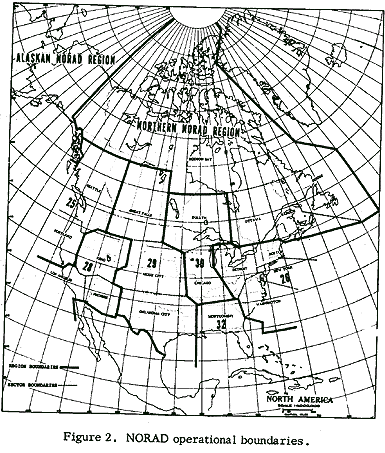
NORAD must guard against manned bomber attack,
ballistic missile attack, and the space threat. It
must watch over the North American Continent from
treetops to beyond the atmosphere. Currently, the
North American Continent is divided into eight
regional areas (fig 2) of air defense responsibility.
Six of these are numbered regions, including some of
the southern portions of Canada and all of the
continental United States, excluding Alaska.
The Northern NORAD Region encompasses the rest
of Canada, including highly populated industrial
areas of Ontario and Quebec. The Alaskan NORAD
Region completes the picture. Each region commander
is responsible to CINCNORAD for all aerospace
activity within his designated area.
Each of these NORAD regions is further subdivided
into areas, called sectors, the basic NORAD unit for
decentralized fighting of the air battle. Sectors that
cross the international boundary are jointly manned by
United States and Canadian personnel. The size of one
sector may differ greatly from another, depending
generally on the amount of air traffic and number
of vital target areas located within sector boundaries.
To perform its mission, NORAD must accomplish
four basic actions: detect the presence of airborne
objects, aircraft, or missiles; identify them as
friendly or hostile; intercept and examine those
not identified as friendly; and destroy those
identified as hostile, using interceptor aircraft
or air defense missiles.
NORAD employs three detection systems, each
designed to detect one of the three possible threats.
The northernmost detection system is BMEWS.
The three BMEWS stations (Thule, Greenland (fig 3),
Clear, Alaska, and Fylingdales Moor in Northern
England) are electronic systems providing detection
and early warning of attack from enemy intercontinental
ballistic missiles (ICBM).
(figure 3 not included in this conversion)
BMEWS was made possible by recent scientific
developments in the electronics field. The system
uses huge radars, approximately the size of a
football field, which can detect a missile at a
distance of 3, 000 miles. The power required for
a single station would meet the electrical needs
of a small city.
The heart of the BMEWS detection system is a
combination transmitter-receiver which transmits
an extremely brief burst of energy many times
each second in narrow fans of radiofrequency
energy at two different degrees of elevation.
As a missile passes through these fans, it
reflects energy to the station, enabling the
coordinates of flight to be recorded. From a
set of coordinates, the trajectory can be plotted
and the impact point, time, and point of launch
calculated. Data processing equipment at the site
rapidly computes the data and flashes a warning
to NORAD.
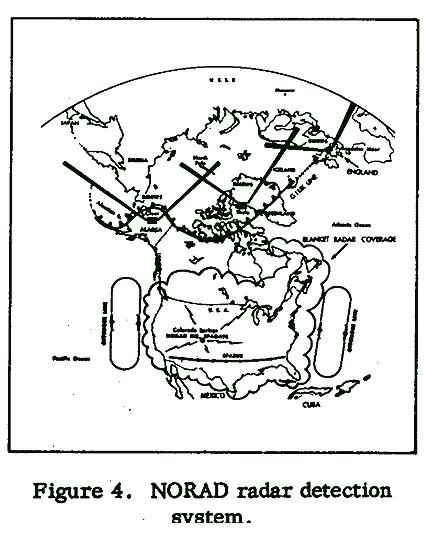
A second detection system is the manned bomber
surveillance network, composed of land-based radar
networks (fig 4) and Air Force planes. The first
line of radars begins in the far north with the
distant early warning (DEW) line (fig 5). This
radar fence, which stretches from the eastern
shores of Greenland across the Canadian Arctic
and along the Aleutian chain, provides initial
warning of attack by manned bombers. A ground-based
radar system, called contiguous coverage, is
extended out to sea off both coasts by Air Force
radar planes (fig 6). All of these systems are
joined together by a communications network
terminating in the NORAD combat operations center
at Colorado Springs, Colorado.
Figure 4. NORAD radar detection system.
(figure 5 not included in this conversion)
A third part of the NORAD detection and warning system
is the space defense system (SDS) which keeps track of all
manmade objects in space and determines entry time and
location of new ones. Through a global system of radar,
radio, and optical sensors, the SDS brings under NORAD
operational control all space detection and tracking
resources available to the military. Civilian and
government scientific agencies throughout the free world
contribute to the SDS on a cooperative basis.
Primary military members of the SDS are the USAP
SPACETRACK system and US Navy's NAVSPASUR. SPACETRACK
provides tracking information through a series of USAF
operated radar sensors and BMEWS. The RCAF provides
inputs from optical surveillance devices, such as the
Baker-Nunn camera (fig 7) and radar sensors. NAVSPASUR
is composed of three powerful transmitter stations and
four receiver stations alternately spaced across the
southern United States from California to Georgia.
Data from this network are furnished to Space Defense
Center (SDC) computers through the system's headquarters
and operations center at Dahlgren, Virginia. The third
type of information comes from other cooperating agencies,
such as National Aeronautics and Space Administration (NASA),
the National Security Agency(NSA), and Pacific and Atlantic
missile ranges on an on-call basis.
(figure 7 not included in this conversion)
Figure 7. Baker-Nunn camera.
Space tracking information from this widespread system
flows into the SDC (fig 8) at Colorado Springs, Colorado,
where giant digital computers digest reams of complex
orbital data on space objects.
(figure 8 not included in this conversion)
The wide variety of data received from the numerous
sources enables the SDC to provide complete and timely
tracking information on all manmade objects in space.
SDC also maintains a running catalog, constantly
revised and updated, on all space traffic. Thousands
of observations are received daily and are used to
refine existing orbital characteristics of more than
600 objects. This includes not only payloads but space
junk, such as burned-out boosters, wires the size of a
lead pencil, and nuts and bolts that go into orbit
with every payload launched.
Once the computers have digested all the tracking data
and produced their findings, the information is displayed
on large status boards (fig 9) in the SDC. From here it
is transmitted to the battle staff area in the adjacent
NORAD combat operations center by closedcircuit television.
It is expected that at some future date the SDS
must be equipped to determine the purpose and threat
potential of unfriendly space objects, to warn of
hostile activity in space, and to provide space traffic
control, operational support to antisatellite weapons
when and if developed, and support to United States
space and weapon activities.
Identification is one of NORAD's most difficult
problems, caused chiefly by the large amount of air
traffic in the United States and Canada. On the average,
there are approximately 800 to 1.000 overwater incoming
flights daily to the United States and Canada, plus an
estimated 300,000 internal flights.
(figure 9 not included in this conversion)
Figure 9. Status boards in the Space Defense Center.
Aircraft penetrating the North American Continent
enter air defense identification zones (ADIZ)
established around and throughout the continent to
assist in identification processing. Any aircraft
originating from an oversea area must enter an ADIZ
within 20 miles of a pre determined point and within
5 minutes of an estimated time, based on the pilot's
flight plan filed at his takeoff point and sent ahead
to the Federal Aviation Agency (FAA) in the United States
and Department of Transport (DOT) in Canada. This
information is relayed to appropriate NORAD sector
direction centers (NSDC) and used for correlation
when the trade is acquired.
If an aircraft enters an ADIZ, but is not within
prescribed limits, it is declared an unknown and an
interceptor is scrambled to make positive visual
identification. The ADIZ system is part of the NORAD
identification process known as flight plan correlation.
Under combat conditions, the identification process
would be somewhat simplified when provisions of emergency
plans, SCATER (security control of air traffic and
electromagnetic radiation) and ESCAT (emergency security
control of air traffic), are placed in effect. SCATER in
the United States and ESCAT in Canada provide for orderly
grounding of nonessential aircraft and for establishment
of military control over radio navigational aids.
In view of the large numbers of aircraft flights
taking place within NORAD airspace in any given 24-hour
period, it is a rare day when none of these appear at
the NORAD combat operations center as unknown. The
average number of unknowns in the system has steadily
declined over the years until now the number is less
than 10 per day. Of these, it is common
to find two or three instances where interceptors
are scrambled but recalled before intercept because
of the identity being established by further communication
checks. The remaining unknowns are intercepted and
visually identified by an interceptor crew.
In all, there are more than 40 regular fighter-interceptor
squadrons (fig 10) in the NORAD system. In an emergency, these
forces would be augmented by available fighter aircraft of the
US Navy, US Marine Corps, US Air Forces, Air National Guard,
and interceptor training units of the RCAF ADC. All of these
forces are highly mobile and constantly practice dispersal
and forward base deployment.
(figure 10 not included in this conversion)
If an unknown is identified as hostile, the aircraft
will be destroyed by the most expeditious method available
in CINCNORAD's varied arsenal.
NORAD COMBAT OPERATIONS CENTER
Nerve center of the North American Air Defense Command
is the combat operations center(COC), situated in a two-story
concrete blockhouse at Ent Air Force Base, Colorado Springs,
Colorado (fig 11). It is from the COC that first warning of an
attack on North America would come; if such an attack should
come, the air battle for survival of the United States and
Canada would be directed from the COG.
Data are received in the COC from the huge complex of
radar stations, interceptor squadrons, missile sites, space
tracking and ballistic missile warning units, and NORAD
regions and sectors and are stored in a large digital computer.
Here, too, information is received from other sources, such as
the Strategic Air Command(SAC), naval forces off both coasts,
the Pentagon, and the Department of National Defence in Canada.
(figure 11 not included in this conversion)
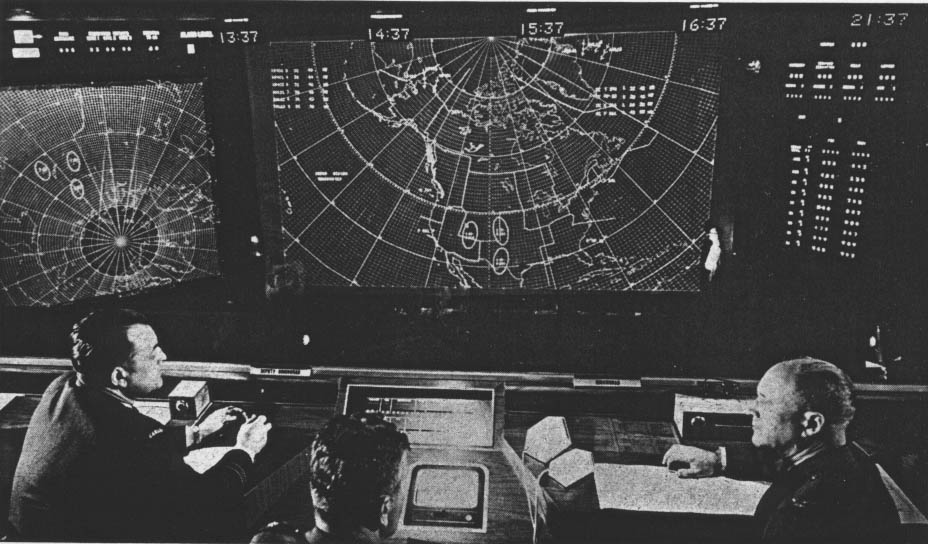
This information is electronically displayed by a
system known as Iconorama (fig 12). The system permits
almost instantaneous observation of the positions of
aerospace and seaborne objects thousands of miles away
and over any part of the continent covered by radar
networks. Iconorama flashes surveillance information
on a large, theater-like screen for easy observation.
On this screen is a map of North America, the
surrounding oceans, Greenland, Iceland, Parts of
Siberia, and the Caribbean islands. Symbols show the
location and direction of travel of all aircraft of
special interest to NORAD. These may he strategic
friendly elements or a commercial or military aircraft
that for one reason or another is classed as an unknown
until Positive identification 19 made. NORAD is
interested in unidentified submarines, friendly aircraft
carriers, Soviet fishing trawlers, and air activity over
Cuba and Siberia. All this is presented on the main
display with special coded symbols that provide a variety
of information about the subject.
Figure 12. Iconorama display in NORAD combat operations center.
Figure 12. Iconorama display in NORAD combat operations center.
To the right of the main display is the weapon
status board. This is associated with the main display,
and information on the board is received, processed,
and displayed automatically. The top part of this board,
referred to as the "commander's box score." shows at a
glance the number of hostile aircraft in the NORAD system,
the number of unknowns, the weapons committed to these
tracks, the kills made, and NORAD losses. Below is a
listing of worldwide major military commands and their
defense readiness conditions. The bottom part of the
status board shows the number of weapons available to
NORAD on 5-minute alert, including fighter-interceptors
and surface-to-air missiles.
To the left of the main display is the BMEWS display.
At the top is the threat summary panel providing, under
conditions of attack, the number of missiles predicted
to impact on North America and the time remaining before
the first or next missile. The lower part of the BMEWS
display is a map of Europe and Asia as seen looking over
the North Pole from North America. On this map the launch
areas for incoming ballistic missiles will show as ellipses.
Corresponding ellipses appear simultaneously on the main
display and show the predicted impact area. These three
displays provide up-to-date information to CINCNORAD and
his battle staff at all times.
There are other types and sources of information
available on call. The weather forecast office in the
COC is manned with trained meteorologists, always on
duty and ready to provide the latest weather information
either in person or through the closed circuit television
network to monitors in front of each member of the battle
staff. SDC also has its headquarters in the COC and can
provide information to the baffle staff either by a personal
briefing or through the television system.
Being completed is a new hardened site for the NORAD COG,
located inside Cheyenne Mountain south of Colorado Springs
(fig 13). The COC will be housed in steel buildings beneath
1,000 feet of solid granite. The main part of the COC will
be a three-story building constructed within the
intersecting chambers. It will include 200, 000 feet of
floorspace to accommodate a maximum of 900 people. By putting
it under the mountain, the vital control center will be
virtually safe from thermonuclear attack. The new COC
(fig 14) is scheduled to become operational early in 1966.
(figure 13 not included in this conversion)
SEMIAUTOMATIC GROUND ENVIRONMENT
Conduct of an area air defense battle requires
a great deal of information, dependable communications,
and coordination among many organizations. Receiving
this information, processing it, and using the
necessary instructions in the limited time available
proved impossible for unaided human beings, and an
electronic air surveillance and weapon control system
was devised to do the job. This system, called
semiautomatic ground environment (SAGE), receives
information, processes it, and communicates
instructions to those concerned.
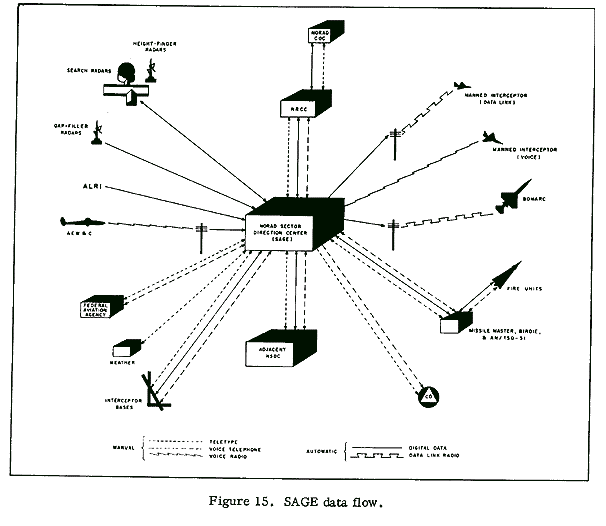
Figure 15. SAGE data flow.
Figure 15 shows the flow of data to and from the NORAD
sector direction center SAGE (NSDC SAGE) in the air defense
organization. Data are transmitted automatically to the
NSDC SAGE from ground-based search radars, airborne
long-range inputs (ALRI), and, on demand, from height-finder
radars. Information on weapon status, weather, and airborne
early warning is received by telephone, radio, and teletype
and is programed
into the computer. Similarly, data from the NSDC SAGE are
transmitted automatically to direct Bomarc missiles and
aircraft equipped with data link receivers to hostile
aircraft. Digital data transmission is used to pass
hostile track information to Missile Master or battery
integration and radar display equipment (BIRDIE) fire
distribution systems for action by Nike Hercules and
Hawk fire units. Selected data are automatically sent
to adjacent NSDC's and to the NORAD region combat center
(NRCC). Manned interceptors, not equipped with a data link,
are directed to the hostile aircraft by voice (ultrahigh
frequency (UHF) radio). Telephone, teletype, and radio
are used to pass information to civil defense agencies,
SAG, and other headquarters.
The US Army Air Defense Command (ARADCOM) is both a
major combat command of the US Army and a component of
NORAD. As a member of the two-nation air defense organization,
ARADCOM is assigned the mission of providing combat-ready Army
forces to the Commander in Chief, NORAD, for the air defense
of designated strategic and metropolitan target complexes.
The mainstay of ARADCOM's weapon inventory is nuclear-capable
Nike Hercules surface-to-air missiles, augmented by low-level
nonnuclear Hawk missiles, currently deployed in defense of the
Homestead-Miami and Key West areas in southern Florida.
HISTORY
The history of ARADCOM dates back to 1 July 1950 when
it was established as the Army Antiaircraft Command. However,
it was 10 April 1951 before all antiaircraft artillery units
located within the continental United States and allocated to
its defense were placed under the command jurisdiction of the
newly formed command.
The command's early armament consisted of World War II
vintage 90-mm and 120-mm guns. Later, the 75-mm Skysweeper,
last of the conventional antiaircraft artillery weapons, was
added to the command's arsenal. The first surface-to-air
guided missile to be phased Into the Army air defense system
was the Nike Ajax, which became operational on site in the
Washington-Baltimore defense in May 1954. On 21 March 1957,
in recognition of its growing combat-ready, surface-to-air
guided missile force, this command was redesignated the US
Army Air Defense Command.
In June 1958, ARADCOM's first Nike Hercules unit attained
operational readiness in the Chicago defense. Since that time,
all of the command's missile sites have been converted to the
second-generation Nike Hercules.
ARMY NATIONAL GUARD
The Department of the Army authorized the Army National
Guard to convert 32 antiaircraft artillery battalions, then
equipped with conventional guns, to Nike Ajax missile
battalions in 1957. The 4th Missile Battalion(Nike Ajax),
25lst Artillery, California Army National Guard, was the first
National Guard surface-to-air guided missile battalion
integrated into the active continental United States defense
mission. This unit assumed around the-clock operations at four
battery sites in the Los Angeles area on 14 September 1958.
At the completion of the phased training program, the Army
National Guard was furnishing 76 batteries in 14 states,
defending 15 areas. These were the first US Reserve Forces
with modern surface-to-air missiles.
In May 1962, the first of the Army National Guard
Nike Ajax units were phased out and started retraining
to operate and maintain the second-generation Nike
missile, the nuclearcapable Nike Hercules. Four units
of the Maryland National Guard were selected for the
initial conversion to Nike Hercules, becoming
operational on 11 December 1962.
The last four Nike Ajax sites manned by the National
Guard were phased out in May 1964 at Norfolk, Virginia.
The final stages of the Nike Hercules conversion program
were completed in 1965 with 48 Army National Guard
batteries, representing 16 states and defending 18
areas, participating in the on-site program.
Guardsmen assume full operational responsibility
for manning the sites around the clock. Full-time
personnel man the equipment 24 hours a day, keeping
it in constant readiness. This cadre of full-time
specialists is capable of initiating effective fire
on the enemy without additional personnel. Remaining
members of the units are citizens of the community who
keep up on their military skills by attending regular
drills with their units. If an air attack should occur,
they would report immediately to their assigned units.
These Army National Guard units, although an integral
part of the air defense system when they become operational
in wartime, retain their identity as State units under the
command of the governors of their respective states in
peacetime. ARADCOM has been assigned responsibility for
training supervision and support of these units. In event
of an emergency requiring use of these units in a combat
role, operational command would be exercised by CINCNORAD.
OPERATIONS
Administrative and training supervision over the
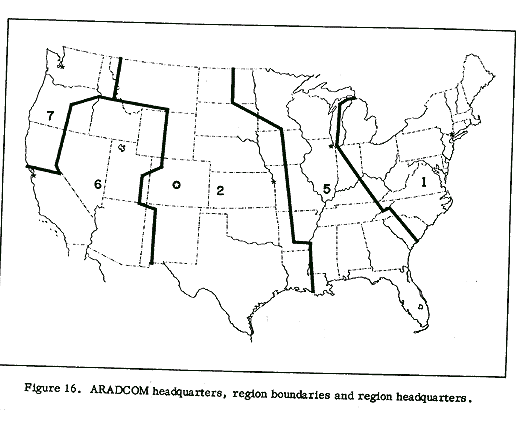
widespread defenses is exercised by ARADCOM regions.
Figure 16 shows the region boundaries and ARADCOM
headquarters at Colorado Springs, Colorado. Region
headquarters and their locations are as follows:
1st Region - Fort Totten, New York
The combat effectiveness of ARADCOM units is
determined by certain indicators, such as engagement
simulator training, operational readiness evaluations,
tactical effectiveness evaluations, NORAD exercises,
short notice annual practices (SNAP), radar bomb scoring
(RES) missions, command maintenance management
inspections (CMMI), and technical proficiency inspections
(TPI). All indicators must be considered together to
determine the effectiveness of units. ARADCOM materiel
readiness evaluation teams aid the units in maintaining
a combat-ready posture.
and region headquarters.
AKMY AIR DEFENSE COMMAND POST IN NORAD OPERATIONS
The wide dispersion of ARADCOM sites poses a
unique problem that requires a specific control
and communications 8ystem. As the heart of this control
and communications system are the Army air defense
command posts (AADCP). Tactical supervision of Nike
Hercules and Hawk fire units is exercised from AADCP's.
An AADCP can use a semiautomatic electronic fire
distribution system, Or the AADCP can be manually
operated. The fire distribution system used is either
Missile Master (AN/FSG-1), a transportable fire
distribution system (BIRDIE AN/GSG-5 or AN/GSG-6),
or the new AN/TSQ-51. The Key West defense utilizes
a battalion operations central, a component of the
field army Missile Monitor system.
AADCP's are linked to NSDC SAGE by digital data,
voice, and teletype lines and to their associated fire
units by data and voice lines and by radio. Normal
operation calls for semiautomatic data Processing from
NSDC SAGE to fire units through the AADCP's, with backup
facilities available for emergency and supplemental
operations. Fire distribution systems provide for complete
semiautomatic operation with fire units when SAGE data are
cut off. Facilities are also available for manual plotting
and voice telling if needed.
AADCP's automatically receive early warning, aircraft
identification, and other data from associated NSDC SAGE.
These data are collected by the AADCP's, improved when
possible, and transmitted to fire units. In NORAD sectors
equipped with SAGE where Army Missile Master systems or
other fire distribution systems are in operation, NORAD
has prescribed four modes for SAGE air defense artillery
operations.
Specified United States air defense artillery units
in Europe are part of the North Atlantic Treaty Organization
(NATO) integrated air defense system of Allied Command
Europe (ACE), one of the military commands of NATO. The
senior military authority in NATO is a military committee
composed of a chief of staff or special delegate of each
member nation.
The standing group, composed of representatives
of the Chiefs of Staff of France, United Kingdom, and
the United States, is the executive agency of the
military committee.
NATO is divided into three military commands and
a regional planning group. The command which concerns
air defense is ACE, which covers the land area extending
from the North Cape of Norway to North Africa and from
the Atlantic to the eastern border of Turkey.
Of particular interest in ACE is Allied Forces,
Central Europe, extending from the southern boundary
of Denmark to the northern boundary of Italy. Allied
Air Forces, Central Europe, has responsibility for air
defense of this area and has divided the area by a line
running southwest-northeast through the approximate
center. The responsibility for air defense of the
northern portion is assigned to the 2d Allied Tactical
Air Force (2 ATAP), while the responsibility for air
defense of the southern portion is assigned to the 4th
Allied Tactical Air Force (4 ATAF).
The commander of 4 ATAF exercises operational control
of all air defense artillery forces assigned through two
sector operations centers (SOC). Tactical control of
surface-to-air guided missile units in the US area of
responsibility is exercised by the SOC sector director.
This SOC is a unified (US Army-US Air Force)
installation, combining facilities of the battle staff,
Air Force control and reporting center, and Army missile
control center or AADCP.
The missile control center, tactical headquarters of
me Army air defense commander, supervises the operation
of units through AADCP's of subordinate air defense groups.
The battle staff, supervised by the sector director,
supervises overall air defense operations and coordinates
activities between the missile control center and control
and reporting center. Operational procedures of US Army air
defense artillery units in NATO are similar to those of air
defense artillery units in the United States.
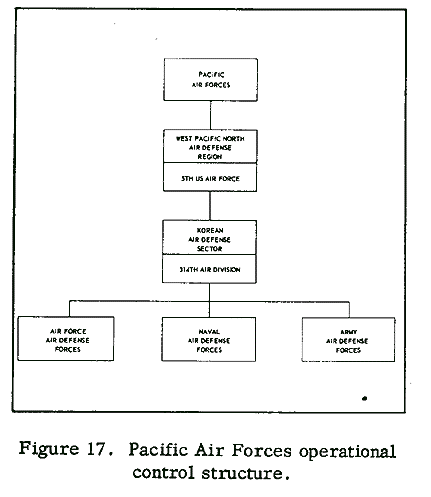
In the Pacific area, US Army air defense artillery
units are deployed in Korea, Okinawa, and Hawaii. The
Commanding General, US Army, Pacific, commands, trains,
and administers these units. Operational control of all
Pacific area air defense forces is vested in Pacific Air
Forces (PACAF) (fig 17).
Figure 17. Pacific Air Forces operational control structure.
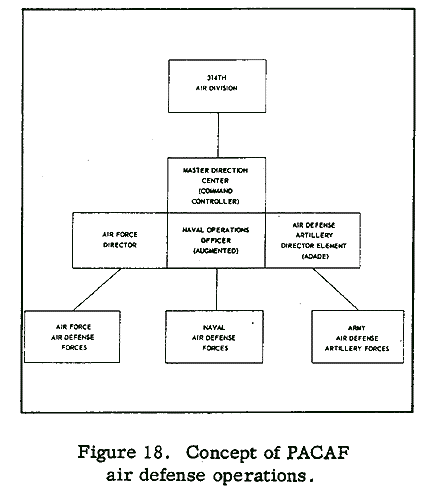
Figure 18. Concept of PACAF Air Defense Operations.
Air defense artillery units in Korea are integrated
for operational control into the overall air defense
system of the West Pacific North Air Defense Region,
a subordinate command of PACAF. The Commanding General,
5th US Air Force, is the West Pacific North Air Defense
Region commander. The region is divided into four specific
actively manned air defense sectors, one of which is the
Korean air defense sector. The 314th Air Division is
responsible for air defense of the Korean air defense
sector and operates a master direction center which
coordinates air defense activities of all services
providing air defense support (fig 18). The air defense
artillery director element, under operational control of
the master direction center, exercises operational control
over all United Stares and Allied Army air defense artillery
units in South Korea. Operational procedures of air defense
artillery units in Korea are similar to those of Army units
in the United States.
In World War II and Korea, the ground-gaining arms
could almost always be assured of being able to operate
without serious hindrance from enemy air. This basic
assumption that our airpower could and would always
provide us with air superiority and hence freedom of
action on the ground in any future action has generally
gone unquestioned, and has been perpetuated in the scenarios
of almost every major exercise, command post exercise (CPX),
Army training test (ATT), or other field problems.
This assumption is no longer valid. A technically and
tactically competent enemy can gain and maintain air
superiority for at least a limited time over areas of
his own choosing. This problem is greatly simplified
if he has adequate conventional gun and surface-to-air
missile defenses in being so that he is relatively free
to shift his fighter aircraft, even for short times,
from basically defensive to offensive operations.
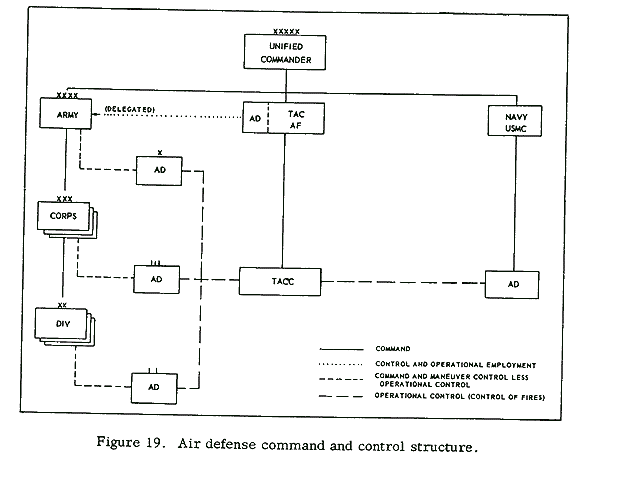
Figure 19. Air defense command and control structure.
Joint Chiefs of Staff Pub. 8, Doctrine for Air Defense
for Oversea Land Areas, May 1964, serves as common doctrine
and prescribes the establishment of a coordinated and
integrated air defense system under a single commander
(fig 19). This document states that air defense forces
must be organized, equipped, trained, and, when possible,
positioned and alerted prior to hostilities. An air defense
cannot be adequately improvised. Constant surveillance must
be maintained to insure timely response of air defense forces
and concurrent warning to the offensive forces of the command.
The enemy air threat must be considered as an entity and
countered by a strategy based unity of effort. The hostile
threat and targets to be defended are the points of departure
for all air defense planning and the basis on which air
defense requirements must be computed.
Within an oversea unified command, subordinate unified
command, or joint task force, the commander will assign
overall responsibility for air defense to a single commander.
Normally, this will be the Air Force component commander.
Representation from me other service components involved
will be provided, as appropriate, to the air defense
commander's headquarters. The mission of the area air defense
commander will be to coordinate and integrate the entire
air defense effort within the unified command. Subject to
the authority of the unified commander, he will establish
broad policies and procedures for the employment of air
defense means and the coordination of such means with the
operations of other elements within the area. Where a
significant portion of the means for air defense is
contributed by a service other than that of the area air
defense commander, a senior officer should be appointed from
that service to serve as deputy in air defense matters to
the area air defense
The area air defense commander will establish air
defense regions. The number of such regions may vary,
depending upon geographical and political factors and
the complexities of the air defense problem. He will
appoint the regional air defense commanders and designate
their areas of responsibility, taking into consideration
such factors as the geography of the area, the hostile
threat, and the contributions of the services. In a region
where a significant portion of the regional air defense
means consists of air defense weapon systems of another
service, a senior officer of that service should be
appointed to serve as deputy in air defense matters to
the regional air defense commander. Service staff
representation will be assigned, as appropriate, to
the regional air defense activities. The regional air
defense commander will be fully responsible for, and
will have full authority in, the air defense of his region.
However, he will normally delegate authority to the field
army commander(s) for control and operational employment
of organic Army air defense artillery means within the
field army
In essence, JCS Pub. 8 states that, in a normal situation,
the Army commander may deploy his own organic air defense
artillery units in support of the forces of his command;
however, these units will be subject to the overall guidance
and rules established by the area and region air defense
commanders. The field army commander may move his air
defense weapons as required to support his scheme of
maneuver--a vital requirement for the safety of the
field army--while the region or area air defense commander
maintains operational control of the fires of these weapons
through target assignment, rules for engagement, identification
criteria, establishment of battle zones, and other SOP--a
vital requirement for the safety of both friendly pilots
and rear area complexes.
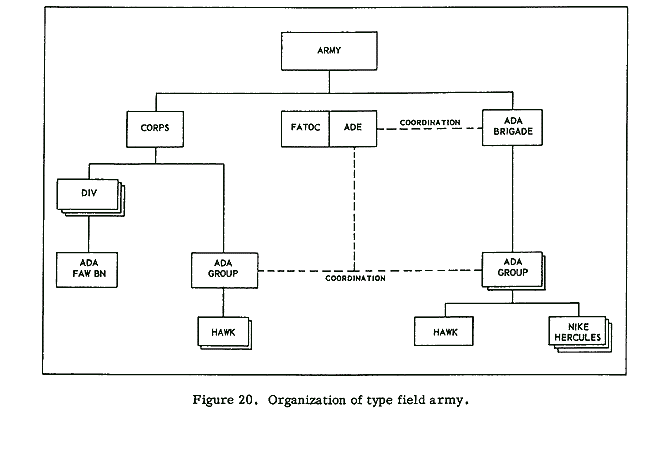
The air defense means of the field army may include
an air defense artillery brigade made up of two or more
groups composed of a number of Nike Hercules and Hawk
battalions. In addition, an air defense artillery group
may be assigned or attached to each corps. These groups
may include one or more Hawk battalions. It is the Air
Defense School position that one air defense artillery
forward area weapons (ADA FAW) battalion be organic to
division as a part of division artillery (fig 20). This
position does not, however, preclude the attachment or
assignment of ADA FAW battalions to the air defense
artillery group at corps level if the units are available.
Figure 20. Organization of type field army.
Figure 20. Organization of type field army.
The air defense artillery brigade has the responsibility
of providing an umbrella of air defense for the entire field
army area. The air defense artillery group(s) assigned or
attached to the corps will employ their Hawk battalions to
provide air defense against low and medium-altitude targets
in corps areas. The ADA FAW battalions will be employed within
the division in support of the division priorities.
The air defense artillery brigade commander, as senior air
defense artilleryman, is responsible for the coordination of
the Army air defense effort (fig 20). He can accomplish this
through direct command within the brigade; however, he normally
has no command authority over the air defense artillery groups
assigned or attached to the corps.
Coordination of the employment of all air defense means
within the field army is normally accomplished in the tactical
operations centers at field army level (FATOC), corps (CTOC),
and division (DTOC). The tactical operations center is an
integrated staff facility where representatives of the special
and general staff sections are grouped to assist the commander
in exercising control of current tactical operations. The air
defense representation is known as the air defense element (ADE);
a liaison team is provided for in the brigade TOE and by
augmentation in the air defense artillery group. The ADE,
whether at army, corps, or division, coordinates air defense
operations with other combat operations, the use of air defense
artillery nuclear weapons, surface-to-surface missions, and the
use of airspace, and exercises staff supervision of the application
of electronic security measures by air defense artillery units.
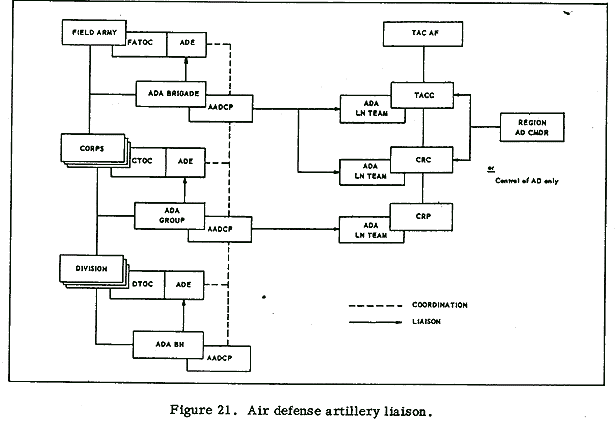
Joint service coordination is accomplished by means
of liaison sections (fig 21). The air defense artillery brigade
establishes liaison with the Air Force at the tactical air control
center(TACC), this section being organic to the brigade, and at the
control and reporting center by an augmentation section. Air defense
artillery groups assigned or attached to the corps would be expected
to establish liaison with a command and reporting center; however,
considering such factors as distance, available communications,
identification capability of the facility concerned, and concept of
operations, this liaison could be accomplished with the forward
extension of the command and reporting center which is a control
and reporting post. Coordination may be accomplished by collocation
of the AADCP's with the appropriate Air Force installation or by
utilizing established communications networks used by liaison teams.
In sophisticated air defenses, coordination may be effected by having
the systems operationally connected.
Figure 21. Air defense artillery liaison.
Figure 21. Air defense artillery liaison.
Current oversea deployments vary from area to area. The principal
differences are generated by the need to tailor the defense to the
local conditions. The local conditions are included in a consideration
of the threat and geographical and political factors.
To meet the requirement for rapid response to hostile air activity,
communications are paramount. The Army, realizing this need for faster,
more positive fire distribution of surface-to-air missiles in the field
army, developed the AN/MSG-4 (Missile Monitor) fire distribution system.
This system may be employed for centralized or decentralized control as
directed by the Army air defense commander.
Coordinated air defense effort is a requirement, not only
within a field army but between the field army and tactical
air force. To fulfill this responsibility, the Army air defense
commander normally establishes liaison with the tactical air force.
This liaison may be accomplished by collocating the AADCP of various
air defense artillery commands with the functional counterpart
of the tactical air force or by liaison between these elements.
Figure 21 graphically depicts a typical solution of the liaison
requirement. Liaison expedites the flow of early warning and
identification information, two vital elements of data for any
air defense. Both the control and reporting center and the control
and reporting post can provide early warning information to air
defense artillery units, and the control and reporting center can
provide target identification information.
Field army air defense is dependent upon complex communications
networks and extensive intelligence inputs. Provisions must also be
made for operations if communications fail, if intelligence inputs
are limited, or if a key command post is destroyed. Identification
is facilitated and reaction time reduced through use of the battle
zone concept.
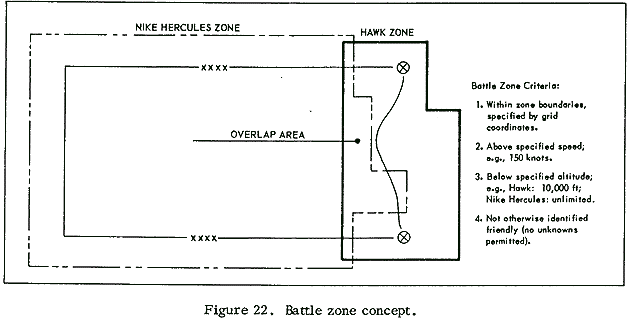
In this concept, Hawk units are deployed well forward, perhaps
to within 10 kilometers of the forward edge of the battle area, and
in depth to form a zone or umbrella of protection. When the battle
zones are implemented by appropriate authority, aircraft entering
this zone and not identified as friendly would be engaged on a
weapons-free basis, providing the aircraft met certain criteria as
to speed and altitude. For example, the criteria may be to engage
aircraft flying below 10,000 feet altitude and at speeds in excess
of 100 knots. This procedure would preclude the possibility of
engaging our helicopters or other slow-flying Army aircraft.
Figure 22. Battle zone concept.
Figure 22. Battle zone concept.
A Nike Hercules battle zone would also be established.
The Nike Hercules zone, however, could consist of a series
of separate battle zones; for example, Alfa, Brave, and Charlie.
In zone Alfa, for example, Nike Hercules would attack all targets,
at any altitude, to the edge of the battle zone extending over the
composite defense; in zone Brave, the range would be extended; and
finally, in zone Charlie, the range would be extended even farther.
Again,
speed also could be used as a criteria, and the air defense commander
would designate the Alfa, Brave, or Charlie zone as the air defense
battle progressed, dependent upon the means available. The limits of the
battle zones may be defined, using a grid coordinate system. A composite
battle zone employed in a field army is illustrated in figure 22.
The tactical and operational requirements of current and future air
defense artillery systems demand employment of skilled technicians and
adequate Lest equipment to provide responsive maintenance support to the
ADC. Preventive maintenance must be efficiently scheduled and malfunctions
rapidly corrected. Maintenance management is the responsibility of every
commander and includes motivation, organization, accurate records and
reports, and training.
The commander of an air defense artillery unit must have the capability
of maintaining a high degree of operational readiness around the dock, in
peacetime as well as in combat, and in the United States as well as overseas.
He requires technicians who are system diagnosticians, supported by repairmen
with a capability for repair of defective assemblies and subassemblies.
Emphasis must be in the direction of performing tests, maintenance, and
repairs as close to the point of failure as practical. Support personnel
organic to air defense artillery units and organizations provide the
commander a maintenance capability commensurate with his responsibility.
In this light, the principal maintenance functions (organizational and
direct support) are immediately responsive to the operational requirements
of the system.
The organizational maintenance technician is concerned primarily with
system analysis. He has a thorough understanding of electronic theory,
the practical application of this theory, and me functions of all
components within his area of responsibility. He supervises or performs
preventive maintenance and verifies system operational readiness. To
reduce repair time and minimize travel on the battlefield, the
organizational maintenance technician is trained and must be permitted
to perform maintenance to the highest practical level under combat
operational conditions.
Timely reports must be made of conditions that adversely affect the
maintenance effort. Examples of these conditions are shortages of qualified
personnel, equipment, and repair parts; improper scheduling of training; and
assignment of missions which impair maintenance of equipment. Commanders must
insure that reports concerning maintenance support of their equipment are
accurate and reflect the operational readiness of their unit. Analysts of
these reports aids in determination of total support requirements.
In short, an effective maintenance program is of the utmost importance
in air defense artillery units. Air defense commanders must apply techniques
of maintenance management which will insure operating equipment to meet
operational readiness requirements. The best in air defense, in peacetime
or war, is dependent on efficient maintenance.
The ability to interfere with the enemy's electronically controlled
equipment while operating our own without interference is included in an
area of military activity known as electronic warfare.
Electronic countermeasures (ECM) is that major subdivision of
electronic warfare involving actions taken to prevent or reduce the
effectiveness of enemy equipment and tactics that employ or are
affected by electromagnetic radiations.
The US Air Force has equipped its aircraft with varying types
of intercept receivers, transmitting electronic jammers, and chaff
dispensers contingent upon the tactics to be employed. Intelligence
reports indicate that potential enemies of the United States have
spent vast amounts of money in the development of ECM equipment.
Generally speaking, ECM is introduced into a radar receiver to
impair the use of the reflected radar signal. If a jamming signal enters
the receiver and prevents the radar operator from seeing the target or
causes him to lose the target, the jamming has reduced the effectiveness
of the air defense.
Electronic countermeasures may range from relatively simple measures,
such as chaff, to complex devices known as spoofers, whereby false targets
are electronically displayed in addition to the actual target echo.
This susceptibility of radar equipment to jamming, both reflective
and transmitted, once again forced military planners to the drawing board.
This time the criteria for research was To counter the advantage gained by
an attacking force employing ECM. These studies resulted in extensive
improvements to radar systems which allow effective operation despite
heavy jamming. Since we are countering the use of electronic countermeasures,
the term, electronic counter-countermeasures (ECCM), came into existence.
To counter an ECM attack, many ECCM devices and techniques have been evolved.
The salient factors concern frequency diversity and frequency change,
increased power, increased receiver sensitivity, greater antenna gain,
and special ECCM circuits. Some devices employed are special ECCM receivers
to allow selection of the best (least jammed) video presentation,
parametric amplifiers to reduce receiver noise level, amplitrons to
increase power, coincidence circuits to counter random pulses, and
other special ECCM circuits, such as antijam displays, track-on-jamming,
and side-lobe blanking circuits. Frequency diversity, involving the use
of several radars in different frequency bands, imposes a great problem
to any attacking force.
During any future conflict, ECM will be the normal operational environment;
therefore, operators must expect ECM, recognize ECM, report ECM, and take
appropriate action to counter its effects. Trained operators must use the
ECCM devices only as absolutely necessary. The purpose of ECCM operation
is to obtain a scope presentation that is free of interference and retains
the greatest possible amount of information useful for accomplishing the mission .
To survive in an ECM environment, air defense artillery units must have
their radar equipment operating at peak efficiency, the latest ECCM equipment,
well-trained operators, and skilled maintenance personnel.
Identification of airborne objects presents a major problem to all
air defense units. To prevent destruction of friendly aircraft, a positive
means of identification must be provided. This need was initially met by
development of the Mark III identification, friend or foe (IFF), system.
This system, used with ground station radars during World War II, assisted
in the identification of aircraft, but limitations of the system caused its
use to be discontinued at the end of the war. Research was started to develop
an identification system to satisfy the needs of all services. The Mark X IFF
system was the result.
The MarkX IFF system is composed of two groups of equipment. One, the
interrogator-responder, is located with ground radars and the other, the
transponder, is located aboard friendly aircraft. The
interrogator-responder is installed at the ground station and depends
on a parent radar for a synchronizing trigger, an ac power input, and a
plan position indicator (PPI) to display IFF video. Its major components
include a coder control (modes 1, 2, and 3), receiver-transmitter and
antenna. The interrogator-responder antenna is unidirecdonal; since the
radar antenna is also unidirectional, it is necessary to have the two
antennas synchronized for azimuth resolution, (This causes IFF video to
be portrayed on the PPI at the same azimuth as the radar video of the
interrogated target.) The airborne transponder is independent of any radar
that might be located in the aircraft; however, it requires power from a
source in the aircraft. The unit consists of a receiver-transmitter and
antenna. The antenna is omnidirectional in order to receive and transmit
in any direction.
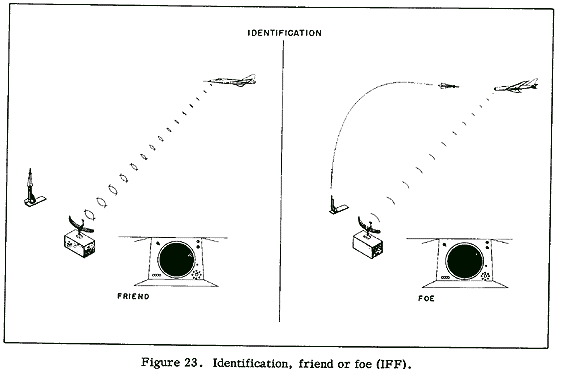
The sequence of operation (fig 23) for Mark X equipment is the same
for Nike Hercules and Hawk batteries, battalion operation centrals, fire
distribution systems, and AADCP's. When target video appears on the PPI,
the acquisition radar operator or tactical control assistant (Hawk battery)
places the interrogator-responder in operation by turning on the challenge
switch. (The acquisition radar operator or tactical control assistant will
determine which IFF mode is to be interrogated.) This causes a pair of radio
frequency (RF) pulses to be transmitted from the IPF antenna at the same
azimuth as the radar pulse. These RF pulses will have an interpulse spacing,
from leading edge to leading edge, of 3, 5, or 8 microseconds, depending on
which mode is being interrogated (mode 1, 3 microseconds; mode 2, 5
microseconds; and mode 3, 8 microseconds). The transponder receives the
RF pulse-pairs and amplifies the challenge signal (both RF pulses must
be present because one pulse does not constitute a valid challenge).
Upon receiving a valid challenge, the transponder will then transmit
its identification signal. The reply is received and amplified in the
interrogator-responder receiver. The output of the receiver is sent to
the PPI where it will be displayed as one, two, or four arcs at a range
greater than the interrogated aircraft but at the same azimuth (one are
is the valid response for a mode 1 or 3 challenge, two arcs constitute
a valid response in mode 2, and four arcs indicate that the aircraft has
declared an emergency).
The Mark X IFF equipment used in conjunction with air defense artillery
radars includes a selective identification feature (SIF) which enables the
IFF equipment to receive 32 mode 1 responses and 64 each of mode 2 and
mode 3 responses. The 160 possible mode and code responses of the
Mark X IFF/SIP system enabled the establishment of a more positive
identification system. When the selective identification feature of
the Mark X IFF system is used, correct responses by the interrogated
aircraft will be displayed as one are at a range greater than the
interrogated aircraft but at the same azimuth. Should the aircraft
declare an emergency, the SIF reply would appear on the PPI as four area.
Figure 23. Identification, friend or foe (IFF).
The vital link between weapon systems and command/control facilities
of air defense artillery is communications. The supersonic nature of the
aerospace threat dictates that air defense artillery communications be
rapid, reliable, and redundant to insure maximum effectiveness on a continuous basis.
Within NORAD, air defense artillery communications in a fixed
environment is adequately provided by a combination of means to
include both commercial and sophisticated military facilities of
the Defense Communications Agency (DCA). The extension of the DCA
system automatic voice net (AUTOVON) throughout the NORAD organization
combined with leased cable, microwave radio, and other means have provided
the degree of redundancy that enhance communications survivability while
insuring reliability under a host of adverse conditions. Presently, the
only organic radios provided to NORAD air defense artillery units are the
AN/TRC-47 used to furnish backup intra area communications for the cable
connecting the battery control and launching areas in Nike Hercules on-site
units and TOE radios for Hawk units.
Communications for air defense artillery units in an oversea or mobile
air defense environment is furnished by attached Signal Corps units as well
as organic means. The primary means of communication for field air defense
artillery units is a very high frequency/ultrahigh frequency (VHF/UHF)
radio relay system. Personnel and equipment organized under Signal Corps
TOE 11-500 are attached to air defense artillery units at group
or battalion level. This primary system of VHF/UHF multichannel equipment
supports the electronic fire distribution system deployed with these field
units. It is capable of transmitting digital data as well as voice information.
To provide a backup to this system and to allow for manual operation if
the VHF/UHF radio relay system is lost due to a break in the communications
link, TOE radio equipment is utilized.
The basic Signal Corps equipment used to establish primary communications,
furnished by the attached signal detachment, is radio terminal set AN/MRC-69
(fig 24). This set is a package consisting of two AN/TRC-24 radio
receiver-transmitters and two AN/TCC-7 multiplexers. it provides a 12-channel,
duplex capability with rated ranges of 30 to 50 miles between stations,
providing a direct line of sight is available. A variation of this set issued
to missile batteries is the AN/MRC-73. This package contains one AN/TRC-24
radio and one AN/TCC-7 multiplexer. It also has a 12-channel duplex capacity
but can act as a terminal set only. It is not capable of acting as a terminal
set and relay station at the same time. The final equipment package found in
the VHF/UHF radio relay system is the AN/MRC-54, a repeater or relay station
consisting of three AN/TRC-24 radios.
(figure 24 not included in this conversion)
Figure 24. Radio terminal set AN/MRC-69 shown in a signal subcenter (AACS).
Providing backup nets to the primary system, Nike Hercules and Hawk units
are issued organic radios.
Radio receiving set AN/GRR-5 (fig 25) is found at higher headquarters
(group or brigade) as well as at battalion and battery level. Its prime use
is in higher headquarters warning nets and For intradefense intelligence nets.
(figure 25 not included in this conversion)
Figure 25. Radio receiving set AN/GRR-5.
(figure 26 not included in this conversion)
Figure 26. Radio set AN/GRC-1Y.
The AN/GRC-19 (fig 26), an amplitude-modulated (AM) radio set, is used in
tactical and administrative nets. Designed for mobile use, it can be used for
both fixed and portable service and is capable of providing communication over
a distance of 50 miles when using the organic whip antenna. Modified antennas
increase the transmission range to 150 to 1,500 miles .
The AN/GRC-46 is a shelter-housed transportable radioteletypewriter set
which uses the AN/GRC-19 as its major basic component. The AN/GRC-46 is
authorized for air defense artillery battalions primarily to provide
communication with higher headquarters.
The AN/GRC-26 is a long-range AM radio used at group and brigade level.
For command and logistical control, Nike Hercules and Hawk battalions
and batteries are issued AM radio sets that have a range of 10 to 15 miles,
Hawk units are issued vehicle-mounted AN/VRC-34 radios, while Nike Hercules
units are issued the ground-mounted AN/GRC-87. These two radios are basically
the same except for the mounting configuration.
The only FM radios presently issued to air defense artillery units are the
AN/VRC-9 and AN/VRQ-2, each having a range of 10 to 15 miles. A Hawk battalion
is issued one AN/VRC-9 to provide the capability of establishing liaison with
a supported unit if such a mission is assigned. The AN/VRQ-2 (fig 27) has a
retransmission capability and is issued to Nike Hercules units in the field
army area to provide backup communication for the cable link between the
battery control and launching areas.
(figure 27 not included in this conversion)
Figure 27. Radio set AN/VRQ-2.
It is anticipated that radio terminal sets AN/TRC-84 and AN/TRC-85
will replace the AN/VRQ-2 radios and cable as the primary interarea
communications in Nike Hercules batteries overseas, thus considerably
enhancing their operational capability and mobility. The AN/TRC-84 and
AN/TRC-85 have a range of 5 miles and are capable of electronically
passing all required data within the Nike Hercules battery.
Revised TOE for all air defense artillery echelons, brigade to battery,
include up-to-date communications equipment. In voice command nets, the new
AN/VRC-12 family of frequencymodulated (FM) radios are to replace the AN/VRC-34
and AN/GRC-87 radio sets. The basic receiver-transmitter of the AN/VRC-12
family issued to air defense artillery units is the AN/VRC-46. The AN/VRC-47
(fig 28) is a basic receiver-transmitter with an auxiliary receiver, and the
AN/VRC-49 consists of two of the basic receiver-transmitters on a single mounting.
These small, rugged radio sets possess a range capability of 20 to 30 miles, using
a Whip antenna. Channel capacity is increased to 920 channels capable
of netting with infantry, armor, or field artillery units.
(figure 28 not included in this conversion)
Figure 28. Radio set AN/VRC-47.
Technical advances in weapon systems and advanced concepts of deployment
result in ever-increasing demands within the field of communications.
Fortunately, improvements in communications equipment design have met
this challenge, and the end product is a new series of radios with improved
capability as well as reduced size and weight.
The mainstay of these radios is the vehicle-mounted AN/GRC-106, a compact,
AM, single-sideband replacement for the AN/GRC-19, with a range of 50 miles.
Additional
equipment may be added to this basic set to double its range and provide
teletype capability. The AN/GRC-106 (fig 29) is presently prescribed by
TOE for all levels of air defense artillery units to provide required
tactical communications.
The man-packed AN/PRC-25 radio, another of the improved radios, is a
forward area radio set to replace the AN/PRC-8, -9, and -10 radios. Its
use by Nike Hercules batteries will improve unit security control. This
basic set is also to be built as a vehicle-mounted version (AN/VRC-53)
(fig 30) or as a convertible man-packed/vehicle-mounted version (AN/GRC-125).
The normal range of 3 to 5 miles may be increased to 15 to 20 miles by
use of an amplifier.
(figure 29 not included in this conversion)
Figure 29. Vehicle-mounted radio set AN/GRC-106.
(figure 30 not included in this conversion)
Figure 30. Vehicle-mounted radio set AN/VRC-53.
The challenge presented to air defense artillery communications as a result
of technical advances in fire distribution systems and modern weapons has been
more than adequately satisfied by aggressive research and development within the
field of communications equipment. The new, compact, longer range communications
equipment will soon be issued to all echelons of air defense artillery to provide
an even greater capability to accomplish the latter portion of the artillery
axiom--move, shoot, and communicate.
If you have comments or suggestions, Send e-mail
to Ed Thelen
Return to Home
go to "Digest", contents,
go to next chapter
Updated Nov 16, 2011
(page 2)
(page 3)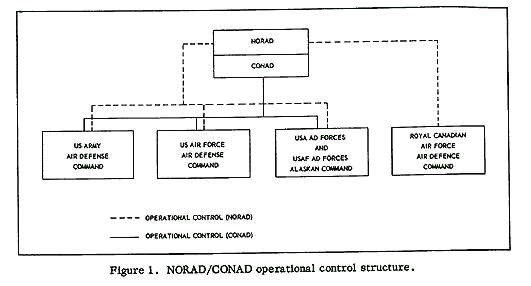
Figure 1. NORAD/CONAD operational control structure.
(page 4)
(page 5)
(page 6)
(figure 6 not included in this conversion)
(page 7)
(page 8)
(page 9)
(page 10)
Figure 10. USAF ADC fighter-interceptors go into action.
(page 11)
Figure 11. NORAD COC building at Ent Air Force Base.
(page 12)
100 K bytes
Spotted by
Stephen Joiner )
(page 13)
(figure 14 not included in this conversion)
(page 14)
(page 15)
(page 16)
2d Region - Richards-Gebaur AFB, Missouri
5th Region - Fort Sheridan, Illinois
6th Region - Fort Baker, California
7th Region - McChord AFB, Washington
(page 17)
(page 18)
NORTH ATLANTIC TREATY ORGANIZATION
(page 19)
(page 20)
(page 21)
(page 22)
(page 23)
(page 24)
(page 25)
(page 26)
(page 27)
(page 28)
(page 29)
(page 30)
(page 31)
(page 32)
(page 33)