The purpose of this page is to present the activities of the U.S. National Guard in the NIKE program.
Contents:
- Lazy? - Dec 2017
- *is* Ready and Effective - April 30, 2009
- a Rebuttal to "kicked the active Army's ..." (4 entries down)
- a History Fragment "First Guard Missile Unit Organized"
- Effectiveness
- "We needed them"
- kicked the active Army's ...
- 17 states whose Army National Guard units served The Air Defense of America
- ... enlist in the National Guard
- Nike guard units were fulltime
- ... personal experience understated the contribution
- Seattle experience Full time Army National Guard Technician
- Forming a Nike National Guard Unit
- Hot Stuff? - Rivalry?
Introductory Remarks - me ;-))
|
I must admit a deep bias about "week-end" soldiers.
When I was in high school in the late 1940s, there were many stories about
older brothers and their
National Guard two week training every summer. The stories had much more to do
with excessive drinking and other adventures than with military training.
As my army enlistment ended, there were rumors that the National Guard might be "taking over" soon. We technical types were incredulous - what - some part-timers trying to keep the equipment and missiles at peak (or even good) status? "You just gotta be kiddin." Just thought I ought to warn you of my bias. (Most reporters don't.)
We full time army NIKE guys tried to figure the time it would take for the National Guard guys to get to the NIKE site. - Assuming Soviet planes were detected over the North Pole, and a decision was made by peace time soldiers and politicians that there was an attack starting, how long would it take to get a National Guard crew in from the various beds, picnics, work places, etc.?
|
a Rebuttal to "kicked the active Army's ..."
Spec 4 Jim Rhodes
Part of a note from Mark Morgan
(Co-author of Rings of Supersonic Steel)
From Gordon Hagewood April 2008
From Richard L. Mitchell
Effectiveness: 75 percent of the Regulars lived on site and were on call at
a minutes notice, giving them a possile quicker response and at least a
back-up crew if necessary. This possible made them more effective. During
my stay with the ING at Homewood [C-50, Illinois]
I saw no difference in the caliber or
quality of manpower. The USA had a strict code of compliance that was
enfoprced and a trouble maker or a man with disipline problems was shipped
out. Each man had already undergone an ongoing security check by the FBI
and was proud of it.
These men came in one weekend a month and two weeks in the summer. Each man
was being trained for that eventuality. To be honest. those like myself,
working full time, needed more help. We were sadly undermanned.
Aside from
each missile pit there was the need for base security (gate, inside and
outside perimeter), missile assembly, fueling and a myriad of other
activities common to all camps. Not least of all was the damn grass cutting
and grounds maintenance that took away from our own training. I have fond
memories of those days but we knew we could not keep that base operating
full time in a war-time environment without the weekend warriors.
Missile assembly alone was a time consuming job. Everything was by the
book. Nothing was put on by memory or by guess or by gosh. Each part was
added in a specific order and then torqued down with special wrenches
designed for that one operation. Sometimes the torque value was the same
for two or three parts. If this was the case the same wrench would be used.
Few of our torque wrenches were multi-use. Most had one torque value and
these were checked every so often at Ft. Sheridan and, if needed, reset.
That was why we needed quite a lot of manpower. Unfortunately when the
Basic base needs were figured out originally manpower was kept to a
minimum. We were told it was a matter of appropriations.
I believe the same plan was set for Homewood. I don't remember if we had
reservists coming in or not but I am sure this was to be the case. I did
not stay there that long to remember.
Angus
and on March 21, 1999
The Army Guard was extremely proud of their successful Nike program.
I thought you might find it interesting that the Regular Army wants the
Army National Guard to field the Missile defense system that we have been
hearing so much about lately. The reasoning one General stated was due to
the outstanding success of the Army Guard with the Nike Program.
Ed, today's Army Guard continues in the missile program with some states
fielding Patriot. Also some states field the multiple-launch rocket system
{mlrs}. One of these battalions, the 158th field artillery of Oklahoma
deployed to the Gulf in 1990 and was so feared by the Iraqi soldiers that
they called mlrs "steel rain". I also believe they had the highest
fire ratio for mlrs in the gulf.
TSGT. JIM SHEWOKIS then sent me eight Xeroxed pages
of a National Guard publication. The first and seventh pages were clear enough to scan.
(Images of 120 mm guns and Nikes are not included here.)
The casing of the colors of the battalions which were in the NIKE-HERCULES air defense
program marks the end of an era during which Army National Guardsmen successfully carried out
a vital
mission in the nation's security on a day to day basis.
Although only a relatively small number of Army Guardsmen were involved in this
program probably no more than 7,000 at any given time in a 20-year span -- this participation
did a good
deal to call attention to a previously overlooked potential. The nation learned that its
part-time soldiers
could take full-time responsibility for a major defense function.
Prior to World War II many National Guard units were allocated to the Coast Artillery -- a
program which was overtaken by the technology which came out of the 1941-1945 war years.
This was a
technology which was spurred by the advent of airpower coupled with the discovery of the
key to the
previously unknown factor of atomic and, later, nuclear power.
The Army had undergone the transition from Coast Artillery to Antiaircraft Artillery (AAA)
during the war, and it was determined that the National Guard would provide units for
the Antiaircraft
Artillery effort in the postwar years.
[image not reproduced]
But few of the postwar planners ever envisioned the development of an on-site, combat-ready
network of Army National Guard batteries, supported by Army National Guard command and control
elements, which would provide around-the-clock protection to major U.S. cities and
industrial complexes.
seven days a week. 52 weeks each year.
The program, at its zenith, was located in 17 States and it introduced a whole new dimension
of modern-day Minuteman; the Minuteman of the missile age. He was a National Guardsman who was
trained to respond to an alert which could call him from his civilian pursuit to the missile
site at any time
of day or night should the nation's security be threatened. Backing up these Minutemen was a
small but
highly trained corps of technician specialists who were on the job full time, keeping open
the
communications networks and providing maintenance and technical support to insure that all
elements of
this highly sophisticated combat system were in working order and ready to function if needed.
There were hundreds of alerts. Some were practice. Others were tense moments of waiting
while unidentified aircraft were scrutinized and accounted for. No missile was ever fired
in anger. This was
a program which succeeded because it was so powerful a deterrent, in its day, that
no enemy ever
challenged it.
In the pages that follow, this story is told in capsule form in tribute to the men,
to the units and
the States that took part in the post-WWII Army air defense of the United States.
The onset of the "cold war" in 1948 and the discovery that the Soviet Union had
lonq range heavy bomber forces and subsequent atomic and then nuclear capabilities,
the need became obvious to more sophisticated air defense of the United States. A separate
Army command for air defense was established in July 1950, four days after the invasion
of South Korea. It was designated Army Anti-Aircraft Command (ARAACOM).
Meeting the jet bomber threat. ARAACOM consisted of World War II 75MM
"Skysweeper" 90MM and 120MM anti-aircraft guns but did not possess enough personnel
nor sufficient locations to provide adequate defense. The speed of jet aircraft required
a weapons system that could provide an interceptor capability. This resulted in research
and development that lead to the Nike Missile system. With the pressing need for air
defense against the threat of jets, General J. Lawton Collins, Chief of Staff U. S.
Army, proposed that the Army National Guard be called upon to defend the critical
areas around the country.
[image not reproduced]
Each unit on site was to be supported by 15 full-time Army National Guard
technicians. The remainder of the unit was available on call. The Guardsmen who manned
the sites would be citizens of the areas they would be defending. Other Army Guard
anti-aircraft units were designated as a Special Security Force with an "M" day
capability of 90 days. By 1955 the Army National Guard was operating 50 anti-aircraft
batteries while the active Army was converting to NIKE-AJAX missiles. In 1957,
ARAACOM became Army Air Defense Command (ARADCOM). ARADCOM became a component of
the North America Defense Command (NORAD) the same year.
The Guard mans NIKE-AJAX units. By 1958 the Army National Guard
anti-aircraft gun batteries were reorganized into 27 NIKE-AJAX missile battalions.
This was in addition to the four batteries of the 720th Missile Battalion, California
National Guard, a test battalion previously converted to the NIKE Missile System in
June 1957.
In 1955 I picked up a folder at an Army Recruiting Station. It stated
that the Army was looking for men with 4 or more years of active duty to
enlist in the National Guard and promising a guaranteed pension after
completing 20 years. Having 6 years of Regular Army under my belt
I figured why not.
I enlisted in Hdqrs Btry 1st Bn 245th AAA at Site 17 just
outside La Guardia Air Field. I don't remember the locations of the rest
of the Bn. they were spread out around New York in a ring of active
defense of the city in conjunction with Fort Totten and Fort Hamilton. A
requirement for enlistment was living and working within 20 to 25
minutes of the Site. I believe your figure of 13 or 15 full time
civilian/ National Guardsmen is about right. The full time men were to
get everything up and running while the part timers were on the way in.
About two years later the Bn was changed to a Nike Guided Missile Bn. For awhile
we operated as before full time part time soldiers. we then were moved
to a site at Loyds Harbor on Long Island. A short time later the
decision was made to use only full time men [ Possibly because the part
time soldiers could not reach the site in a reasonable time and not a
great enough pool of local enlistment prospects. So the part time
soldiers were given a choice of becoming civilian employees or finding a
new home.
I guess that's about all. I hope it adds a little more to your
files
Henry W. Schuchardt
My site features a section
on the ARNG Nike units
(www.homestead.com/nenike/files/norg.htm). It includes manning charts, etc.
Essentially Nike guard units were fulltime units. The program was called the
On-Site Program. Most key positions in the unit were matched with a fulltime
"technician" position. A technician was a guardsman [had to be a member of
the unit] who worked as a civil service employee with the unit. Technicians
had to wear their uniforms (still do- the guard still has them!) The
advantages to the Army was that the techs were paid by the hour and were not
paid when not working (unlike regular Army guys who are salaried workers).
The Army also did not have to provide mess and housing for the techs. So
they got a fulltime unit on the cheap. I believe the New Mexico guard has
such a unit to this day. It's an ADA unit but obviously not Nike.
In the Mass guard there were initially two Nike BNs with 4 batteries each.
But only two of the batteries were on-site in each of the battalions. What
the other two batteries did with part-timers is unknown via my research.
They were located at armories not at Nike sites. The BN headquarters were
staffed almost at fulltime levels too.
Thanks for your kind comments about my site. It will be featured on Boston
tv the first week of the month of June [1999].
My
first assignment fresh out of 22F school in 67' was to a warhead custodial
team at Grand Island, NY. The unit was Btry A, 2nd Bn, 209th ADA (NYARNG).
I followed those missile experts around like a puppy and went to school on
them every day of my assignment there until the unit was inactivated in Feb
70.
They forgot more about the technical end of Nike than I would ever
learn. The crews had been together for years and had packaged trained from
guns, skysweepers, Ajax and then into Nike. Their outstanding inspection
results during ORE's and TPI's and the consistently near-perfect scores at
SNAP/ASP underscored their technical expertise. I recall being on-site only
about 2 weeks and one of my duties was to insure the guard techs didn't vary
or omit any steps during nuclear warhead operations, mating, demating, etc.
Why, by the time I found my place in the TM, they were mated, checked out,
and opening the doors of the warhead building getting ready to head
downrange and join.
My education in Nike continued and for that I was very
grateful, because it paid great dividends when I finally got assigned to a
Regular Army firing battery and more so when I received my Warrant Officer
appointment. I could go on and on, but in closing I really believe someone
needs to do an in-depth study to really capture and highlight the role
played by the Guard in Air Defense Artillery.
Regards,
During our alert week we did radar bomb scoring for the Air Force making
practice on Seattle. We also pulled alert duty.
I was a Spec 5. My primary duty was a target tracking radar operator.
We had annual missile firing at Fort Bliss & Mcgregor range.
There were 5 nike sites around Seattle. 3 sites were Ajax sites belonging
to the Wash. National Guard & 2 sites were Hercules sites belonging to the
Army. During our one week of alert duty we were paired with a Hercules site.
During the Cuban Missile Crisis we were activated.
We actually came within minutes of firing on a unidentified air craft that
came in through the coastal air defense zone. The Airforce finally
intercepted it over Lake Washington.
Ed Thelen asked What is a Unit AST?
A unit AST in the National Guard is a civilian title for
Administrative-Supply Technician (AST). The AST is a full time civilian
technician employed by the guard to take care of the day-to-day operations
of the unit. The AST must also belong to the Guard Unit where he is
employed, normally as the 1st Sgt. However, the AST can hold any position
and rank for which he is qualified in the guard unit. Full time AST's wore
their uniform daily, and looked, acted and were seen, by the community, to
be professional soldiers.
When my regular Army enlistment was completed in June 1962, I returned home
to my civilian job. But the place I worked was being closed. I heard about
a full time job with the local Ohio Army National Guard unit, and applied
for it. It was the unit AST for a transportation company. I was a SP5 at
the time, but was promoted to SSGT (E6) and held the guard position of
Supply Sergeant.
After a short time, the guard units were re-organized and
I took another AST position in a Infantry unit in Cincinnati. Because of my
active duty at the NIKE site in Wilmington, Ohio, in the Summer of 1963, I
was asked to consider a position in Oxford, Ohio as the AST for a new guard
unit being formed to take over operations of the Nike Missile base from the
active Army. A Captain and I were the first 2 members of B Btry, 1 Msl Bn
136th Arty (ONG) assigned to the Oxford area.
Our first office was in a
downtown building and our job was to recruit 100 full time technicians and
also National Guardsment for the unit. This was accomplished and the unit
was actually about 130 strong, with 100 of the guardsmen being employed by
the State of Ohio as full time technicians. We had a part time First Sgt,
but I was the full time First Sgt. When we had Guard weekends, I would be
the Supply Sgt. After training, and the departure of the regular Army, The
site was manned 24 hrs a day with full time personnel of the Ohio National
guard. The remaining part time guardsmen would pull their weekend duty. I
stayed in this job unit March 1965, when I resigned to work for Armco Steel
Corporation.
Several of the persons we recruited for the Guard unit had been assigned to
Nike units during their regular Army service. And these men were proud to
again serve their country as civilian technicians, guarding the skies
against enemy attack.
I will try to answer any questions you may have about this transition from
Active Army to National Guard operational controls, how units were formed,
etc.
This rotating HOT status schedule was an enormous sore point between RA and NG sites.
The average experience level for a radar operators at a RA site was measured in MONTHS,
while the NG sites had operators whose experience numbered in YEARS or even DECADES.
Despite that massive experience and expertise gap, the NG sites routinely called in as "down"
exactly when their site's turn for HOT duty came up. Often staying off-line for the full week
causing the two RA sites to pull their 24/7 duty for them (in effect we RA sites pulled TWO weeks
of HOT status each month and the two NG sites skated by with little or no HOT status!).
This abuse was regular as clockwork and we RA site had to suck it up and take it. !
If you have comments or suggestions, Send e-mail to Ed Thelen
Back to Home
Page
*is* Ready and Effective -
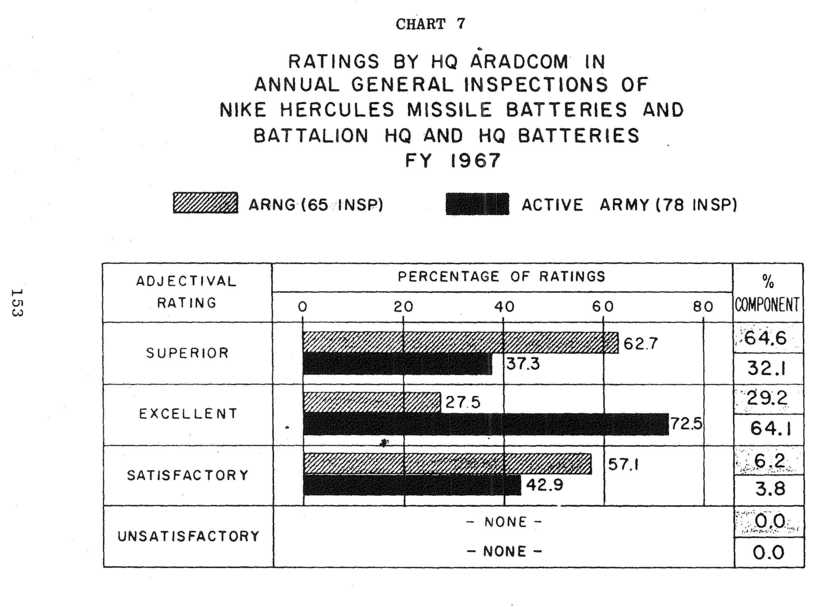
from start of Part II
The Army National Guard
in Air Defense
1951 - 1967 (U)
(ARADCOM HISTORICAL MONOGRAPH ARAD 3 M)
Part I - 8 megabyte .pdf file
Part II - 8 megabyte .pdf file
from Spec 4 Jim Rhodes Dec 2004
Not so quick, Shewokis.
a History Fragment
from Dave Patterson
Dave supplied a URL to his page on the
his page
on the
WSMR "KIDS" web site.
"See text of article--
last photo"
which contained an undated "Army Times" newspaper clipping which he thinks is 1956-1957.
The transfer of multiple Ajax batteries around the country to the
Army National Guard during the late 1950s - the first ones to transfer were
in the Los Angeles Defense Area in September 1958 was a big experiment for
both the Regular Army and the National Guard, one that paid off. The Guard
started assuming operational control of several Hercules batteries in 1963
and retired the last Ajax missiles out of the Norfolk Defense Area in late
1964.
Effectiveness
... Regarding ASP, the NG units simply had very little personnel turnover so
they could really hone their skills. Plus, they had more than one "shift"
so that you had a choice of the best to take to Fort Bliss. They really were good
and in my view this was an ideal use of full time National Guard assets
-- especially during the Vietnam era.
In response to Ed Thelen's question "Do you have comments on the relative
effectiveness of regular army vs. National Guard?".
My understanding about our Wolf Lake site was that if we were to engage in
a shooting war all our National Guard weekend warriors would be activated.
kicked the active Army's ...
From TSGT. JIM SHEWOKIS
ED,
TAKE CARE
AND SLEEP TIGHT,
YOUR AIR GUARD IS ALERT
AND READY ALL OVER THE WORLD
TSGT. JIM SHEWOKIS
103 F.W A10A CREW CHIEF
A salute to the 17 states whose Army National Guard
units served The Air Defense of America.
On guard in Chicago, a radar-directed 120 mm anti-aircraft gun crew swings into
action during a mock air raid
... six pages unscannable ...
It appears that the National Guards of the following
states participated in the Nike program. They were
California,
Connecticut,
Hawaii,
Illinois,
Maryland,
Massachusetts,
Michigan,
Missouri,
New Jersey,
New York,
Ohio,
Pennsylvania,
Rhode Island,
Virginia,
Washington,
Wisconsin,
and ???? [can't read it]
How the Guard was called upon for a new mission.
Defending Washington, a 120 mm anti-aircraft gun crew stages a gun drill in 1956, a
year when missiles were already taking over.
... last page unscannable ...
I dont know if this is the kind of information you want but here goes:
M/SGT Retired
Nike guard units were fulltime
From John McGrath
Just read your letter from the NYC based retired MSG ARNG.
understated the contribution
From John J. Federico, Jr.
Ed,
Full time Army National Guard Technician
From Charles Ross Site S-03,
Seattle, Washington, 3/61-12/62
I was a full time Army National Guard Technician. We manned
the site full time and trained the National Guard one weekend a month and 2
weeks per year. We provided minimal manning 3 weeks per month and pulled
alert duty one week per month.
Forming a Nike National Guard Unit
From Paul Presta
> Nike site: Oxford, Ohio, B Btry, 1Bn, 136th Arty (Ohio NG)
> Date from: 10/63 to 3/65
> comments: As Unit AST, helped Capt recruit a Ohio National
> Guard unit that assumed control of Oxford Nike site from Active Army
Hot Stuff? - Rivalry?
From: Dallas Foster
> Thanks Ed,
> ... It was a good program for the NG and we did a "Super" job.
> The regulars could not touch us. Keep up the good work.
> Dallas Foster

OOOHH - OOOHH -
    Sounds like the U.S. Marines vs the rest of us   ;-))

I thought we (Regular Army) were pretty hot stuff in 1955-56
Lazy?
From: Larry Croll - Dec 2017
At the end (my tour of duty), there were EXACTLY four Nike Hercules sites in southern NJ,
two RA and two NG. I am positive of this because the life of a radar operator was 24 hours
on followed by 24 hours off. The key was that each battery was scheduled to be "Hot"
(the hard core 24/7 duty) for only one of four weeks as the HOT duty rotated across all four site
(on the other three weeks you could go home in the afternoon subject to 30 minute recall if the alert status changed).
Last updated Dec, 2017
