Proposed format:
- Descriptive Story Name
- Author's name and e-mail address
- Approximate location and date of events
- The tale - Remember the point, the audience, and that we are not paid by the word
Also see Nike Technical Stories
The Ft. Hancock web site has some oral histories.
Listed usually most recently arrived at the top (near this point) until a better organization makes itself evident.
Click on high-lighted name to send e-mail to that person.
Table of Contents
Bristol RI Nike site
from Bill Shaw - July 7, 2020
Bill runs this Nike Web Site - Local Copy of Bill's techie material
|
Hi all
Here is what I can remember about our Bristol, RI Nike site...good bad and SCARY. First, the almost scary. Back when we were Ajax missile in the launcher area pits they were running a drill and the the crew was raising a missile up thru the outer doors from the pits to put on a topside rail and the Ajax was on the way up and the doors did not open. Something apparently happened to the safety swiitches to prevent this happening. No-one hurt but the missile was destroyed. Second case was with our big (nuc)Hercules when we in the IFC area got the word something bad happened in the launcher area. There was a fire in the Herc's battery section. Apparently they got it out ok because we never heard any more except all better Both times the missles were sent back to the Letterkenny Arsenal (?) Third case was when I was in the launcher area on a tour of what was going on there (never been down there before) and all of a sudden word came down to clear the area and get the hell out of there. Apparently the Corps of Engineers(?) was modifing some Ajax topside and at the same time in NJ was when the Ajax blew up killing several people and destroying several missiles. They were doing the same modifications the COE crew were doing in our own LA area. The word came down then any modification on any bird would be behind a dirt burm and no other missile would be topside at the time. Don't know how true it is but we heard it was because someone did something to the primacord connecting the 3 Ajax warheads. During the Cuban Crises all us people that lived off-post with our families were ordered on post for the duration. I came very close to a courts marshall when this happened. I had just moved into my own room in the barracks and tossed my stuff in a corner when I got word that the computer in the BC van was down. I remember rushing back up the hill and was buried in a computer bay when some warrant officer who was the OD told me to get back down the hill and (right in my face) told me to get back down and straighten out my room now. I flatly told him the priority was here on the hill NOT the barracks. One word led to another and he was going to report me to the BC. End result was he got his butt chewed and he was told where the priorities were. Our first BCO was Lt Leggett who helped us in many ways. There were 3 Naval stations just south of us, Quonset being one that had one huge scrap yard. We use to get much good stuff from them whenever we sent a crew to scrounge. Best time was on a Friday before lunch. We had super cooks on our site but bar none the Navy chow was the best. Shrimp etc all you could eat. Back to Lt Leggett. He had scronged (2) 20 ft small house trailers from the Navy that we made a small NCO club out of (seen on one of my website pages) At this time no was allowed in the NCO club but us NCOs except at our yearly super clam bakes when all would attend . I often wondered what happened to the club after I left in 1963 as no-one knew. Then someone spilled the beans (and this does surprise me because no civilian was allowed in either the LA or IFC area without proper authorization. The gov security people use to sneak someone in to plant a "gadget" but never got away with it during my 9 years there. Anyway as the story goes after I left in 1963 apparantly some lower EM were sneaking a few Brown Universary girls for a party. One of the girls was a RI State Senator's daughter and he found out and that was the end of our old NCO club we had after 1963. During the Cuban Crisis some Bristol local kids would throw firecrackers over our IFC area fence in the middle of the night. Darnn lucky they were not shot because we had to carry a weapon full loaded at all times. One of our 2 crew chiefs a SGT came up with a bright idea to light up the inside of the fence to prevent this. Thanks to the BCO we had at the time, (and me only a SP6) convinced the BCO to light up the outside and clear away back some 50 feet all the woods and bushes. I don't taking any credit but it did work. Last story. Originally right out of high school in 1954 I was always interested in nuc energy so decided to join up and get the schooling I wanted for free. The inlisting NCO here in nearby Canandaigua, NY told me that the nuc shool had alreay started and I would have to wait for another year to get it. So decided for the next best thing ..Schooled at Ft Bliss. All total got quite a bit .. Ajax, Herc and FUIF (SAGE) Many of our old crew I still remain in contact with including old Battery Commanders and enlisted folks. Just a bit of info I can remember now. There is more but maybe later on. Hope I didn't bore you too much Bill Shaw Later
The last 3 months or so was pure hell as the only 2 radar mechanics (a guy by the name of Peter Thomas,
a super CWO Schultz and myself and we all took care of all the (HIPAR,FUIF computers and the radars plus
the inner area (IFC,LA) radios that were there in case phone lines were down.
|
(The other side - not Nike) Soviet S-75
from Thomas Wiegleb - July 25
|
Hi Ed,
even if you may not answer the Thank You, let me express my respect for your work descibing almost everything about the Hercules thing. I'm interisted in learning and understanding how the folks on the other side of the Iron wall made the things working. From 1981-1990 I had served as a technician on the soviet made S-75 on and the the modern Patriot like S-300 SAM-airdefensesystem. It was the only one introduced into the airdefense system of the NVA (army of the former GDR).
Please do not call it East Germany or Russian occcupied zone of Germay.
This would not the repect the poeples work and life when the tried to
keep peace on earth (against incomeing western aggressors, you know) ;-).
Good luck
|
German Duty Vs USA Duty
from Rocky Stovall rcstov44@hotmail.com - updated July 7, 2018
|
ED:
We each had our individual weapons plus one 50cal machine gun per section. It seemed like we handled our weapons as much as the Missiles, we were always pulling guard and training to defend and protect the Item in transport. We trained to destroy the missiles if need be, we had shape charges and detonators stored in a bunker in the Launcher area. I was one of the Drivers in my section and assigned a 5ton, there was times I would be dispatched on the truck several days in a row. At one time I was the only qualified driver in our section. I was also the Generator operator. I was trained on the 300-gallon Fire water trailer. All the drivers in the unit was qualified on all vehicles, with the exception of the 5ton Wrecker and the Fuel Truck. As for the launcher crew, my Job was crewman 4. I pulled duty driver most times my section was hot (24-hour duty). We had three shifts, each section pulled a 24-hour shift, then off 24-hours and the third day is an eight-hour regular duty day, no guard duty and no duty driver. The 24hour section supplied all the Guards and duty driver and Generator operators. Each section works in their own section. We did the other stuff too, all the scraping and painting, and we had a lot of it. There were earthen berms that runs from south east of the storage barn around the west side north to the access road. There was a shorter berm on the east side of the section that ran from the accesses road south about 75 yards, inside this berm is the Panel room, which has where the Launcher Control Panel (LCP) is located. Charlie section is South of Bravo with a field between section and it’s the same for Alfa which is north of Bravo. Motor Pool personnel would use a brush hog to mow the fields, but the berms were the responsibility of each section. At first, we used hand weed cutters, those things you swing back and forth, then the Platoon Lieutenant got permission to use gas push mowers, but first, Maintainece had put spark arresters over the mufflers. They worked better but was still very hard to us on the sides of the berm. We would start at the top and push them down, then drag them back up and push them down again. A lot of wasted motion there. Then some one thought of using two lengths of rope, tie one to the handle and the other to the front of the mower, then two guys would pull on the rope from on top of the berm to hold the mower emplace while the third man pushed it along the side of the berm. This worked just fine. We had Five guard post - there would be one in each section, walking the berms or in the corresponding tower. The Gate to the Launcher inclusion area was inside the fence, so there were two guards there, that makes four post and the fifth was the guard on the main gate to the Launcher area and in off duty hours he would become a roving guard. That's the five posts. During alerts we set up a perimeter around the entire Area and each section manned its own sector. That is how we deployed during the Cuban Crisis. There were some nights when my duties as a guard, duty driver and generator operator would interfere with the other. It seemed like I was always on the road to someplace, mostly Bitburg or Spangdahlem, Bahmholder and Kaiserslautern. As duty driver, I had to make shuttle runs to town. And transport personnel to and from the Admin area to the launcher area and make the chow runs and PX runs for the Launcher crew on 24hr duty. Especially when we were the hot Battery, then we would sleep in the sections on the concrete floor. For chow the duty section would relieve us, and we would go eat in the ready room and then back to the sections. The section coming on for the 24-hour shift, would eat morning chow, then load up in the back of a truck and go to the Launcher area to relieve the section coming off duty, and that section would get in the back of the truck and be taken to the Admin Area, and if they wanted chow, they would go directly to the mess hall to eat and was off duty till the next day. Except for the Duty driver, after chow he would clean his truck and top off the fuel and make sure everything is ok with the truck, he would perform an after-operation inspection, if he found any problems he wrote them down on the inspection sheet and turned it into the Motor Pool Sergeant and then he was off. Duty driver was just that, you were the driver for the entire unit. If IFC need some type of equipment from Spang, then you would go get it. YES! I pulled plenty of guard. There were times I had to be replaced on guard because I had to make a run some place. Sometime these runs would go into a big part of the next day. I wasn’t the only one caught those runs, so did several others. Training never stopped, neither did cleaning and painting or digging foxholes. Being in the Army, you know I was trained in the fine ARTS of digging a ditch, so was everyone that went through Basic Training. We had to dig a fox hole, it took us a week to dig that blasted hole, the ground had so much rocks in it you could not dig, the entire sections took turns digging because it was so hard. That fox hole was for the 50cal position. We got’er done. Everyday we used some part of our TA-50, in the winter especially. For me duty in Germany was one challenge after the other and when I look back at it, I wonder how we completed so much in one day, every day was busy, yes, we had our breaks. We had so much to do each and every day. In 62 we loaded everything on wheels and was ready to move to the field when it snowed, and they cancelled the move, so we had the practice of setting everything up again and we were operational that night. October of 62 brought home why we were there. We lived those days in the sections, our Missiles ready, just need to final checks and fire. We could put the first one up in less the 3min. We manned our own section of the perimeter. We rotated two on and four off and climbed into our sleeping bags on the side of the hill. It was the coldest October in decades. The only place to warm up was inside the panel room. Defcon 3 came and the missiles was ready to erect. Then Defcon 2 and the Missiles was armed and raised. And we knew war was inevitable. In Dec. 22, 1962 I went home on emergency leave, then received a compassionate reassignment. I was assigned to a unit in Calif. A-1-56 Brea. On top of the Puente Hills. When I arrived I noticed the lack of Military Vehicles. The unit was an underground site. There were three sections, no Generators in the sections, there was four Launchers and Six Hercules and one elevators in each section. They had 1 pick-up, one 2-1/2-ton truck one window van and one 2ton flatbed truck. The next day I drew my TA50 and drew a M14. We never used the TA50 and went to a Police indoor range to fire, one time. Except for the checks and maintainece on the Missiles and rails, nothing was the same. TA50 - was the field equipment you were issued every time you arrived at a new unit. It depended on where the unit was on what you would get issued - in Germany, along with the basic TA50, we had cold weather gear, parkas w/liner, thermal boots, wool shirts and field trousers w/liner, winter gloves w/liners - In California, TA50 did not have any of these items. The basic TA50 consisted of - shelter half, trencher tool, Tent pegs and rope, web belt w/ two ammo pouches, first aid kit, Bayonet, Rifle, sleeping bag and air mattress. As for Guard Duty, we had two posts when the MP’s and their dogs wasn’t working. We didn’t have MP’s and Dogs in Germany. There was only one Guard on the Launcher Exclusion Area Gate and one Roving Post on weekends and off duty hours. The Roving Guard walked his post around the exclusion area on the outside of the fence. We walked the fence during the day hours, 0700 – 1900, then the MP’s and their Dogs would take over. I didn’t catch guard often, we had KP and I didn’t catch that often either. We did have more PT – Every morning - then we did in Germany. Duty driver was from the HQ platoon. I don’t think they had a machine gun, never saw one. The Missile elevator in Bravo section was my responsibility to maintain, other than that we did what all GI's did. Scrape, Clean, Paint. and train. I caught mowing detail twice. Alfa didn’t have Fox holes, we never trained to destroy our missiles. Headquarters Platoon supplies a roving Guard in the Administration area and a Guard at the Main Gate. CQ was drawn from the E-5’s and E-6’s in the unit and SP-4’s was CQ Runners. Both Units had outstanding personnel, men that knew their jobs and performed them as best as anyone could. I did liked Alfa, I had some very good friends there, I dated and some of my friends married, it was close to home and I was able to spend my Dad's last weeks with him. I had my moments good and bad in both units. I didn't get along with all my fellow Nike men but, we came together as one when the siren sounded. I got to thinking about both units and how different they were, and that got me to wondering if anyone else felt the same as I did. In Germany I had so much more responsibility. And I wasn't alone, we all had more to do. The Guys I served with at Alfa never raised a missile without supervision, only one below E-5 in Grade could confirm commands sent to a missile, at Delta everyone new and did raise a Missile just so IFC could send commands to it. At Alfa I can remember only one time we were put on alert and had to put on the TA-50 and form ranks outside the Barracks. Then we reported to our Sections. It lasted about an hour. In Germany, I can’t count all the time we were in full combat gear. There was a few at Alfa that served overseas and had much more responsibility in their former units. In Calif. we did interact with the community more than we did in Germany. When I arrived and had time in my new unit, I realized I knew more than they did, but that was because we did more in Germany. The men I worked with at Alfa was as Knowledgeable as any I had the pleasure to serve with, when it came to the Missiles and performing drills. I was disappointed. I was used to doing more and wanted to do more and show what I could do. Like I said, is there anyone that felt the same as I did? Was it that way with everyone who served overseas and transferred to a stateside unit? Rocky Stovall SFC Retired |
Tales from Korea from Rigney, Roger - Oct 4, 2017
|
I remember walking guard duty in the Maximum Security Area one night and The other guard
and myself ( this post required two persons ) had stopped at the gate to speak with the
dog handler , who walked around just outside the MSA . As we spoke I put my hand through
the gate , the dog handler told me that the dog may chew my hand off . I replied that
I was not afraid of the dog . I unlocked the gate and stepped through and began petting
the dog . I told the handler I would walk the dog around the MSA if he would hand me
the leash , He did , and around we went . As we approached the handler on the way back
I reached down and petted the dog on the head and said "watch him boy " , the dog
growled at his own handler . Needless to say I never got to walk that dog again .
Sometime in summer of 1967 , First Sgt approached me and asked if I would drive down to another battery ( I think it was C Battery ) and deliver one of our generators , They were on "hot status" , and their generators had failed . I told him I would but had no idea how to get there . He said he did not know either , but told me to go to Battalion Headquarters to pick up a man who knew the way , Off I went , four hours to battalion , picked up a man , and drove all night over some of the roughest roads one could imagine , arriving at the battery about 7 am the next morning . I located the supply sgt and he signed for the generator . We ate breakfast and took about an hour break before heading back to battalion to drop off the other man . When I finally arrived back at my battery , just as I drove in the First Sgt came out to meet me with " Where is that generator ? " I told him I had delivered it as I was supposed to . He asked if I had the log book and if I got a signature for it . I showed him the book with supply sgt signature , and then he told me the generator was on the black market before I arrived back at my unit . I never heard any more about it , but suppose that had I not gotten that signature I would still be paying for that generator .
|
Guard Duty - from Rocky Stovall - June 7, 2017
|
I read a short story in your web site under the heading of Security. A solder talked of pulling guard duty in Germany on a Nike site ( Ajax I believe) with an empty Carbine. It made me think of what solders seam to hate most. I have been to many post and had many jobs while serving my country in the US Army. I was a Missileman, Infantryman, Operations NCOIC, NBC NCO, Motor Pool NCOIC and Food service NCOIC.
I guess what I’m trying to say is – the two things solders hate most is – KP and GUARD DUTY! In all my years especially my peon yrs -E-1 thur E-4 those is what I disliked the most and so did the men I served with, KP being the worse. In basic at Ft Ord I pulled my share of Guard Duty and there we didn’t have ammo either but from there on , even at Ft Bliss I was never on Guard that I didn’t have Ammo. I guess the key word here would be Hercules. And of corse the year, He was pulling guard in 57 I believe and I started in 61, In Germany I walked my or manned my post with my magazine in my weapon, I know it wasn’t supposed to be in the weapon but we didn’t want to fumble for it if needed, we didn’t have one in the chamber. One night I was on post #1 – a roving guard in the Launcher area. The siren went off – we were having an ORE while I was on Guard. The other sections and departments not on duty or performing checks and being evaluated set up a defensive perimeter. ( they did not have ammo) As I made my rounds I checked in with a machine gun position – at that time what I thought was a very dumb move by and NCO that was approaching our location and was challenged by one of the gun crewman, he failed to halt and so did his companion, he was challenged again and again failed to halt, a third time same results. So the ranking solder a SP-5 put them in the prone position and to my surprise they complied. This is when the dumb came in – the NCO started to reach for a 45 on his side when told to halt again he didn’t so that is when I locked a loaded my weapon and informed him I have a loaded weapon and I would fire if he touched his weapon, he froze. As I moved closer and the SP-5 unarmed him I recognized him – oh ya , it was night and pitch black. So I would not have shot him ( I think) ?? Later after coming off Guard Duty and back in the Guard House I met one of the men that was approaching, the second SSGT that was out there and when I told him that I did load my weapon and would have fired if the other SSGT had touched his weapon – He turned PALE. Another time I was on Gate Guard at post # 2 ( gate to the Launching Sections) the Guard shack sets inside the fence so there was always two Guards, the guy with me was from another section and I always thought he was sluff off, both of us was SP-4’s so he would not listen to me and I really didn’t care, not that night, I was as sick as a dog and did everything I could to stay warm and kick the flu. I happened to look out the window and saw someone beyond the fence at the edge of the woods and then duck quickly behind the trees, I told the man with me I saw someone and he said I was crazy and when I told him I was going to call post #3 – the only other post that had a view of that section of woods - I thought he was going to try and stop me but before he could the field phone rang and it was England on post 3 – he ask if I saw some guy at the edge of the woods and I said I did and to hang up and I’ll call the SGT of the Guard but he was already on and said the react force was on the way. WE ALL HAD AMMO The next day after being relieved we were told by our CO that our BN was hit by a security check by CID and we was the only unit that was not penetrated. England and I talked about it and he said he had just reached the back side of his section and saw the man just duck in the woods and I just looked up and saw him, WE WERE LUCKY Another time one of our guys was going into the Sections to perform a check without and escort and when told he couldn’t enter he went around the fence line and climbed the fence when ordered to halt by the tower guard he refused and the guard fired a round over his head and held him at gun point until the react force got there. Don’t what the solder was thinking. I walked guard during ice and snow storms during rain storms and yes when it was lightening so bad it was like day light, when I had the flu, in the desert at a 100 degrees, in sand storms, in the fog when you couldn’t see before you a foot. I pulled guard in Germany during the Cuban Crisis and then had to man the perimeter on frozen ground with the wind blowing up the mountain, it was so cold we couldn’t pitch tents so we slept on the ground in our sleeping bags fully clothed and didn’t even blow our mattresses up. We were there for the entire crisis. I was at Brea, Ca on Gate Guard to the Launcher Area when President Kennedy was shot. I wasn’t alone of corse, there were many that went though the same things I did and at the same times and places. There is always something special, the people you serve with. SFC Rocky Stovall USAR |
Nuke Delivery and mobility - from Rocky Stovall - Feb 25, 2017
|
Thank for the quick reply. D-4-6 IFC, Admin and Barracks was about 1 K east of Neuheilenbach and the Launch area was about 2 K's west of Town - East of us is Balesfeld and Burbach was farther east. We had both Ajax and Hercules - our Hercs had both HE and Nuclear war heads. We had three sections in the launch area and when we were on 15 min we slept in the guard house and our food was hauled in into us and in Murmite cans. bad way to eat. When we were on 5 min status we slept in our sleeping bags in the sections panel room, on concrete , we would be relived to go eat.
We would have many drills , ORI's, ORE's, OPS Checks and just plain old IG Inspections, but only once did we get Blazing Skies. That's another story. David Tincher's account of mobilizing a Nike unit brought back memories, not great memories. Our unit had four Ajax and six Hercules Missiles per section so thats 12 Ajax and 18 Hercules . How would you like to take them out for a drive, In 1962 we got our orders to load up and move out and we did, of sorts , unlike C-5-6 we had all that was needed to be mobile. Oh right - transportable - we did work through the night and still pull out tour of guard duty. We were ready to pull out and head to the field when it started to snow. This was the first time I know off that a WAR was called off for a 1/2 inch of SNOW. It was a disappointment , a lot of work for nothing. We never made it to our training area so I can't say what it was like but David's rendition seams the norm for that. Maybe I should have started from the beginning. ... in May after I turned 17 - that's when I enlisted into the Army and I wanted to go to Europe, so I enlisted as Europe unassigned . I did ask for Combat Engineers , so after Basic at Ft Ord I had orders to report to Ft Leonard Wood, MO . but that was changed and my new orders was to Ft Bliss. So I trained in the IFC on the Acquisition, MTR, TTR and the computer - I did good - when I arrived at D-4-6. I was transferred to the Launching area. OH JOY. The Unit was new and still trying to get their Nuclear Warheads so that meant every body from BN to DOD to NATO was there and most of them put the unit through HELL. For every time we didn't pass an evaluation then we would start all over again. As for me I pulled KP three weeks in a row and when my Secret Clearance came I then pulled guard ,but by this time the unit was on the verge of winning their Nuke status , and boy was that great . I started training on my new job in earnest. After that I really enjoyed most of what I was doing. I didn't like Guard and we had Civilian KP's a few months later . I was trained as crewman 4 and trained also at the Fire Control Panel. By the time I was transferred to the States I qualified and I was the generator operator , we had two 60 cycle 45kw generators per section, I Qualified to operate the 400 gal fire trailer, was assigned a Missile, launcher, a set of bogy's, a Hercules Missile Trailer, I had at one time had a 2-1/2 truck , and 4 five ton trucks - well lets say anything on wheels I was responsible for the 1st echelon and that was because all our old timers rotated back to the states and none of their replacements were qualified . The reason for that is another story. Lets just say The new NCOIC and his assistant for B Section was a major problem. I had a lot of responsibilities in Germany. State Side LA-29 was a deferent animal. Start off I got on the wrong side of the platoon Sargent and I paid for it. Some was my fault but a lot was the his. Back to way I emailed you. I understand what Doyle Piland is saying but I trained extensible in transporting an Item and he's right there is a lot to moving one and procedures that must be followed. However when we received our warheads the convoys was very unremarkable . Moving an Item by the regulations does mean you will not only have vehicles that are well maintained and well armed and every person on the convoy is in full combat gear, there are many vehicles that have nothing in them to confuse anyone from knowing which one was caring the Item, plus a security force to the front about 1/2 mile and another following about the same distance. The ones we got was not moved this way. At LA-29 when we received two Nukes and they were shipped to us in an ordinary 18 wheeler. The drivers had no idea what they were hauling and they picked the load up in Ney York. They didn't say the City's name. What we did in Germany was for show , I'm sure of that. D-4-6 was a NATO site. What I was told is that site was designed to fit the needs of any NATO allies in the event thy should have to man the site. We would have dignitaries' from other Countries to observe our operation. I don't know how many sites was like our but when I arrived I was told we were the only one. Oh ya, when we prepared for movement we loaded Missiles with Nuclear Warheads also. And all our Vehicles and all equipment had to meet the same requirements as they would if they carried just the warhead. State side was kind of boring. There wasn't much to do , the care and upkeep of the section and our personal space. Ops checks and ORI's and ORE's normally would break up the tedium. It also was our time to shine , show higher Command how good we are - I don't care we may not be pals but we were crewmen, team, we worked together to do the best job that can be done and I am very proud to say we were the best. For the time I was at LA-29 A-1-56 , we never failed. If you need more or have any questions please send me an email or you can call 618-315-7425 my cell SFC Rocky Stovall USAR |
Surprise Visit - from Robert F Bohlander - March 27, 2016
|
I’d rather relate a Nike story which is appropriate for today.
After I got out of the Army I joined the NJ National Guard and went to work on NY-94 located at Franklin Lakes, NJ. I was there from 1969 until we closed in 1971. NY-94 was on top of a mountain. I know for you guys in California where you have mountains, our site was on top of a mole hill, but it was still the highest point around. I was on 24 hour duty my first Easter Sunday at the site. I was in the Admin Area on the switchboard shift in our Hq. Building. It was still dark but beginning to get light. I was looking out of the window when I was startled. Coming up the road toward our area from the direction of the IFC was a long line of cars with their headlights on. I had no idea what was happening. I called down to the gate guard to find out. He told me everything was all right, that there was a representative with him to identify all of the people coming onto the site and I should just ignore them and let them go. They all went around behind the Hq. building, where I couldn’t see. After a short while the Sun began to peak over the horizon which gave me enough light to see what was going on. They were all sitting on chairs on our tennis court. It turns out that permission had been given to use our site for a local church to hold their Easter Sun Rise Service. Our location was the first in the area to see the Sun rise and it all seemed quite fitting. An unusual event considering what we were there for.
From NY-56, happy Easter to everyone at SF-88.
Bo |
Language Troubles - from Richard Levine - September 16, 2015
|
I would be willing to bet that the Nike missile will not work for the Turks.
When I went to Ft. Bliss for Nike Herc FCS training, I was held for several months extra since my security clearance did not arrive on time, during which time I assisted in basic electronics training labs for various foreign students. The Turkish students did not get anything out of the training since they could not speak English. During the time they were in class they spent much of their time rapidly thumbing through their dictionaries trying to keep up with the instruction. I always wondered how in the world would they would maintain Nike missile systems. We were also told not to fail them on tests because one of their students failed and was executed for the failure. Ed Thelen (web site "master") here. I remember the Ft. Bliss Electronics School in 1954, required before Nike Fire Control School - Several of us students had radio amateur and/or radio repair backgrounds and sat in the back of the class for several weeks playing 3D tic-tac-toe on paper. Soon things got tougher and we had to pay better attention. One week I got into an argument with the instructor about how to tune up a high frequency transmitter.
Being stuborn, I failed the weekly test and had to go to "DumbDumb" night school,
to "catch-up", for a week. :-((
Richard said: You might add: In contrast, the French students used English translators in the class, who seemed to be very bored because the French understood more of the English language. I used to try to encourage the translators to learn electronics because I thought it would give them a useful skill. They still refused to learn. I agree that these were excellent schools. Another interesting thing about German and Israeli students was that the Germans had very neat uniforms, and marched to and from classes. According to unconfirmed stories, their barracks were very messy. In contrast, the Israeli students walked to and from classes in informal groups. I never went to their barracks to be able to comment on neatness. |
NAMFI Prize
from Larry Rogers - Aug 5, 2014
a link to Ed Thelen's NAMFI adventure
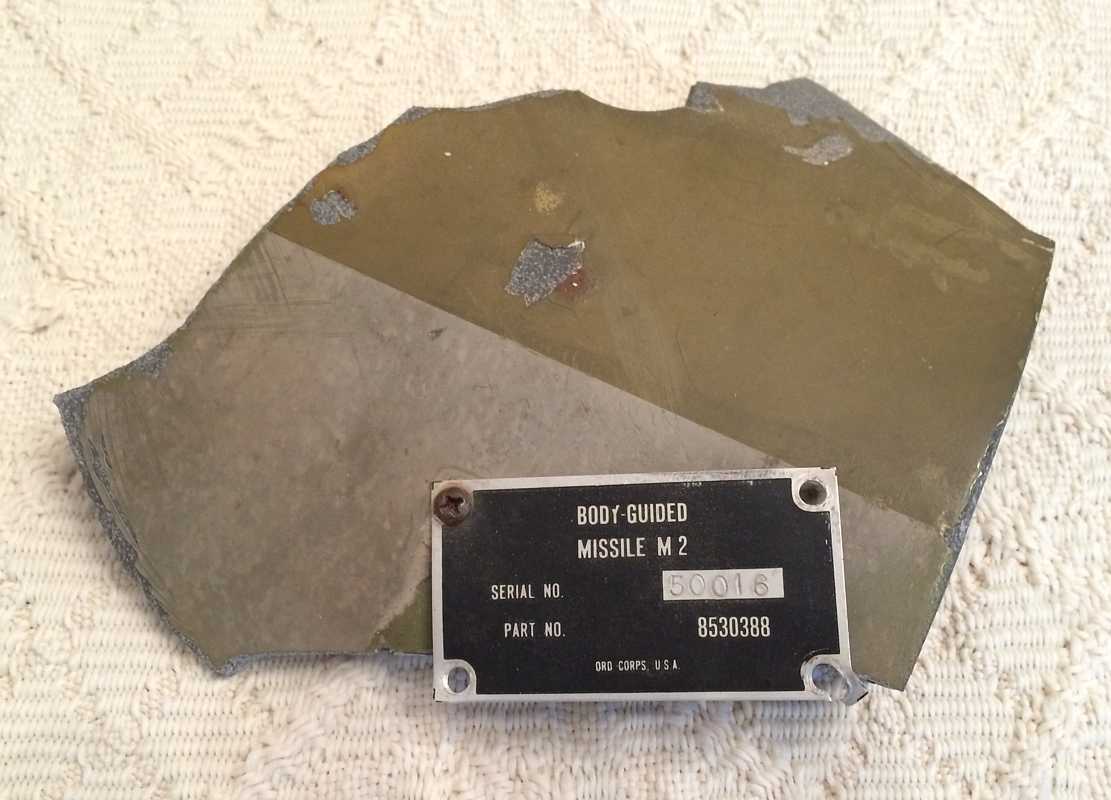
by Larry Rogers I may be the only Battery Control Officer (BCO) ever to hold an actual piece (containing the data plate) of a missile personally fired by that BCO. The story begins in the fall of 1973, as I was a new arrival in Germany, fresh from the Air Defense Officer Basic Course and Nike Hercules Officer Course at Fort Bliss. Charlie Battery had been on a string of Honor Battery performances, and the BC, CPT William Meeker, wanted 1973 to be no exception. Considering that I was fresh out of BCO training at Ft. Bliss, I was named the BCO to travel to Crete for Annual Service Practice. One of my least fond memories of that experience is the plane ride in the cattle section of a C-130, freezing my tush off and remaining deaf for at least two days from the painful sound level in the back of that thing. After we arrived, the quarters were, let's say, not exactly up to Bachelor Officer Quarters, but that's quite fine, as all the men in the unit were in the same boat so to speak. On firing day, the weather was beautiful, and the location simply picturesque. As we arrived on station, the NATO chief evaluator asked our BC, CPT Meeker, if it would be OK for us to fire an old Ajax missile instead of the standard Hercules. It seems NATO had one last Ajax to get rid of and they were under pressure to get rid of this one soon. CPT Meeker asked if I was OK with that, and who was I to get in the way of progress, so I said "Sure, I'll fire that thing" and we all took our positions in the Fire Control van. The exercise started. The Chief evaluator was standing directly behind me, and I was sitting at the Fire Control console. All stations reported "Ready for Action, Sir!" and I turned to the chief evaluator, stating "Ready for action, Sir!". "Charlie, acquire target at Kilo-Echo three-zero eight-zero." I immediately get on the track-ball and move the circular cursor over a radar target at the location reported. "TTR has the target, sir!" reported my target acquisition radar operator. All the appropriate indicators lit up on my console. "Missile ready for action, sir!" reported the launching area. I went back over my training... is this target high enough to meet hostile criteria? Check. Is this target moving in the right direction to meet hostile criteria? Check. Is this target moving fast enough to meet hostile criteria? Check. I turned to the chief evaluator, "Ready to fire sir." The pens on my overhead chart spun into action as they began marking the course of the target on chart paper as the target moved across the sky. "Charlie Battery, engage!" came the command from the chief evaluator. Into my headset, I spoke these familiar words, "About to engage. Five. Four. Three. Two. One," and then I reached across the console to raise the clear plastic cover over the "Fire" button. "Fire" I shouted across the command net. I wasn't sure what to expect. People had told me to expect the ground to shake, but that was for a Hercules, and this was an old Ajax missile. I didn't hear anything. I didn't feel anything. "Abort! Abort!" came the command from behind me. The chief evaluator was talking on his headset to observers downrange, who had noticed that the missile failed to turn toward the target, but instead kept going straight up. We had been trained for this possibility, known as a "moonball" in the Nike community. Instinctively, I reached for the "self destruct" button, but the chief evaluator was already on it. "*&#$," or words to that effect (the chief evaluator was speaking in German, and clearly not happy. He turned and litterally ran for the door of the van and went outside. I later learned that the self destruct command had failed to destroy the missile. Now everyone was worried that it would come down on us! A few minutes later he returned, asking me to "stand the unit down." The exercise was over. Now the question was, would Larry Rogers become the BCO that failed to win Honor Battery status, or a hero? I was worried. Leaving the exercise area in a military van, we noticed a smoldering pile of rubble in a nearby Hawk launching area. That was the final resting place of the last Nike Ajax ever fired in Crete. We got the news the next day that we were invited to a presentation ceremony. It turned out that we scored a 96.5 out of 100 possible points (to this day I can't see where we lost any points, but it is what it is). We had won the coveted Honor Battery status again for Charlie Battery. Just as the ceremony was about to end, the chief evaluator told everyone that a very special award was about to be presented...an award so special that it had never before been awarded. He had a package in hand, and he walked over to me, and handed me the package. Here is what was inside. |
My tour in Korea at Nike Site C-4-44. Dec. 65-Jan. 67
from Al Dietz - March 10, 2014
|
Ed: Well, I wrote a story, reading the book Kimchee days jogged the memory a bit, going through my old slides helped, and reading some of the stuff on this site helped too. It got kind of long, Don’t know if you can use it, but here it is: I was drafted and went into the army in Feb of 1965. Went through basic at Fort Leonard Wood Mo. and went to missile training at Fort Bliss Tex. Vietnam was not going real strong yet at that time and I don't think my Nike Herc MOS (16C10) was needed in Vietnam, that is probably why I did not end up in Vietnam. There were seven of together at Fort Bliss, we got to be good buddies. We all left for Korea Dec 21, 1965 by airplane. We got separated after we got to Korea, with most of us going to different batteries. Two of us went to Charley Battery. I believe we got to Korea Dec 21, same day we left because of the international date line. I remember getting off the plane, I believe it was at Kimpo. first thing I noticed was that the whole country smelled like human waste. No wonder, a lot of it was used on the fields and rice paddies. I remember a long train ride to I don't know where, eventually we got to K-6 or Camp Humphries. That's where the reception station was and where we processed into Korea. Of course we got to the reception station right during the holiday season and all permanent party were only working working half days. What should have only took a few days to a week for processing wound up taking 10 days to two weeks. We would go through one station, then head to the next one and it was after noon and it would be closed down. Nobody seemed overly concerned that we were going through such a long delay before getting to our permanent duty station. The tour was 13 months at that time, so my tour spanned parts of 3 years, 1965, 1966 and 1967. While we were at the reception station I saw the wildest New Year's party in my life at the EM club there. Just about everybody got drunk well before midnight and it was just bedlam. You couldn't even hear the band playing, guys were whooping and hollering and popping champagne corks and they were hitting the ceiling, champagne flying all over the place. The band quit playing and the place was closed down before midnight and everybody had to go home. While at the reception station I met a guy that was out processing to go back to the states. He was going around looking for somebody to buy some MPC from him. There was a rule there that you could not cash in more than a certain amount unless you could prove that you got it legally, I didn't know how he ended up with extra money like this. Turned out he was from Charley battery, the battery that I wound up going to. When I got there I heard some stories about him. seemed that he was a supply sergeant (or maybe a courier) and would make regular runs to K-6 to get supplies etc. On the way through the various villages he was taking orders from koreans for many things from the PX at K-6. They would have to pay him in advance of course. He was making a profit on this of course. His last trip he took a bunch of orders, and money and never returned. The next supply sergeant, his replacement was making his first run and had a bunch of koreans chasing him through the villages as he went through screaming "where's my stuff Sargie?" Of course he had no idea what they were talking about. I don't know if the army ever caught up with him or not. One of the first stories I heard when I got to Charley battery was that they had come within 8 seconds of firing a missile just a few weeks earlier. They had spotted a plane on the radar that they could not identify (possibly because the IFF was not working) They went to battle stations and got missiles ready to go. In the midst of all the excitement one of the seargents from the launching area said to the BCO over the radio: "I'm not familiar with this proceedure, I don't know what to do". They got it straightened out and started the countdown to fire, when it got to 8 seconds they decided that the plane was a friendly plane and called it off. Had they fired it would have been a major international incident. Not too long after I got there my section chief told a story about the first NCO meeting he attended after he got there. NCO meetings were to talk about problems in the battery and what they could do about them. Serious problems. The NCO running the meeting said we got a problem. Those business women in the village are charging us too much money, theyr'e way out of line, we've got to do something about it. I don't know what they did, probably nothing, but It was kind of an eye opening experience to an NCO new to the scene. We normally worked 24 hours on and 24 hours off with 2 crews, one was always up on the hill, the other was down in the admin area. It could get cold in Korea, really cold in winter time. Up on IFC hill it was even colder, and of course there was some severe wind chill too. We had to walk guard duty regularly at night, in the cold, patrolling inside the perimiter of the fence. We had mickey Mouse boots and winter parkas, but it was still cold. One night when the other crew was up on the hill they spotted a slicky boy inside the fence. He ran and they didn't catch him but I think it was kind of a scary wake up call. One night when I was walking guard duty I found a piece of an old cable that had been drug to a hole in the fence. It was cut off there, so I knew a slicky boy had been at work. Those cables had copper in them and were valuable to the Koreans. I reported it to my section chief, he didn't seem to get too excited about it, I don't know what they ever did about it. Nobody ever asked me about it, nobody even asked me to show them where the hole was. The biggest highlight of my tour on the positive side was the visit by president Johnson in October of 1966. I did not get to see him, but one of my buddies from Fort Bliss did. When he left South Korea Johnson made the famous visit to Cam Ranh Bay in Vietnam. The food was not too bad for the most part, quite often we had sour milk in the mess hall, but I just quit drinking milk, lots of guys drank chocolate milk which killed the sour taste somewhat. Rank came fairly fast in Korea, I saw quite a few draftees make E-5 in under two years. I heard that was pretty unusual in other places. I think it was partly because of a shortage of personnel, When promotions came down from Battalion there weren't many guys eligible for them, so almost everybody that had the minimum time in grade to qualify received them. A buddy of mine told the BC that he might reenlist if he got his E-5. They gave it to him a few weeks before he got out of the Army. Actually he had no intention of reenlisting. If we had to go to battalion headquarters (K-6) for a doctor's appointment or something it was a 4 or 5 hour ride in the back of a deuce and a half truck on narrow winding rough dusty dirt roads. About 80 or 100 miles. If one of the security dogs got sick they were flown out by helicopter. I guess they were more important. It seemed that there was always a shortage of something in Korea, including personnel and critical parts for the missile system. Our IFF and TRR did not work for most of the time I was there, maintainence men could not get parts they needed. I believe they did get both of them fixed eventually though. Parts for the vehicles were hard to get too. It was common knowledge that there was a lot of black market activity in Korea. Our section chief told us once that our motor pool sergeant had been using his own money to buy truck parts on the black market to keep the trucks running. I found that a little hard to believe, but probably true. I think we came quite a long ways as a unit during my tour, Charley battery was known as "junkpile Charley" when I got there. We were known for ineptitude and broken down equipment, but we did get the TRR and IFF working and we did very well when we went to Sea Range, scored two hits and got compliments from the evaluaters. My crew fired at a drone, the other crew fired at a simulated target.I think our improvement as a unit was due to good crewmen and good work by our maintainance people. All in all it wasn't a bad tour, we had Korean civilians to do KP, Korean houseboys to clean our barracks and shine our boots. There was no fighting any more so it wasn't bad duty, much better than Vietnam I think We had a fair amount of freedom to go out of the battery area and do some sightseeing etc. My buddy and I went to Japan for a ten day leave. We did have a few tense moments, once we got word that there might be some North Koreans in the area, we doubled our guards for a week or two I believe. No North koreans were ever found though. I remember several times being called to battle stations, and a time or two when we were on "hot" status. (Be ready to fire a missile in 5 minutes.) I remember the incident when 6 North Korean planes flew into South Korea and then back into North Korea in 1966. It was a major international incident, and made headlines back in the states. One of my buddies from Fort Bliss was an acq operator at Foxtrot battery. When we all got together again at the out processing center for going home he told me he was the one who spotted those planes on the acq. Going homr was the best part, When I first went in it seemed that two years was really a long time, when I got down to one year it was all downhill, and I started to think I would survive my tour. Going home was the best part, I have never been back to Korea, but I know there have been huge changes there since 1967. Korea is an economic superpower now, and still growing, more power to them. Al Dietz, scope dope. |
High Water in Alaska - March 2014
from Bob Belli
|
During the summer of 1967, we had a bunch of rain, so much so that the rivers around Fairbanks AK,
flooded. The water came down off the Brooks range into the Tanana river valley. The river that
flows through Fairbanks is the Chena river. It also flows through Ft. Wainwright. Well, it flooded
too. All of Fairbanks and much of Ft. Wainwright were flooded. The water knocked out all vital
services. Water, electric, and sewer were affected. Communications were down, it was a heck of a
mess. We had to scoop buckets of flood water to 'flush' the toilets, but had no drinking water.
Temporary communications were set up using field radios. It was not good. BUT, there were some
funny things that I became involved in and I'd like to relate them in two separate stories.
1st story
2nd story
The first shirt told me to go over the the post (Ft. Wainwright) housing area and pick up this 1st Sgt. and some women dependents and take them to Eielson AFB outside of Fairbanks for some shopping at the BX. So my ass't driver and I set out for the post housing area and a one point on the route, the water had washed out part of a trench that had been dug across the road for some kind of road work. The trench was marked with a saw horse about 20' BEFORE the actual trench, depending on direction of travel. Remember, this entire part of Ft. Wainwright was under about 18" of water! I got to the housing area without any mishaps, loaded the women, about a dozen of them, and the 1st.Sgt. He now was my 'shotgun' rider and my ass't driver was in the back with the women. Everyone back there was having a blast, with food and several pots of coffee. It was a real 'event' for the 'girls'. The 1st Sgt. was one of the guys who had a permanent stick up his butt, if you know the type. We were heading back across post to the Richardson Hwy, and I was coming up the that 'trench' across the road! I remember thinking that the trench was about 20ft. past the sawhorse. What I failed to remember was that I was going in the opposite direction and now the trench was 20' BEFORE the sawhorse, not after. Even though I was only going 10-15 mph (because of the water), I hit that trench HARD. And when I did, the entire back of the truck erupted in screams and laughter. We continued on after being able to holler through the window and found that all were OK. We proceeded to Eielson without further mishap. Once there, I got a chance to talk to my ass't driver. He as laughing as he explained that when I hit that trench, all the women were tossed off the benches they were sitting on. Coffee, and food was flying around. Fortunately no one was injured and no damage done! Even old prune face managed to crack out a smile!! |
Chief Warrant Officer v.s. the Lt - from Chester Beach - August 20, 2013
|
It was I believe sometime in August or maybe September of 1965 and I had only been in Korea
a short while and was assigned to the position of ballistics computer operator. The computer
operators job was, on the surface, not too demanding ...When the siren went off you went
into the van and did a few checks and adjustments and held the overrides for others who were
doing checks and getting their equipment ready to go...You were, at times expected to man
the plotting board that was mounted on the wall directly behind the BCO....
I don't remember how the board was laid out...numbers on the horizontal and letters the vertical perhaps.... Anyway... On that day they were running a battalion wide exercise and I was taking tracks from K-6 through headphones and putting them on the plotting board with my trusty grease pencil. It was my first time on the plotting board and I was definitely a little nervous... There was a lot of noise in the van and the headphones were not the best so I found it difficult to keep up... One particular track came in from the northeast then turned and headed directly east, away from our site. For the sake of my story, we'll call that track alpha one. After the exercise was over I was standing at the board admiring my work when the phone directly to my left rang. I picked it up and yelled into the phone SITE FIVE, just as I was trained to do.... It was K-6....Lieutenant such and such wanted to know why we didn't fire at Alpha one. Alpha one, says the lieutenant, was within your firing sector and you should have fired on that target.....One moment sir, says I, I'll check the board.... Alpha one was out of range says I...WHAT! says he...THERE IS NO WAY THAT TARGET WAS OUT OF RANGE!! I KNOW WERE THAT TARGET WAS! IT WAS IN YOUR SECTOR AND DAMNED WELL WITHIN YOUR RANGE!!! Ok...now I'm starting to get a little scared.... I must have goofed something up real bad... .Let me double check that track, says I.......Alpha one was out of range sir..... You know, I believe swearing is an art form.... Some folks have an natural talent and others must learn it over time.... Now the Lieutenant was apparently a young fellow because the only thing I heard was a lot of spit and sputter.... Nothing of form or substance that one could apply to the situation.... Well.... No one had ever ask ME which target I liked or if I would like to fire a missile at something, or ask my opinion on anything that went on around there.... The Lieutenant was definitely chewing on the wrong GI.... So, I take a look out of the van and into the ready room and the first one I see is.......Mr. Deitz. Now CWO. Deitz was not what you would call a physically large man... He was smallish in stature.... But what Mr. Deitz lack in size he more then made up for with his expertise in all things NIKE.!! There was little he didn't know about everything.... And on top of that, rumor had it, he was the soul owner of a much coveted position on the ARADCOM ORE team back in the States..!! So, needless to say, if you were anywhere in the missile shooting business, sooner or later you would come under Mr. Deitz sphere of influence... Mr. Deitz....this gentleman wishes to speak with you....with that, Mr. Deitz takes the handset and begins to listen.... Soon, eyes begin to bulge.... whiteness around the mouth... redness in the cheeks.... NOW JUST A MINUTE..! YOU CAN’T TALK TO ME LIKE THAT..!! I’M A CHIEF WARRANT OFFICER, YOU WILL APOLOGIZE IMMEDIATELY OR I’LL HAVE YOUR A-- BEFORE SUNDOWN.!!! I had made my exit from the van at the first sign of the coming battle...I moved to the ready room and made myself as small and inconspicuous as possible, vowing to myself that in the future I would avoid that phone whenever possible!! Well... As to what happened to the Lieutenant...There were all kinds of rumors... I don’t think anyone knows for sure... I heard he was forced to present himself in person to Mr. Deitz and provide a very formal apology in writing...But, one thing that may be true. If he was a career man...I’ll bet he steered clear of NIKE sites the rest of his days...... So...I suppose you can say the moral of this story could be....Always take time to be sure which dog it is that your kicking.... Because, it’s not always the biggest dog that has the sharpest teeth..!!! |
True Sport of Kings - from Charles Beach - August 20, 2013
|
It was great fun being stationed at sea range during Annual Service Practice. We had a
front row seat to what someone said was "the true sport of kings"!! Watching all those
missiles go up was pretty amazing!!
Someone on this web site spoke of a helicopter crash.. I was on duty that day and got some photos of the whole thing.!! A small chopper had broken down at our helo pad. After a week or so along comes some fellows with an H-21 of some sort and they hook a sling to the smaller chopper. As they begin their lift, the hook came open! We started waving and jumping up and down in an effort to get their attention, but they just gave us the "adios" and off they went!! They carried the thing right over the launch area, then turned and went over the admin area! The village was next and we knew that wouldn't be good at all! The little chopper held on until it was about 1/2 mile past the village and then let go. You don't have to take my word for it, just ask Lieutenant. S. Hofer, he was there! As were others. The weather stank, and the food was bad but the people I served with at Camp Holladay were some of the finest folk that I ever known.. I remember SFC. R. Sebold, from Penn. Who was kind enough to give a lowly red-neck a chance. |
Nike Hercules from Robert Bethman - Febuary 10, 2013
|
NIKE HERCULES
I was NOT selected by the Draft Lottery. Felt it was *DUTY / GOD / COUNTRY*. So I went and signed up without finishing High School. My mother was in FITS! She was bound and determined to have me classified as the “Sole Surviving Son”. I turned 18 on the First of June. I signed up and got on the Greyhound Bus off to AFEES Center in Montgomery, AL. I signed up as a 91A, Medical Corpsman, with my Basic at Fort Benning, Georgia. I was placed at Harmony Church for training. It was anything but its name. All of us in the late ‘60s remember the whole drill. Testing after getting uniforms and scalp job. The buzz cut didn’t bother me since I already had a flat-top anyway. I received the standard harassment from Drill Sergeants as all have. I had the XO on my left side, and an E7 Drill Sergeant on my right. One yelled in one ear to get down! – meaning of course the front leaning rest position – the other yelling Get up! So the three of us played that game. Others got worse. I spent about 4 years in the Civil Air Patrol – harassment was old hat! I survived through Basic Training. Then was a Hold over as my Clearance was processed. Why? Because Corpsman have access to Medical Records! I was sent to Fort Sam Houston, TX for corpsman training. Next I received orders after AIT, to go across the pond. Did my tour of duty, took GED tests at Education Center, got GED and took CLEP tests, with return to “The World”. This led to getting together with my Jr. High School Sweetheart. It began with letters between us while across the pond. I spent a fair bit of time visiting her in Atlanta, especially since I got sent to Fort Benning once again. I used to donate blood or pawn my watch to pay for bus fare. (Anyone NOT do such things?) February was the month of return. She finally started to come down and pick me up in the ’66 VW Beetle. Now it has come to the end of March. We’ve been talking a lot, and climbed Stone Mountain a time or two. We’ve spent evenings starting discussions. I re-enlist to go Nike, and now discussions are serious! She wants to go with me. She is told that I am making the Military a career, and if that is not what she is prepared for, then it is time to call it off. She agrees, and we tell her Father the next morning at the Breakfast table. He tells us to sleep on it. We were in separate rooms at night. Her father doesn’t know it, but we’ve already gone to the Church and have a date selected. So we tell him again next morning. We also tell him it will be in ten days. You can come or not. He gets on the phone and puts the Wedding together. Ten days later, it is history. We are Husband and Wife. He gives us the ’66 VW for our wedding present. That thing had a 6’ X 9’ U-Haul on the end of it full of everything I owned in a duffle Bag and suitcase – They are in the trunk, and ALL from her Hope Chest that will fit is inside the rest of the car and in the trailer. We approached the Site, saw the large Dome. Kept driving for an hour or so trying to get to it. Worse than a scavenger hunt! So large and yet so distant from us, we finally find the way in. I report to HHC to inform them I am in area. We spent a week or more in the Tonnidale Motel while looking for an apartment. It is complicated since neither of us is 21. Have to get around this. Military ID and Orders helps. Landlady finally accepts, along with Realtor. Second floor walk-up has only a view of the alley. The former tenant was definitely “Hippie type” as there are black and white painted 2 foot squares as you enter. That along with eyebolts in ceiling and floor with jute strung from floor to ceiling. The apartment has a kitchen, living room, bedroom and bathroom. Step up for a Barracks Rat. It is a big step down for newly-wed wife. We commence moving in. I’m still on “leave” and we start to settle. Wedding gifts and the contents of Hope Chest make viable means of cooking. We have electricity, didn’t realize that gas was on. We assumed, (All know what happens when one ASS U MEs!), that a deposit was required. One of first things cooked was Rock Cornish Game Hens that I squashed to fit in the toaster oven wedding gift. We discovered that no deposit was required for gas. So I begin cooking on the stove. I used to make crepes when about 10 or 11, so I know how to cook. Leave time gets cut short, and I begin the 16K OJT in the AADCP. Shift is three days, three nights, and three off. Days are 9 hours long, nights are 15 hours, of course subject to recall. First thing I am to learn and do is plotting behind the huge Plexiglas Board down and in the rear of the “infamous” Blue Room. Two sets of lights on ceiling, one set is normal white fluorescent, the second has the blue plastic sleeves over them to make it blue, floor is blue tile, and the walls are blue. Understand the need for blue when the AN/TSQ-51 scopes are used. They begin with me filling out the requisite clearance papers. It is a royal pain in the rump. Continue plotting and get very proficient at this, I can keep up with the “Lord’s Prayer” as it is spoken or played back from a tape. Have the format down quite well. I am making an impression. Crap – scored 136 on GT while processing at Ft. Benning, and score well across the board. I even scored 496 on the SFQB. I finally start getting time on the scopes. Start to learn how to use, read the display either as pure returns or as the IFF/SIF ones. We are also the feed for the FAA at Greater Pittsburgh Airport. We sometimes turn off the IFF/SIF and track simply by the returns. This is possible without bothering the FAA feed and using just the MTI function. Clearance comes finally and I get more added on. I begin reading all the TSOPs, NORAD documents, and warhead inventories. This is much to absorb, but when I hit the 14 month point the 16K is mine and on the records. Then comes the proficiency test, and guess whom scores higher than some that have been doing this for several years. Now have more money in pay, and the Regulations change to allow an SP4 to live in Quarters. The quarters are directly adjacent to a Battery IFC Area. This is a grand total of 7 homes. Someone screwed the pooch – our quarters are intended for much warmer climate. These are hot as hell in summer and cold as Alaska in winter. I placed a sealed bid at HHC for an 18K BTU A/C window unit. We got it for $75. Facilities Engineers put in a 220VAC receptacle. Life is getting better! The AADCP has movies in 16mm so we get the movies that the Post shows or sees elsewhere. Obligatory training films are also shown, and I get “licensed” for Audio/Visual to make it legal to run. I remember seeing 2001. It had been in theaters while I was off in the jungle and paddies. Amazing what I had missed! I saw some of the Moon landing in Consolidated Club over there. Not a lot, but better than nothing. Stars & Stripes was usual fare and well passed around. Now the wife and I are expecting our first. This issue comes to the forefront when the gas furnace in quarters craps out. I have to go to the IG to get it resolved. She is sick with the flu or something, I can’t remember anymore. The IG is as dark as asphalt, and he is reaming out a “brother” over his issues with race. He sent him out to listen to me. He’s NOT done with him yet, but is trying to do for everyone that has the stones to come to him. He’s a Major, and also the S-3. Everyone on a site wears a series of hats. More to be added over time! |
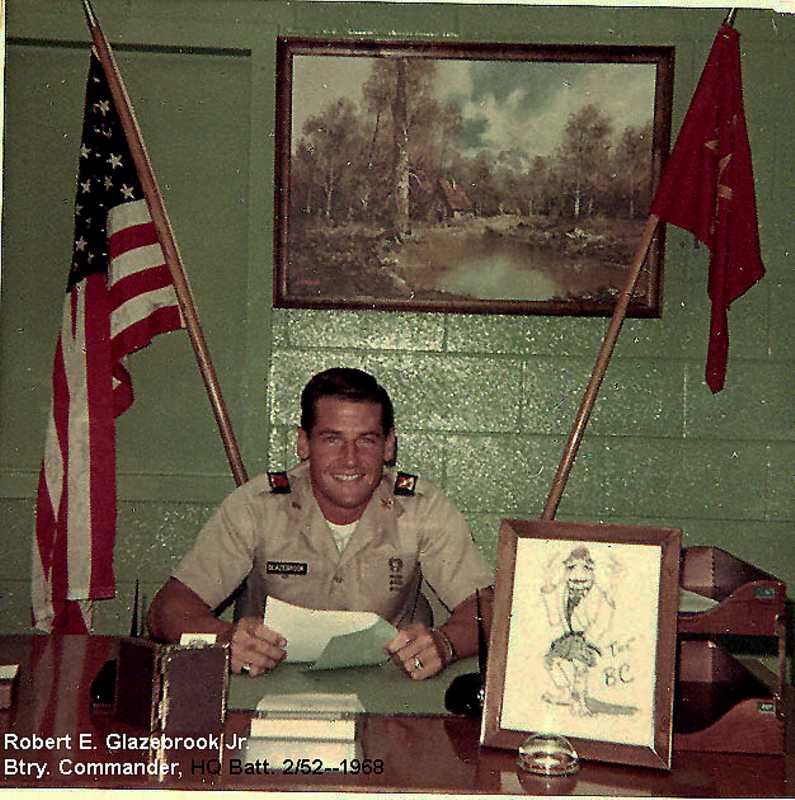
Gold Braid Held at the Gate from Robert Glazebrook April 15, 2012
|
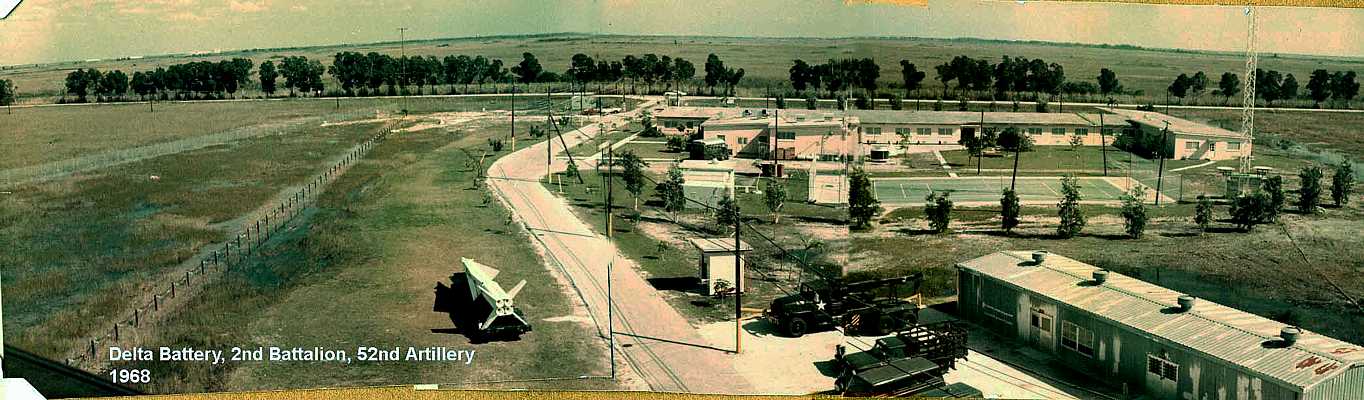
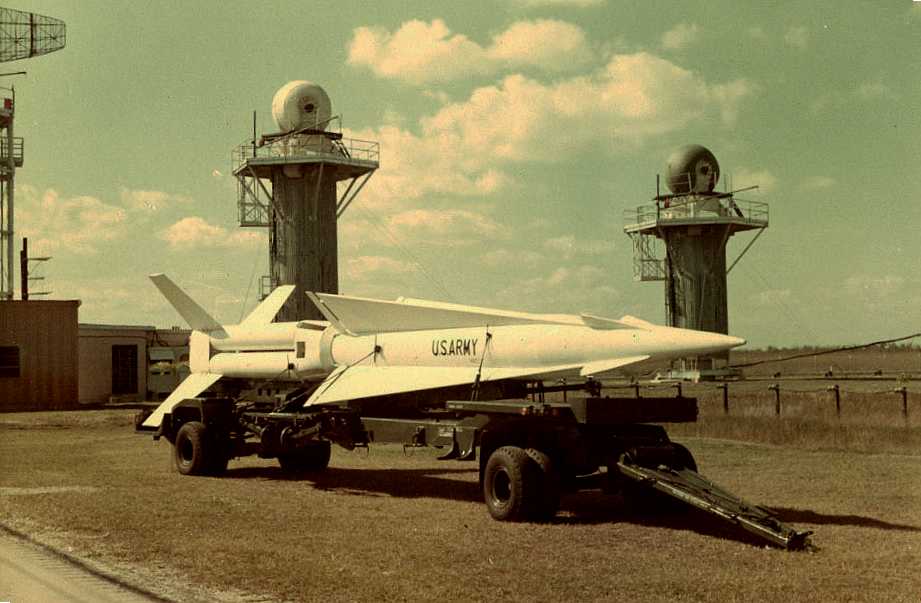
(1967-1969) I was [the HM-95] Battery Commander - 2 miles south of the intersection of Krome Ave.
and the Tamiami (US #41) Trail .
[Answering a question] Warheads were either HE (high explosive------- and useless I always thought------except in a drop shot) BXS ('bout 2-3 KT and BXL ('bout 20 KT). Easy to tell, b/c all nuclear warheads had a red cap on the tip.
Some pictures
[And the story]
One night in '68 at Delta Battery, I was firing officer when the battery was on hot status. I got an urgent call from the guard at the front gate. He sounded in a state of panic. He said: "Sir, this is private xxxxx and you better get out here right away!" I grabbed the .45 and ran there only to be faced with an extremely pissed Army full bird who was threatening the PFC for refusing to let him in the gate. After a brief conversation, where I politely explained that he was NOT on my assess roster and he needed to go away, he threatened to court martial me. Now, I was not a career officer. I just wanted to serve my country for a couple years. So, bottom line, is he going to ruin my career? What career? When he ignored my suggestion to leave and walked to the gate, I drew the .45 and said: "Private, chamber a round." Which he did as he raised the M 1 carbine up to the Colonel's chest. The two officers (I could see the gold braid) with him both dove into the back seat of the car and the sergeant they had driving just rolled to his right and out of view. This colonel immediately raised his hands and said: "I'm CID! For God's sakes don't shoot me!!" Now, at that time, I was much more concerned with what the two guys in the back seat might come up with. I'd had a 1911 A-1 since I was a kid and had fired thousands of rounds thru it. At ROTC boot camp, (Ft. Riley), I was only 4th with a rifle, but I was 1st of 1,632 with a .45---so I figured I could easily kill the colonel and get one or two of the other three. So I cocked the .45 and brought it up as far as the zipper on his khaki's. As he saw me looking past him towards the others he yelled: " EVERYONE! STAND DOWN !STAND DOWN!" I couldn't see their heads anymore. The "colonel" then said: "Lieutenant, I can prove who I am. I'm just going to reach into my shirt pocket here get my ID. OK?" And then---------without my permission--------------he reached for his pocket. As he did that, I raised the .45 to his chest and raised his hands again and said: "God Damn it Lieutenant! Could you NOT DO THAT! Could you and your private just not point your weapons directly at me." (He was probably wondering if that M 1 carbine was actually an M 2-----------------and he was about a 5 lb. trigger pull away from 20 rounds at point blank range from a very nervous 18 year old PFC.) I said: "Sir. One more time. Leave!" Which they did. I remember looking at the PFC and he was pouring sweat. And still staring and pointing his carbine at where those guys had been. And I thought: "Oh-OH". So I moved further back on his left side and said something like: "Good job Private. Now hand me the weapon." The Battalion Commander (Colonel Hicks) later told me that the guy really was CID. I remember thinking that I could have probably found him again that night at the first bar south (direction they headed) of the battery and ------the CID almost had a vacancy for a bird colonel slot. Robert Glazebrook Palmetto Bay, Florida |
Hidden in a Museum from Bud Harriss April 14, 2012
|
I (Ed Thelen) was at C-41 until 1957, less than a mile away from this museum - reputed to be
HQ of 5th Army and also our ineffective Nike HQ which was incapable of even properly
inspecting our air filters :-(( I visited the Museum often, being a museum geek even then,
but had no curiosity about any Army unit in there !!!
I was rotated from the Far East Command in summer 1956, after service in the Korean War as a forward observer with a field artillery outfit, and later duty in Kyushu as CO of a 90mm Gun Battery in defense of Itazuke AFB. In summer of 1956 received duty assignment to the 514th AAA Operations Det, Chicago, Ill. This unit was stationed in the basement of the Museum of Science & Industry, and all our personnel were able to freely use the Museum snackbar as a messhall. (Everyone had a key to a special door in the woodworking exhibit.) The control center operated in a semi-darkened room, with an edge-lighted plexiglas board showing a bare outline of the operational area. Entries on the board were made by soldiers standing back of the board, writing backwards (Try it in a mirror) in colored grease pencil. This was prior to the placement of the submarine U-505. In mid 1957 we moved to a new site at Arlington Heights and were advised that a brandnew plexiglas control board was being shipped to us by rail, and when it arrived I took two soldiers with me in a closed truck to the railyard to collect our treasure in kit form. With help from the local phone company, we put the board together piece by piece, had it operational in two days and conducted system-wide drills. That was probably my high-water experience in the Stateside Army, and I did receive a commendation for the effort, which I shared with my soldiers. The 45th ADA Headquarters commander was BGen Peter Schmick. He reported to MGen Cardwell, Brigade CG, who was stationed at FT Sheridan. |
A Lesson Learned, from Norman Paik, Jan 6, 2012
|
Norm reminded me that when we graduated from Nike IFC school in 1955, we lower ranks were promoted to
corporal. Then we spent a two months at Ft. Bliss in packaged firing batteries practicing our new trainning,
fired three Ajax
missiles at RCATs at Red Canyon, and then went to help install our new equipment at various cities around the U.S.
(Norm went to the wilds of Hanford, Washington, I went to the wilds of downtown Chicago, Illinois.)
The following story, appearing in the December 2011 "IEEE Life Member's Newslettter" reminded Norm of one of his early Nike adventures. In his battery at Ft. Bliss, the three IFC "mechanics" were all newly minted corporals (making $99/month). The Army Table of Organization & Equipment ( TO&E ) said that a battery could have the three "mechanics" in the IFC, and that one could be a sergeant. Apparently Norm pulled off a stunt similar to below, and the battery commander quickly promoted Norm to that open sergeant slot. Rather unusual for a corporal with two months time in grade ;-)) I'm guessing that Norm's stunt involved Zero Set Switches, as he has a special fondness for them ;-))
A Lesson Learnedfrom December 2011 "IEEE Life Member's Newsleter"When assigned as the site engineer in Tin City, Alaska, early in my career in electronics, I was told by the site commander that, "If it uses electricity, it is your responsibility to keep it in running condition." While I had many opportunities to remember that challenge with fire alarm systems, homing beacons, radios, power distribution, and the site radar, one problem stands out in my memory because of the lesson learned. As part of the radar system, there were a number of planned position indicators (PPIs), which provided the operators with a visual of what was being detected by the radar. The radar system was part of the Distant Early Warning (DEW) Line, the radar fence that looked over the North Pole toward the Soviet Union, trying to detect any offensive moves by the Soviets. One day I was called to the operations room to look at a failing PPI. When you looked at the sweep, it looked like a snake wiggling from the center of the picture to the outer edge. lf you changed range scales, to see a more precise view at shorter ranges. It almost looked like jamming from an outside source. Fortunately, since none of the other PPI units were displaying similar results, I determined that I had a problem in the unit. We had a number of spare units, so taking this one offline did not present a problem. Over a period of three days, typically 12-14 hours a day, I worked on the unit. I checked power supplies, filters, and strobe generators among others, but no failing unit or part could be found. I was about ready to give up when I thought about the high-voltage power supply that was used in the PPI display tube much like early versions of television sets-high voltage used as the target for the electron beam drawing the screen images. Much to my delight, I found an inductor shorted in the output of the unit, where its function was to act as a filter for the high harmonics used in the power supply. Problem solved! When my assignment in Alaska was complete, I was reassigned to a radar site in Manassas, Virginia. On my first day as part of my walk-around introduction, the communications and electronics (CE) officer and I passed a crowd of airmen gathered around a PPI. As we passed them, I asked, "What seems to be the problem?" They described the problem as - you guessed it - a wavy, snakelike presentation. I looked at them and said, "Replace L1.401. in the high-voltage unit. That will fix the problem." As the CE officer and I walked away, I overheard them talking to one another, "'Who was that? Who does he think he is?" Later in the day I heard the first sergeant telling the CE officer, "I don't know how he knew, but what he told them to do was exactly right." After that day, I could have told them that painting the radar red would increase the operating range and the next day the radar would be painted. Truly a lesson learned!
Kay Floyd, LSM
|
|
I was stationed at LA88 in Chatsworth, California in all of 1965, (Jan thru Dec) as a Fire Control Operator. I lived in Granada Hills in "Leased Housing," which for a SP4 at that time, was like heaven. I lived on Devonshire Avenue, and I remember going to work in the morning, and as I headed west on Devonshire I reach a certain street, then turned north until I got to Highway 118, then turned west again until I got to, I think it was Brown's Canyon Road.
I remember I always had to stop and open the gate, because it was private property, and I always closed and locked after I got in. Every once in awhile we would get stopped by the old fella that owned the property. He told us his name was Jess (he dressed and looked just like Jed Clampett on the Beverly Hillbillies) and he made it very clear, if we didn't close and lock that gate, there would be severe consequences, Why? Well, it seems as though he had a whole bunch of livestock that roamed the property (mainly cows, I think), and he told us the first time he loses a one of his animals the Army will pay dearly for it. Needless to say, we always made sure the gate was closed and locked behind us, both coming in and going out. After a few months we got to be pretty good friends with ol' Jess and he would invite in for a beer every once in awhile. Believe it or not but this guy had a name for every cow, pig, chicken etc; on his property, I couldn't believe that. He told us we could hunt deer on his property if we wanted, during deer season of course, but the one thing he emphasized was, "Make damn sure you shoot at the deer, and not my animals," ha! ha! Ol' Jess drove a 1954 Ford Stationwagon (I think it was) and he had painted it himself, with cans of silver spray paint, ha! ha! I guess it worked for him. Going to work in the morning always required us to stop at the Administration Area for accountability purposes, of course, and the other reason was, the road to the Fire Control Area was a one way road, because it was so narrow. We had to call the Fire Control Area and make sure nobody was coming down, when we were going up. It was sort of a pain in the butt, but it seemed to work out okay in the long run. ... The reason I wrote is because I have often wondered what ever happened to ol' Jess? Is there anybody out there that may be able to tell me. He was just a nice ol' friendly guy. He was a multi-millionaire, but one would never know it by the way he lived and dressed. William M. Sunde, MSG (Ret), Texas |
They were apparently living in abandoned barracks of SF-89
|
I see there's not much on SF-89. I was stationed there pretty much all of 1968. Assuming it's the same site(former Ajax site)-when I was there, Ajax was gone (launch area growing over(I think I read that Ajax stopped in 1963), so we used the combined barracks(upstairs)and downstairs had the 2-man rule shops. We provided warhead support.
We supported sites in the bay area. [My training was:]
-Basic electonics-Redstone Arsenal, Huntsville, AL -Nuclear weapons electronics-Sandia Base, Albequerque, NM -Nike Hercules Weapons Support Section, Presidio, San Francisco, CA When I was there, we (about 5 of us-1 Sgt and the rest SP4's and 5's) lived and worked in this building within a fenced compound. Everyone had his own room, and there were another 5 or so available. In the upstairts living area, the rooms were on the perimeter, leaving a large open area that was probably once rows of open bunkbeds. There was a day room and 2 bathrooms upstairs too. The room was big enough that the Sgt E5 set up a practice range for his hunting bow. Downstairs housed the work areas and office, lunchroom, and bathroom. Downstairs access was a heavy steel door that required two locks be opened. The two man rule was in effect at all times in the workshops. We trained regularly, both disassembly and testing of components. I think the '55G' guys would take the process from opening a M409? container, attach transfer jigs and hardware in order to complete a safe and effective de-coupling of main components. We also tested the test equipment. I seem to remember there being a lot of cleaning solvents in use. Tolulene? Carbon tetrochloride? Strong solvents. I think about once a month? we would load up the van and head to the sites. We would go to the assembly building, where the warhead component testing would be done. I think the assembly guys left and came back when we were done. The old Chev van had a lot of slop in the steering. The motor pool never fixed it properly. I think it needed a steering gearbox, but intead-got packed with heavy grease to slow down the drifts. The Golden Gate bridge could be an adventure, between the fog and the steering issue. One of the Spc5's built a '34 Ford hotrod in his year there. There was a separate lower level outbuilding that stored M409? containers. He got permission to use some of the space to build the car. He drove it out of there at the end of his tour. Andy..??? We had Spc5 join us for a short time from a unit in Italy. We were told-some sort of security issue? The guys wife wanted a divorce so-Maybe he is emotionally unstable? Human reliability? AR611-15? I can't remember the Reg citation. We took our meals down at the HHC 6th Army HQ messhall. I guess that our Warhead Support Section was 'attached' to HHC for admin/headcount stuff. I think we had to coordinate sick call through them too. I do remember having to do Parade Ground formations in the Large parade gounds in front of HHC. I never had reason to go to Letterman Hospital that I recall, except for processing out, headed to Fort Bliss, TX. I did have some dental work done, that was part of Letterman. I went down to Haight Ashbury once. In civilian clothes. I think the haircut and Oldspice gave me away. I wasn't made welcome. Our Unit bordered one of the holes of a golf cours on the Presidio. I use to sneak on at dusk. Very tight and heavily tree lined. I learned that -I can't play. But, this has not kept me from embarassing myself over the years, to current. That's it for now. Ed-take care Bill Worrell |
Ready to invade Japan - from Jim Spieth May 2011
|
see Jim's adventures with SCR-784 & more
Anyhow---all the guys in the class of '46 figured we'd be part of the million casualties conquering Japan and with 4 years of WW2 in the movies and news there was no question we'd be in the military immediately upon graduation especially since the government required high schools (at least ours) to put up conditioning and obstacle courses around the football fields as the military was wasting too much time getting guys into physical condition so there was NO question we'd hit the beaches of Japan ---then---Harry dropped the bombs and saved our lives---but---most of the guys joined anyhow---it was the thing to do---best decision I ever made! Well, I didn't turn 18 until Oct. of '46 so joined in Sept. therefore am technically a WW2 vet and so proud to be even remotely associated with that bunch. Got to Bliss and our basic training was cut from the normal 8 weeks down to a little over 4 hectic weeks then into "advance" training, a 40mm anti-aircraft battery set to finish training in Alaska in January of '47. Why the rush? We were within inches of having it out with Joe Stalin we were told! One of my classmates went to the 10th Mtn. Div. in Leadville and trained in the snows to fight Russia in Siberia he was told. A confirmation told to me by one of the vets I volunteer with at the local veteran's home but he was sent to Alaska in the winter to train to parachute into Siberia. So---I didn't do anything but was there if they needed me! For decades I wondered where in Alaska they were to send us and finally found out I'm sure! My daughter lives up there and helped with the research. Whittier, Alaska! The army built the town in '42 as an anti-aircraft base to protect Seward which was Alaska's only ice-free, deep-water port so essential to our defense. Since Prince William Sound is socked in with low over-cast 2/3rds the year I can just see the 40's sitting on top of the 2000 foot mountains at the sea's edge horizontally firing at the bombers coming in under the clouds. Visited Whittier last September, gorgeous place. |
Shape Up - from Hurd, Chuck March 2011
|
Background:Chuck Hurd -
Assistant and Team Commander at D/35th USAAD; XO at HQ, 35th. D team was wild--failed
several inspections and went through a big investigation. The worst and toughest
assignment of my 25 plus years active duty. Made some great friends despite it all.
Eventually made Colonel and commanded a brigade at Fort Bliss, then retired.
Now living in Monterey, California and still working. 7/72-4/74
Being a techie, a bit of a Dilbert - I asked Chuck how to "shape up" a unit - I had seen the movie (and read the book) "Patton" but still uncertain ;-) I definitely learned a lot about how to shape up a unit...over there and later in my career: Always work on loyalty up and down the chain of command. Expect and demand high standards--soldiers want this even if they won't admit it. Reward hard work and dedication; more important than results in the long run. "Tough love" sums it up. |
Integration, Army vs Deep South, from Rodney R Doan US ARMY RETIRED, October 2010
Nike site BD-10 was near Belleuve La., in remote area called Bodcau Bayou, on Bodcau Dam Road. This site was really in the boon docks and of course it was 1960, before civil rights came about. Mr. Biggs owned the only bar near the site where you could get a cold beer. It was a real dump, no bathrooms inside, and the beer was cooled by ice. Blacks had to go in the back room of the bar, and they had the pool table. Now blacks and whites were not to drink together - no way - this was the south in 1960. But one night the white guys and some black girls and black guys got together drinking beer and dancing. So the Hi Sheriff came and arrested them. For Integration. So the CQ (Charge of Quarters) got a call that they were arrested, so the duty officer called the BC and they got out. However the next day when the BC had a formation, he was pissed to say the least. He said "We are here in the south and while the US Army does not support this, you must follow the laws here." |
Kid Raised near Launcher Area, from Douglas V. Coggin July 2010
|
I live here in Estes Park, Co. I am employed by the National Park Service with 30 years of Government service and plan on retiring within one year.
I was raise up in Dorseyville, PA, [PI-03], where the Launching Facility was only located within 60 yards from our farm house. They built 16 Army houses behind my Dad's property and the rader site base was located on the other hill approximately 3 miles away. What a great childhood I had and a sad one too. I remember the day when several flatbed trucks past our home with the shell of the missiles on the back of the trucks and a police escort from our local police department right before they open up the base. It was a relatively small force approximate;y 5 officers in those early days. I wasn't able to comprehend what was actually going on at that time. I was only eight years old at that time. My parents were not much on conversation to say the least. I could remember the drills the launching facility would have, the loudspeakers, sirens and raising the missile up. What excitement it was, scaring at times, but exciting. I remember they would transport the troops by bus, from the launching facility everyday to the rader site for their meals, where the mess hall was located. I was friends with the families at the Army houses, I had a paper route the morning and evening paper. I made friends easily. What great fun we had. The families would invite me to different functions, picnics, outings. As I remember most of them were WW11, Koren War Veterans. Every second or third year they would transfer to Germany or Korean. What a sad day it was to see my friends leave. I would see the moving vans coming in and out. It took me several months to get over the hurt knowing I would never see my friends again. I believe I still have that little hurt left inside of me as we speak. My father rented out a space for the soldiers to park their vehicles because parking was very limited at the launching facility. My Dad would contact the Captain every other week because the soldiers would forget to pay their rental fee space. The next day, the soldiers would come down to visit my father with the money and also would apolize for not paying on time. The Corp of engineers visited my Dad in reference to buying up the rights to run the water lines through our property to the Army houses. I can remember a few disagreements they had in reference to money and not being able to tap into the water lines. At that time we had well water. The Army had open house only once at the launching facility that I can remember. I ask my parents if they could take me to their open house and they said no and I ask them why. They just walk away from me. I was extremely hurt about this, I wanted to go so bad. I was really interested in learning about the functions and operation of a launching facility. I considered this a one time opporunity that was lost. I believe my parents held a grudge against the Army for not being allowed to tap into their water lines. If only I knew in time the good lord would provided me with another opporunity years later. I made a career out of the Air Force Reserve with 30 years service. During the first Gulf War our unit was activated and sent to Malstrom Air Force Base and guess where they sent me to? Yes, I worked at the missile Launching Facility for 5 months. I was in my hey day, my dreams finally came true I couldn't believe it I waited for over 30 years for another chance. I ask numerous questions on the function and operations of the launching facility at Malstrom. I was extremely happy to be given another opporunity. The good lord was with me. I was given another chance. I just wanted to share my story with everyone what a great childhood I had. There is never a day that goes by that I don't have a thought in reference to launching facility in the late 50's and early 60's. I still have a little hurt on losing some of my best friends I had in the early yearly, but it made me a stronger person out of me. I believe without this early environment I would never have made the military my second career. The memories will always stay with me. One question: How did they transport the missile head in and out after they close the base. Thank-you Douglas V. Coggin Ed Thelen here - was an IFC (radar/computer) guy - faking it as best I can about the Launcher Area. About transporting Nike Missile warheads [outside of the launcher area:] Any launcher guy - please correct and/or amplify the above. There is a special building in the launcher area called the "Missile Assembly Building" where assembly, disassembly, and I imagine some servicing took place. For moving the assembled missile about the launcher area, there was a missile transporter trailer. |
Sentry Dog Retraining, June 2010
|
An additional comment in support of sentry dog retraining. After many years Nike service,
I attended HAWK schooling and first assignment was as a Battalion S-2 (Battalion
Intelligence and Security Officer). HAWK was mobile and security section with handlers
was at Battalion level. S2 ran the sentry dog program.
We also did retraining. After a handler was discharged, the dog was not feed for a few days and a newer handler introduced with food. The dogs response was monitored and the new handler slowly brought on scene. The program worked, except for one dog I knew. This dog ended up as the warmest most affectionate dog ever. The vet was summoned to terminate the dogs service. Rather than that - I took the dog home (unofficially) and had her as a pet - for several years. She was so affectionate and obedient - an awesome companion. Then one day - out of the blue she turned on the mailman after he returned to work from a heart attack. Was an interesting situation to say the least. Who knows why. She went to a new home and I never knew anything after. Years latter she is now at the rainbow bridge for sure. Just a note. But retraining did work. The big incentive was not from the dogs point of view - the government looked at the cost savings.
From: Tom Namtvedt
George, tell your friend Bill that the sentry dogs were probably shipped back to the sentry dog training school at Lackland AFB in Texas and assigned to a new handler. |
I was too scared to -
from Pat Copeland March 2010
[Later]
I chose the missile master repair course because it was the longest (57 weeks) electronics
course in the Army. Missile master involved the latest cutting edge in technology -
transistors on circuit boards. That was 1964.
Thanks
Army exit of a Nike Site?
I had even called the last battery commander that was at
Bristol in '74 and he said no ceremony, pictures .. nothing. All he did was hand the keys over to a civilian
and that was it. Sure different than when the site opened in '56.
All the best from western NY
Civilian ViewPoint - well, young kid ;-))
When I moved with my wife to Washington in 1979, I was interested in the extensive coal mining history of the
Cougar Mountain region, and went to "Newcastle days", a local celebration of the old mining settlement that used to exist.
That is where I learned that there had been a Nike missile base on Cougar mountain, and that the man to talk to about it
and the old mining facilities was a guy named Fred Rounds. Fred had been the foreman for the Palmer Coking Coal company,
which owned all the land comprising Cougar Mountain at the time, with the exception of the old missile bases.
Those were, of course, owned by the government. They are now owned by the King County Parks and Recreation Dept..
So, I went to see Fred.
Fred was about 85 at the time. He has long since passed away. He lived in a house he bought from the mining company
when the coal mines closed. He bought it for $1.00, and moved it higher up on Cougar Mountain with a team of 10 horses
and some axles he built himself. The house is now gone, replaced with "McMansions" built during the housing boom.
Sadly, this housing boom and construction caused the complete reshaping of the entire mountainside. The land where
Fred lived is now completely unrecognizable.
Fred was an interesting guy. He had lived on the mountain for over 60 years, since before he was in his 20's. The
stories he had to tell about the missile bases are as follows;
As I 'm sure you know, the government decided to place a missile site on Cougar mountain in 1953, and it opened in
1957. It closed in 1964. The ground on which it was built was completely undermained with old mining tunnels.
The government looked Fred up, and asked his advice on where to build the missile holding facilities, so that they
would not run into any of the old mining tunnels when excavations began. Fred told them where they should dig,
and where they should not dig. They went away.
When they returned, they began digging. Fred went up to see what they were up to, and told them that where they were
digging was right over the #11 air vent for the old Palmer Coal mine. They told him he was mistaken. They were the
U.S. government, and they knew what they were doing. They told him that his input was not welcome and that he should
get off of the property. It was now owned by the government. Fred left.
A few days later, there was a knock on Fred's door. When he opened it, the U.S. Goernment had come calling. It seems
that they had struck a shaft, and a bulldozer and driver had plummeted down the shaft. The driver was assumedly dead
(although they could not yet get to him), and they had no idea what they were into. Could he shed any light on the matter.
Fred told them that he certainly could tell them exactly what they were into. He told them that they had hit the air
shaft, and that it was 1400 ft. deep. He told them that if they had listened to him in the first place, and built it
about 50 feet to the right, they would not now be having the troubles they were having, and the bulldozer driver
would be alive. By the way, the never recovered the body of the driver, and he and his bulldozer are still at the
bottom of the shaft. The government went away.
About a week later, Fred was cutting wood across from the site, and he heard a bunch of deisel engines getting louder and louder.
He then noticed a lot of cement trucks coming up the road. He flagged down one of the drivers, and asked him what was up.
They told him that they had been contracted to "fill up" a large hole. He told them that they better bring in a lot of trucks,
as the "hole" they were filling up was an old air shaft, that was 12'X12'X1400' deep. They laughed at him. The government
mining engineers had told them that it was only 12'X12'X150' deep. They would have it filled up in less than a week. He
smiled at them and said "good luck".
Several weeks later, a different set of government officials came knocking at his door. Seems that the original contract h
ad run out of money, and they seemed to be making no progress in filling up the hole. They wanted to know exactly how
deep the shaft was. They were determined to build the facility where they wanted it, but they needed to know how deep
the darn shaft was. It was going to take a larger cement contract then they had originally estimated.
Fred got out the same records and charts and maps and engineering diagrams he had showed the original people who had
contacted him, and pointed out that the shaft was 1400' deep. They thanked him once again, and went away.
For the next FIVE months, concrete trucks trundled up the dirt road to the missile site 18 hours a day, and they filled
up that entire air shaft. They obrtained gravel to mix with the concrete from the gravel pit further up the road past
the missile site. The pit is still there today, and its size is a tribute to the amount of gravel it took to mix with
the concrete to fill up that hole. The government would not admit that they were wrong and should have listened to
ol' Fred. They decided it would be less embarrassing to just keep on going and fill up the shaft. Fred has no idea
why they didn't just fill it up with dirt, and then put a concrete plug in it. But he guessed concrete wa cheap, and
they had lots of it, and once the government starts on a course, it is hard to get them to change their designs or tactics!!!
So, that is story # 1
Story # 2 takes place in 1960. Fred was again cutting wood on his wood lot across from the missile site. The base had
been in operation for about 3 years by that time, and had been a good neighbor to the locals living on the mountain.
There were no complaints. All of a sudden a loud siren went off, and there was a bunch of activity at the site. He
stopped what he was doing, got out his lunch, and prepared to eat it and watch the entertainment. About 30 seconds
later, however, a whole bunch of military people came out the front gate on the run, and headed down the dirt road.
Fred was alarmed. He began runninng to. He pulled up next to an officer, and asked what was going on. The officer
told him "Well, we may have to launch the missiles. We got an alert. The problem is that sometimes they go this way
(he made his hand into a missile shape, and pointed it straight up) and sometimes they go this way (he laid his hand
flat and moved it horizontally) and sometimes, pal, they just plain blow up on the launching pad!!!!" Fred ran back
to his house and he and his wife hid inside a closet. The alert was later cancelled, and no missiles were ever fired,
but Fred never forgot the terrified look on those people's faces as they ran out of the base and scurried off down the road!!!
When I visited the missile launch site in 1980 (and talked to Fred), it was still mostly in tact, though long abandoned.
Not many people knew of its existance. I took quite a few pictures of it at that time. The hatch down into the missile
storage facililty, next to the blast doors, was open, although at one point it had obviously been welded shut, probably
when the base was abandoned. Someone had broken the welds, and opened the hatch. Fred and I climbed down inside.
There was some old unrecognizable and rusty equipment in there, and a lot of dirt and mold. It was quite dark, and I
had no flashlight at the time, and neither did Fred. So, we saw what we could, but it was not much.
I determined to come back with a Coleman lantern, and did in fact return about 2 months later. I went to the hatch,
but there was water right up to the top of the hatch. The mines (and everything else built underground up there) flood
with water whenever whatever tunnel the water drains out of gets plugged. Apparantly it was plugged badly, as the whole
system was filled up. It rains so much in Washington that this does not take long.
So, when I visited in 1980, the missile storage and launch site was still uncovered, and you could see the large metal
doors with their yellow warning markers painted on them. There was a missile repair facility, a housing unit, a mess
hall, an incinerator, a base maintenance facility, and many other buildings. There was also a basket ball court on the
other side of the "blast hill" that had been built between the base buildings and the launch site.
I next visited the site in the 1990's, and found that the King County Parks Department had removed all the buildings, and
bulldozed dirt over the launch site. There is nothing left now but a large meadow and a few road remnants. Clear back
in 1980, I had gone to Olympia and gotten an aerial photograph of the facility which had been taken the previous year.
I still have that photograph. I noticed a trail leading from the launch site off to a corner of the base. When I was
up there in 1980, I followed that trail, and it led to a marijauna field!!
Fred Rounds was an interesting and generous character. You had to visit Fred after 10:00 AM, and before 2:00 PM. Fred
was in poor health with a bad heart, and he didn't get up until about 9:30 AM. He took a nap every day from 2-4:00 PM,
and then he had dinner and watched some TV and then went to bed.
The control facility (one mile further up the hill, reachable by a different road) is now a developed Regional park at
the top of Cougar Mountain. The buildings were there when I first visited that facility with Fred in 1980, but they
were in very poor shape at that time. One had been burned, and the walls of many of the other buildings had been
vandalized and torn apart. Many of the roofs had collapsed. I do not have pictures of that facility. Those buildings
are now all gone, but the original radio tower is still used, along with a number of others that have been added.
There are now a slew of radio, TV, cellphone, and other transmitters up there. The sidewalks and places where the
buildings used to be are still there, and there is a large sign with a map of the whole control base on it, and individual
markers where each of the buildings used to be located. There is a short history of the missile site on the sign as well.
I even went so far as to look up information about the sites at the National Archive facility at Sand Point, Washington,
about 20 miles away. This was back in 1980, as well. There I learned that both fo the sites got their water from a well
that had been drilled by the government. The well was 1000' deep, to get down to where the aquifer is. There is water,
of course, much higher on cougar mountain, and they could have gotten all the water they would ever need by simply drillling
down only about 10 '. Unfortunately, that water is contaminated from the mining operations that spanned approximately 100 years
of the area's history. The town of Renton (SW side of cougar Mountain) is named for George Renton, who operated mines there.
This is where the Boeing bomber assembly facilities were located, which is one reason the missile system were installed around
Seattle. The town of Newcastle, which was where the mining headquarters was located, and which is just about 1 mile from where
the launch facility was located, is named for the type of coal found there, which is very similar to the coal found in Newcastle Scotland.
The town of Coalfield (now gone but still a placename in the area) was where a significant exposure of coal was located.
Nike Unit Blasted by Corporal Missile....Almost
In the spring of 1954 I finished ordnance Guided Missile Repair School at Redstone Arsenal and was assigned to White Sands Proving
Ground, New Mexico. My assignment at WSPG was to a new unit called Nike Field Maintenance (NFM).
Our mission was not only to repair the Nike Ajax missile from guidance, propulsion, hydraulics and airframe systems but to also
test and checkout the equipment testing consoles and try to work out any "kinks" in this equipment before it went to the batteries
around the country. Our unit was located approx. 15-18 miles out in the desert from the main post. Out past the main blockhouse
for those of you familiar with WSPG.
Many of the missile launchings, especially the larger ones came from this blockhouse complex that was about 5 or 6 miles from the
main post. As a safety precaution, all units in the field were tied into the Range Safety Radio network. As such when there was
a launch all units would vacate their buildings about 5 minutes before a launch just in case a missile would wander off course we
would know which way to run.
Most of the time we would watch the launch or catch a quick nap or a smoke. (Everyone smoked in those days) On one particular
day in 1955 a Corporal was to be launched....5,4,3,2,1 fire and we began to see the missile raise into the atmosphere above the dunes.
At about 2,000 feet the missile started to slow and dance sideways and about that time something came over the radio that amounted
to "Abort!". As with most missiles the Range Safety Officer had the ability to blow the fuel tanks or in some manner destroy the
misile so it would come down in a safe location.
This time, however, we could see that the missile was still moving in our direction. Any missile launched always looked like it
was almost over your location because of the height so we just kept watching it come our way, however in just a few seconds we
realized that it was REALLY coming down on top of NFM. We could actually hear the missile roaring as it started to come to earth.
Capt. Marino shouted "run for cover" as if we weren't already running around in circles trying to figure where "cover" was.
Our quonset type building was located on a concrete or asphalt pad that ran out about 75 feet beyond the building. I was looking
over my shoulder about the time the Corporal hit the sand and exploded and sent up a dust cloud and an acid fuel cloud that looked,
at the time, like a mushroom cloud. People were knocked off their feet either by the concussion or each other and then many were
also covered by the acid cloud.
I hate to think what would have happened if the missile had landed another 20 feet closer and hit the concrete pad. Fortunately
the soft sand had absorbed most of the impact. As we began to get to our feet and start to figure out if we were o.k. Capt. Marino
somehow got us all together and did a quick head count. We were all alright save some minor scrapes and scratches except that we
were missing one guy.
As we got to looking around we realized who was missing and we knew that this one guy always slipped off in the afternoon and took
a little "siesta" behind some of the nearby dunes. Those of us that knew him started checking around and hoping that he wasn't
hiding out where the missile hit. Well in about 10 minutes when the crowd had dispersed he came walking into the unit with this
sheepish grin on his face and said, "what's wrong, you guys looking for me?"
Fortunately Capt. Marino was on the other side of the bldg. when he showed up. As I said no one got hurt. About 15 guys had to
get their lungs checked out because of being in that acid cloud and again there was no problem. We were all very lucky. We were
all told not to talk about it when we got back to post so we had to try to keep quiet, but everyone on the radio network had already
heard it and pretty soon word got out and of course the Corporal guys caught hell for attacking us. Just another day at WSPG.
That's how a Nike Unit got attacked by a Corporal.
great duty being a liaison man
I was eventually assigned to the HQ of the HQ BTRY
on top of a mountain outside of New Britian.
I and three others were sent as AAA liaison to the
Eastern Air Defense Command (air force) in Roslyn NY.
We were there until Jan 1957 then moved out to Montauk Pt NY.
The air force radar site in Montauk was the 773 aircraft control and warning
and Sqd.(773rd ac&w).
We were there to call in the locations of U S aircraft during
a possible enemy air attack so we wouldn't shoot down our own aircraft.
I do remember that the call sign for our location was “cowboy”
and New Briton was “powder.
It was great duty being a liaison man and I remaind there until Discharge in Aug. of 1958.
They sent a helicopter over from New Britain to pick me up for processing out
and I felt like a General for a short time.
The reason for my letter is the absence of any information on the New Britain location
( I would like to know what happened to it) of the HQ BTRY.
And as expected most people don't know that we had a small unit
of AAA liaison People on the Montauk site.
If you goggle 773rd ac&w squadron you will find more info about that site.
I had a very good experience in the USARMY
mostly because of the people I came into contact with
My Capt., Andrew J Kelgariff (sp) was the greatest (most decorated man in the 63rd AAA GR)
and I still see one of my army buddies from time to time.
Riot Gas Exposures - a dark side of the world -
Doing some research and found a link to Muth ... .
I knew we were both Nike veterans, but I didn't know we had both done time at Edgewood Arsenal and participated in the chemical warfare experiments.
I was at Edgewood in November/December 1959 and January 1960. Except for the holidays, most of my time was spent in psychological tests
and physical endurance testing. (You remember the great shape we were in when we were young.)
Spent the last 3 hours reading the horror stories of some of the 7720 vets. Without a doubt, we are both very lucky. The Good Lord must
have something in mind for us.
Unlike many of the vets, I did get to see what was supposedly my official records. The reason was my security clearances. Like you, I
also had a top secret clearance (for over 30 years). TS was where clearances started in the world I worked and I had many 'need to know
' above TS' clearances.
When publicity about Edgewood testing LSD really came out in the early 80's, I was ordered to make a request for my records through
channels. For some reason, my sponsoring organizations didn't seem to want an official connection. Although based on what I've read
in the past few hours, someone made sure that what I received was complete.
I don't have the records. They were submitted for review to my sponsors. I do remember that the summary said that I had not received
LSD or BZ and had only been exposed to contaminates in one test; e.g. a 'non-lethal' nerve gas - identity not given. I have long
believed that it was a diluted Sarin and from what I've been reading, this is a logical conclusion.
I was also contacted in the 1982 follow-up for Edgewood volunteers, I should have kept a copy of the questionnaire but I didn't.
Also didn't keep the letters. Just felt that I was ok and had moved on.
I remember my single field test well. Under the command of a ranger colonel, a small group of us received tank operations training
at Aberdeen Proving Grounds. It was fun. Once we had the hang of it, we were given a tank to take on a joyride across the range.
Our only orders were not to knock down any buildings or objects and don't run over any trees larger than about 8 inches.
Early the next day we reported to the tank range for tests. I sat on the left with the viewport open and dressed only in my fatigues.
On my right sat an experienced tank driver dressed in protective clothing, gas mask on and viewport closed.
The scenario was simple. We were to drive down the road and ford a stream. There would be a cloud hovering about the water at the ford.
It could be early morning fog from water vapor. It could be low lying smoke from a smoke bomb to obscure an enemy across the stream,
or it could be nerve gas.
Just before my tank entered the water, a grenade exploded in front of the tank and released gas. I don't remember much except that I
managed to cross the stream and stop the tank before my panic took over. I bolted the tank and ran. Just ran. Some men grabbed me
and kept me from rubbing my eyes. I received on-site medical aid and in a few hours felt fine. I learned later that the person next
to me in the tank was responsible for stopping it so that the volunteer wouldn't be run over. I understood why. I still don't know
how I did what I did. I was told most volunteers bolted with the tank still moving.
There has never been any residual effects. I do remember that liquid flowed from every orifice in my body, including my ears, and the
stinging, burning sensation was akin to moving your hand too closely across a blowtorch except that it was everywhere - inside and out.
My time in the wards was pretty uneventful except for one person. I've always been an observer and the one thing I remember was a young
sergeant who in retrospect must have been given either BZ or LSD. We were in a closed medical ward and he kept wandering around
commenting to no one in particular about his body - e.g. he didn't have one. As time progressed, I remember him commenting on seeing
his hand floating beside him but not connected to his body and then about other parts as he came down from the high.
I also remember my first blood test at the Edgewood clinic. I passed out. They gave you a beaker, stuck a glass tube in a vein and
said call the medic when it was nearly full. I called the medic , he took the beaker and the tube, and then I keeled over.
Didn't mean to ramble, but the readings brought back long forgotten memories.
Roy
Social life on Belle Isle Detroit Mich. Fall 1955-Dec 1956
Free bus rides every 1/2 hour to downtown.
U S.O. was center of activity - free movie passes - also free tickets to many events - stage shows-hockey and 50-75 tickets to football games.
G.I.s had own section right field Brigg Stadium - uniform or I.D.card got you in free.
We would boo Al Kaline & Mickle Mantle for being 4-F.
U.S.O. came to Belle Isle about every 6 weeks for a talent show. Sat night dances at Veterans Bldg. U.S.O.
located at that time basement of stage theater. We would hang out in bar next door knowing when the bell rang to leave in a hurry and
return 1/2/hr.later. The bell was the intermission sign for the stage show we were to leave the bar to give space to the big paying customers
from the stage show.
We would return when stage show started again.
U.S.O. had free snack bar - Free coffee, "Coke" (the drinking soda) cost a nickel from a canteen machine.
Female hostess would sit and talk to us. One got up to "powder", one of our boys being polite handed the hostess her purse which on the
floor. "This is heavy -what's in here a gun?". "Yes I'm a police woman". We were on our good behavior that night!
This was 1955-1956 female cops were an unknown quantity then.
One Sunday night all the girls ran to the T.V. screen. GIs wondered what was going on - Elvis first time on T,V.
Red Faced in Red Canyon
Our latrine was a pit and an orange crate with a hole in it.Soldier K came into the L.C.T. where we kept the rolls of toilet paper and a
magazine and left to attend to natures call.
K returned to the trailer to return the paper and the magazine. Sarg. Underdue told him he had gotten a call from the safety officer
asking why a soldier was running "bare assed" in the desert with his pants around his ankles --out of uniform" K got red in the face as
he would pull jokes on us but did not liked one pulled on him.
"I THOUGHT IT WAS A RATTLESNAKE and took off in a hurry."
Some of the boys had cars at Red Canyon. Returning from a near by town they captured a tarantula spider--put him in a box and came back
to the barracks where half of us were
Next morning "the not in the know group" headed to the latrine. All of a sudden came a loud yell"%#@****^^^
Look what we have been sleeping with!!!! We never told them it was an import. I wonder how much sleep was lost the next night
One of the launch crew killed a rattlesnake cut off its head --when the duce&1/2 picked us up he coiled it with the rattles showing
under a tarp which he placed over the rest of the dead snake.
A sarg in assembly site at Red Canyon was bragging that he never misplaced a tool because he wore a tool belt to prevent this. A challenge
to our boys. At every chance they had they would pickpocket a tool from the belt---Sarg was not happy when he reached for a tool and
found a empty slot
Setting up site on Belle Isle A tree on the Fisher (made car bodies for G.M.) estate was in the line of site
between radar and missile. Our Lt. told this to the groundkeeper who oked the tree removal. A detail cut down the tree. The next day the Lt.
went back stating another tree was in line of site also. The Fisher groundkeeper said he would have the tree removed.
Wonder why he didn't want our free help again?
Red Canyon Tales
I was sent there as a heating and ventilation specialist...Sgt cambell said he needed a mechanic ..I told him I really was a mechanic...
He took me to this old chrysler industrial engine that had been taken all apart and was frozen up with rust...It was attached to a six
inch hale centrifical pump...He said get it running...So I dumped the sand out of it and put diesel fuel on the pistons and valves and
tapped on the pistons with a hammer handle to set up vibrations to let the diesel fuel work..I got it broke free and took it in the shop
and rebuilt it..It ran like a watch...
Sgt Cambell had our c.o. change my mos to 621.10 from 521.10... I remember wiley hit a cow one night coming back from carrizozo with his
ford...I was busy putting transfer cases in the M 52 tractors...They were being used to haul potable water from carrizozo to red canyon...
They were going to advance me in rank every 4 months instead of the usual 6 months...
I went down to the nike bar...It was packed ..This nice looking lady came in and asked if she could sit at my table..Yes I said...so we
had some drinks and listened to the music...Later,I said I`m hungry so we went to a restaurant that was half a bar .. we were going up
one set of stairs, sgt campbell was coming down the other side..He saw us but didn`t say anything..
Later she drove me back to red canyon..The next morning sgt sidel said to take the duece and a half downtown to the jail and pick up our
personnel...There had been a disturbance..The lady was sgt campbell`s fiance..the following week I was filling the water coolers on all
the buildings..driving the garbage truck and at night I was filling the pot torches on our road construction job..Sgt campbell said I`ll
make sure you don`t have time to hang around my fiance...I finally convinced him I was innocent of wrongdoing and he let me back in the
engineer shop...
Then I went to Kaiserslautern,Germany for 25 months..They were going to send us to vietnam but the russians put up the berlin wall in
aug 61,so we stayed in germany..We got extended past our enlistment for several months...and we mustered out...I would like to know the
grid coordinates of red canyon if anyone knows them..then I can look it up on google earth..
Thanks..george miceli ra12567961
N 33 deg 43.100, W 106 deg 07.383
Nike site closing, wish pictures
What I have desperately looked for years were pictures of the IFC equipment or missiles at the Nike site at PR-38 Bristol RI getting
dismantled and or trucked away in 1974 for posting on my website. Alas... no-one I have contacted has any. Civilians now at Bristol
or Army fellas that were there when it closed ...nobody has anything. We did have a fella who was part of our old crew go back to Bristol
a few years ago and went thru their small newspaper's (Bristol Phoenix) archives which at the time were only stacks of dusty newspapers
in a room and he found nothing after spending a day there. Unfortunately no archives at that time at the newspaper were kept on a computer
of microfiche . I have talked on the phone with Don Wantuck who was the last BC at Bristol when it closed and he told me all he did was
hand over the keys to a civilian and that was it. No ceremony, pictures or anything. Strange as the site was there for 18 years defending
that area. I would have thought there would have been some sort of a closing ceremony
Off subject a bit:
Anyway, now I even would accept some pictures from other Herc or Improved Herc sites of the dismantling to post if possible since we can't
find any from Bristol. Full credit would be given to whomever submits them.
Can you help?
2 Red Canyon Stories, Mess Sergeant, I'm Doomed
When I arrived at Ellsworth AFB (late Summer 1957), the Nike sites were under construction. There were 75 MM gun placements still in use,
pending activation of the Nike batteries. All of the Army personnel (75 MM and Nike) lived in 3-story barracks buildings at the back
(North) end of the air base. We had our own mess hall, motor pool, etc.
At the mess hall one evening, one of the gun crews didn't come in for their supper. The mess sergeant waited for maybe an hour, then
told the mess crew to clean up. They had just about finished when an officer came in with the gun crew. The mess sergeant said he was
sorry, but they were too late. The officer told him the crew had pulled their duty, and he WOULD feed them. So the sergeant went back
into the kitchen. A few minutes later, the officer went back to check on the sergeant's progress. There was the mess sergeant, picking
hamburger patties out of a garbage can!
Well, that was the end of the sergeant (we thought). He was quickly shipped out and we never saw him again. That is, until maybe a year later when
we went to Red Canyon. When we went to the mess hall, there was the sergeant. He was serving food on the chow line. But he wasn't a sergeant any
more, he was a PFC....
The second story concerns one of the missile firings I was involved in. I participated in two. For one, I was in the bunker near the missile
as it fired. That was a little scary but uneventful, other than the roar, the ground shaking, the stove rattling and dust flying down the escape
shaft.
But the second firing was different.
For the second firing, I was in the LCT (Launcher Control Trailer). The LCT was across the road from the missile bunker and up the hillside
several hundred feet. This time, we fired at night. There were road guards posted on the road to prevent vehicles from passing through when
we went to red alert.
We were in red alert and nearing countdown to launch. Several of us were in the LCT with the door shut. One of the roads guards reported that
the other guard was letting vehicles through. The other road guard didn't reply to our calls, so the warrant officer yelled, "Eichenlaub, get
down there and seal off that road!"
I jumped out the front door and ran full-speed down the hill. After being in the lighted trailer, it seemed to be pitch black outside. I could
see nothing, but down the hill I went. And it was going pretty well, until I got to the road.
Well, almost to the road. I had forgotten that there was a drainage ditch next to the road. It seemed like I was flying for a second or two.
Then I hit the other side of the ditch. I laid there for a few seconds, taking inventory of my moving parts. Then I started crawling up toward
the road, yelling for the missing road guard. I heard him yell something back. And then the world came to an end.
At least it seemed so. The missile launched, maybe a couple hundred feet away from me. The roar was enough, but in the darkness it seemed
like the whole world was on fire. I got to my feet and watched the missile.
I had seen several Nikes blast off from a distance (in daylight). When the booster separated from the missile, try as I might, my eyes always
followed the booster back down. I could never keep sight of the missile.
But on this night, I watched the booster come ALL THE WAY back down. And it was headed straight for me. You know those pictures where the
eyes follow you all around the room? That's the way it was with me. I was running around in circles like a cornered rat, but that ball of
fire was going to fall on my head. It finally did hit the ground, maybe a hundred feet from me.
I walked over and was watching the remains of the booster burn, when my lost friend came up and said, "Don't try to put that out, that's
magnesium." Yeah, right. Like I was gonna try that, just after recovering from the certainty that I was gonna die....
My memory is not as good as it used to be. I've forgotten a lot of things over the years. But I'll never forget my night with the Nike
booster.
I'll send some more stuff later.
What the world didn't know ...
We had no idea that if, in the
event we were not able to blow up missiles that we couldn't launch,
our Air Force would do it for us thus leaving us with our field gear,
an M-14 and ammo to fight who? Defend what? We had 11 nukes per
section, 3 sections to a firing battery or team if you will. I shiver
at the thought of what could have happened and at times nearly did
happen. If you add up all the fire power there was in Europe,..... MY
GOD.....
And we worked each day, many times under manned, and so dependent on
our host nation for support. Lots of times, guys would go off the
deep end, go out and get drunk, I mean drunk, cry for home, puke their
guts out then wake up the next morning and face the reality. If they
weren't stuck in Germany, it could be the Nam thing. See, a lot of
the guys were US not RA. That means they were drafted. If you were RA
and complaining about being in Germany, hay, you enlisted, you let
someone else think for you!
What the heck, the food was good, we could have our eggs cooked the
way we wanted. living standards were good, and lots of hot water and
we didn't go out into the field. The herc for us wasn't mobile. I
heard stories come out of Turkey where Artillery units did pull field
duty. My brother Frank was Hawk, and he saw plenty of field duty. For
the person reading this who has no idea what field duty was for an
Artillery man, let me just say, " as I understand it, it's kinda like
camping with BIG RV's".......
ED, Great site, and I hope to see lots of others check in who served
under USAREUR and SASCOM during to 60's, those of us who are
left........
Germany - Ajax to Hercules
Germany we had Ajax and herc... In late 65 the Germans took their
Ajax back to Bliss and fired them. On return we were kept busy
training the Germans on assembly of the Herc.
In the warhead building
we, the Americans were busy making ready for the day we were stocked
with Nukes, then all hell broke loose.
2 man rule went into effect,
film badges and pocket docemeters were the order of the day, and we
all became known as custodial agents. We even got the new M-14 issued
to us. The M-1's were retired and I guess were all sent state
side.That was the same year we were told to cut the long sleeves off
our Kaki's. The nex funny looking boots were issued too, no toe like
the conkrins.....
R Rivenburgh
Nike Sites Germany
I was assigned to A 5/6 in Schonburg, Germany from late 70 to mid 73. I
was trained at Ft. Bliss as a Scope dope but when I arrived on site in Germany I
was converted to a launcher rat. Our launchers were all above ground in earthen
mounds that we had to mow the grass on in the summer.
Three BHE rounds were on
the pad in each section(A,B,C, and D) there were an additional seven rounds in
each barn to bring the battery to a total of 40 rounds. The nukes that we had we
of two variations: one was a small nuke warhead and the other type a larger
warhead. In the battery, out of the total rounds 12 were nukes. We were told by
on of the section sergeants that there was enough fire power in one of our sites
in Germany to level all of Europe. there were four such sites in our BN.
Today I
look back and think that I was playing catch with the guys using these warheads
like footballs. We use to have Huey gunships accompany the chopper that brought
us fresh warheads every three months. I am sorry that I am rambling on, but
they were some great memories of Germany in my earlier 30 years of service.
I
visited the site in 2000, but it was turned over to the Germans and the radar is
gone but the mnt, ready bldg, generator bldgs, launchers mounds, and the
barracks are all standing stil fenced in and guarded by German civilian police.
I wanted to take my family in and show them but we were not allowed, so now that
I know that you have a similiar site out in Ca, I will come and visit.
...
Sincerely
Western Electric stories
LOPAR story: In Pittsburgh: An ordinance tech was working with the LOPAR and disconnected the
high voltage line between the BCT and LOPAR. He insisted that it be turned on while he was
holding the cable. The Warrant Officer warned him, but the Ordinance Officer insisted. Suddenly
he became a purple shaft of light. They turned it off immediately, and the Warrant Officer was
scared but unhurt.
Ah - those big cables, and the big cable connectors - I forgot to get pictures of them.
Will do so next time I'm at SF-88 - Thanks for the idea
I was there for the change from analog to digital for the Nike system. It was part of the
upgrade from vacuum tubes to solid state devices. Installation crews took out the analog out
and put in the first military approved mini computer. If it didn’t work, I had to find out
why. Sometimes a wiring problem—one time-if we connected a capacitor on wires leading into the
computer it worked better.
A Little on the Rowdy Side ;-)
Dispatch from a fallen soldier
Post closing unauthorized visits - Nike Site D-51
I read with great interest tonight your very comprehensive history of the Nike Ajax Missile Installations, and I felt compelled to write, and add a little insight and my own personal history involving Site D-51, right in my own backyard, so to speak, here in my hometown, Grosse Ile, Mich.
I have lived here since 1969, when I was barely 8 years old, and incidentally, that was the same year that the Grosse Ile Naval Air Station was officially decommissioned.
For years following, there was virtually no activity at the "Navy Base" as we called it, and little by little every one of the buildings fell rapidly into a state of disrepair. One by one, the buildings burned, fell down, or were demolished. I have quite vivid recollections of "exploring" in these various different buildings throughout the early to mid 1970s.
It was quite the popular hangout for us kids, as one might imagine, and we often were removed from this building or that by the local representatives of the Grosse Ile Police!!!
The "Nike Site" was always a mystery to me as a kid, and my father only referred to the (now as I have learned it is called) the "IFC" center, which was on Groh Rd, and all that remained then was the large concrete platforms. This was what i thought, all there was to the Nike Site. It was 1980 or shortly thereafter when a few friends asked us to go "exploring" with them, down in the abandoned missile silos. I was quite intrigued by this, and went along for the ride. Of course, this was done in the dark of night, as not to bring attention to our presence, as the former Grosse Ile NAS had been converted to the Grosse Ile Municipal Airport by the mid seventies, and there was still sporadic light plane traffic on the runways at all hours. We also knew we could get ourselves into quite a predicament with the law if caught, because this was federal property, and we were most definitely trespassing.
I still remember parking our vehicles at the Elba Mar Boat Club, on East River Rd, basically directly across from an access gate into the Nike Silo installations. We would sneak across the road, through the ditch line, and sneak under the gate to gain access. After a short walk to the west and south, we would come into a basically open area, with three large and completely separate installations. There were three large diamond plate steel doors, possibly 30 ft long by 8 ft. wide. These doors were split down the middle, and obviously were both dropped downward by hydraulic rams. There were also three large raised berms (asphalted) with three large spring loaded double doors (6' x 6') angled upwards at maybe a 15 to 20 degree angle. These three identical doors, I gathered were the main personnel entrances into each installation. The interesting thing about these doors were that they were heavily (rubber) gasketed as to seal, and heavily spring loaded to shut automatically, and each door was marked with the "conelrad" "Fallout Shelter" insignia, and painted yellow and black.
These doors had been hastily welded shut several years before, so no access was possible here. We found access to the western most installation through the "escape hatchway" as i have now learned it was called. This was a large metal tube ladder vertically mounted inside in a tall (30 to 40 ft deep) boxed concrete enclosure, with another smaller steel spring loaded hatch cover, possibly 3' x 3'. Someone had either broken the welds, or possibly jimmied this hatch cover off, making access possible for us. I distinctly remember descending down this ladder to what seemed forever, and finding that my small flashlight was very inadequate for the job. Also, it was so dark, damp, and musty smelling, almost overcoming us. There seemed to be 2 to 3 inches of water on the floor, with a permeation of red hydraulic fluid blobs everywhere floating around.. I don't think we went too much farther that first visit....re-thinking that we had better prepare ourselves for a real expedition in the near future.
It must have been very shortly thereafter that we once again trekked down to the "Nike Site", this time armed with hip waders, Coleman Lanterns, and other accessories....I am imagining that a few six packs of some cold brewed beverage may have found its way into our knapsacks too!!!
The trip back through the woods, and into the site was again, uneventful, as we were not seen by anyone, and we began our descent down into this dark abyss.
As a footnote, I could kick myself roundly, and repeatedly for not taking a camera, for these sights were truly fascinating to many. But as a young "punk kid", I suppose documentation was not too high on my list of priorities at this time.
Anyways, i remember exploring the three or four various rooms down in this western most installation, and was just fascinated by what i was seeing. The "platform" used for transporting these Nike Ajax Missiles to the surface was removed from over it's "pit", and was laying diagonally, on it's side in the western cormer of the largest or "main room" Because of the couple inches of water and hydraulic fluid on the floor, I was not aware that there was a rather large, and deep "pit" that was right in front of me where this platform would have normally sat. I took one step too many, and at the very last second, my friend grabbed me by the back of my coat, and stopped me just before I tumbled right into this watery mucky pool. needless to say, we all walked a little more cautiously after that!!
There was a sign stenciled on the cinder block walls just to the immediate south of this "pit" that reminded the servicemen or "technicians" (??) to "Make sure JATO fins are not extending over platform before raising platform to surface" This intrigued us greatly, as to just exactly what the hell was a "JATO" fin?????? I asked around shortly thereafter (remember this was loooong before "Google" :^P ) I found out that JATO stood for "Jet Assisted Take Off"..... (how cool, we thought!!). There was also a three buttoned control station electrical box laying on its side next to this pit, and it said "Raise" "Stop" and "Lower"....obviously for the operation of said platform.
From underneath, you could easily see the several hydraulic cylinders used for opening and closing these huge long steel access hatches. Obviously a hydraulic fluid storage tank, had ruptured, or the rams had blown their seals, or something of this nature, because there was quite an abundance of hydraulic fluid floating around on top of this water.
Immediately to the east of this largest room was a long conventional type stairway, leading to the surface, and these aforementioned spring loaded gasketed personnel access doors were located there. I am assuming this was the main access-- ingress and egress for Navy Personnel. There was even a conventional bannister and hand rails leading up to the ground level. East from this stairway, I vaguely remember was either one or two smaller rooms, I am recollecting this may have been filled with ventilation type machinery, or filtration devices, or equipment of this general nature. I also vaguely remember a "locker room" of sorts somewhere down there. The walls were still painted white, and were all in near pristine shape, considering this was around 1980 to 1982, and these installations had been basically abandoned, and decommissioned as i was told in the fall of 1962. Matter of fact, I still have somewhere around my junk collections, a couple of the large red glass light bulb covers and aluminum protective screw on covers that I "absconded" with back in the day. One of us from the old gang may still have the three button "Control Box" for the raising of the platform. It had been disconnected, and was laying on it's side, and one of the guys grabbed it.
I think we must have visited this particular silo three or four times, and unfortunately, word spread to a few of the less careful people we knew, and before we knew it, some of the "stoners" and "burnouts" from the island were partying down there, and being less than discreet about their treks back there. Before we knew it, these guys got busted by the Grosse Ile Police for trespassing, and it even made the front page of the local GI paper. These idiots had the guts (or the stupidity) to just drive their vehicles right down the (active) runways at night, and drive right into the Nike Ajax site, just like they owned the place!!!! Pretty soon, some of the maintenance guys from the Grosse Ile DPW came down, and welded all the access doors shut.
I remember going down there at least one more time after that, as the challenge of welded doors was too much for a couple of the more innovative gentlemen whom i made acquaintances with.... (?????) and one rather resourceful fellow brought down a mini cutting torch one day, and unceremoniously just cut the piss poor welds, and voila!! we were "back in bidness"
I remember that the middle and the eastern Nike installations of the three were inaccessible, as one was full right to the surface with water, and the other one (middle, i believe) had about 5 ft of water in it. Needless to say, we never did venture down any farther than the bottom of the escape hatch ladder on that one.
I am thinking that this was probably the last time I ever ventured down into the "D-51" Nike site. I can still distinctly remember that acrid musty smell, and the chill in the damp air down there. The entire compound and all the "out buildings" were still intact in those days, and I believe the Grosse Ile DPW used one of the storage or maintenance garages on the immediate site for storage of snow removal equipment.
I was witness to the abrupt demolition of this entire compond about 1992 or thereabouts. I was told by a past director of the Grosse Ile Airport Commission that Federal Monies had been allocated to completely remove, and remediate this former Nike Site. I remember that whole summer the large tanker trucks that hauled away all the water, and contaminated sludge from those three pits. I was told that every trace, above, and below ground was removed, and all filled in with clean brown clay, and seeded over. This area is now deeded to the "Grosse Ile Nature Land Conservancy" or some similar horsepucky. .....me myself, I would have much rather seen some kind of remedial restoration to the site somehow, and it be preserved for future generations to see. The cold war days of the fifties and sixties are certainly a harsh reminder of just what might have been if one country or another had a hair trigger finger on the "button".
It is amazing, the lack of documented information on this site "D-51" down at the Grosse Ile Township Hall. A couple of the old farts that were there back in the day are kind of foggy about the whole place. I am wondering how secretive this whole program was back in the day. If indeed this was kind of a "hush-hush" installation, to keep prying eyes away. Maybe this is why not many islanders really know the story of the missiles that were virtually right in their own backyard.
Anyways, i hope i haven't bored you to tears with my recollections tonight, it is indeed fun to recall those days so long ago.
Feel free to write back anytime.... I would enjoy the conversation.
Scott C. Anderson
Colonel Mendheim, of Red Canyon Range Camp
Bat Guano - from J. P. Moore October 2006
I'm sending the WSMR Gift Shop copies of my book, The Malpais Missiles, next week. Please check back with them in about a week.
I did explore a cave located on the western edge of the Carrizozo Malpais several times (55-57), although I don't think it had a name back then. Maybe Craven was the name of the old sourdough hermit who had a small ranch abutting the west side of the Malpais? Or was it Prather? Been too long to remember. Whatever his name, he is the one who told me where the cave was.
We soldiers were not supposed to go there, which meant we all did,of course. I got lost inside it once, scared the hell out of me before I got out. I've heard stories of a GI truck being accidentally driven into the deep opening. Which, by the way, was rattlesnake headquarters on a hot day.
After listening to me tell of the cave and its rooms deep with guano, our Nike site Warrant Officer secretly dispatched me and a couple of buddies to the cave with several canvas sandbags to fill with guano. He took the guano to Soccorro for assay of nitrogen content, hoping to be able to sell large quantites and planning to have it mined for free by us peons. Luckily for us it assayed very low grade because it was old and too dry. Project Bat Guano never saw daylight, thank goodness.
In my book, First Sergeant Johnnie Nale of Red Canyon Range Camp (RCRC) tells of exploring a cave at the Malpais which had running water in it. I am sure there was no water in the one I explored extensively....it was dry as a bone. Unfortunately Johnnie died a few years ago, so he can't help on this story.
I am sending this message to several RCRC and Oscura Range Camp (ORC) vets as a BCC. I'm sure some will be able to tell you more about the cave(s).
Please let me know what else you learn about the cave.
Attn: RCRC/ORC vets, please make me BCC on any cave stories sent to Craig. I was fascinated by the place.
Best wishes,
Round Engines
Hurry up and wait - oops, outa here!
- from Paul Koko July 2006
Here, in a nutshell, is my military history.
I was drafted in August 1963 and started basic at Ft. Knox, KY in Sep
1963. After Basic, I was sent to Ft. Belvoir VA for "Engineer Missile
Equipment Maintenance" School. We were in a class when the news of the
Kennedy Assassination was sent down. We weren't told what had happened,
only to report back to our units immediately. Back in the Barracks, we
were issued full battle-dress, and the then brand new M-14 rifles and
told to be out in formation in 10-minutes. Once there, we were told
that there had been an attempt on the President, and we were to be
stationed in a defensive perimeter around Washington. We stood in
formation for about an hour, waiting for the trucks to show up. About
the same time the trucks arrived, the C.O. came out to tell us the alert
had been canceled, and to stand down. We then learned that Kennedy was
dead. By that evening, we all had passes, and headed in to D.C. proper
for what turned out to be a very long weekend. I was in the crowd
outside the White House gates when the hearse arrived bringing his body
back to the White House.
Following the completion of our AIT, I received orders to USARYIS, and
departed for the west coast. After spending two weeks milling around
the Oakland Army Terminal, I finally received orders for Okinawa, and
lucked out on a Transport Plane instead of the old troop ship, the
Gaffney. Upon arrival in Okinawa, I reported to the transient barracks
at Kadena, and found that I still had to wait for the rest of the
company to arrive by ship (about two weeks later).
During that time I
had processed through the various levels of beurocracy at 30th Brigade,
and a personnel officer, after reviewing my records asked me "Can you
type?", I said yes, and he had me tested. I guess I did OK, as the next
thing I knew, I had been assigned a temporary MOS of 716, and was
assigned to C-Battery, 1st Missile Battalion (N-H), 65th Artillery
Regiment. The 1st Sgt. took me under his wing, and had me work with his
current clerk, Sp4 Angel Carbajal who showed me the ropes. Within a
month, Angel was gone, back to ARADCOM, and I was promoted to PFC as the
Battery Clerk. Within a few months, a second man joined us, Sp4 Sam T.
Johnson and we shared the duties in the Orderly Room.
Life at site-7 was no picnic, but it wasn't too bad either. There was
the unfinished Swimming Pool which never held a drop of water, as there
was a water shortage on the island, and the filtration equipment was
surplus and was all rusted and corroded. We tried for months to restore
it, but it was hopeless. The pool was used for dead storage. Having
the Hq of the 65th Artillery Brigade on Site, meant there was more spit
& polish than usual at a Nike-Hercules site, but having a Great
Chef/Mess Sergeant, an EM club, an AAF/MPS theater (which I later
managed), etc all made life more pleasant. It was at Site-7 that I
first discovered that the Phil Silvers character "Sgt. Bilko", was for
real! I could tell some great stories about some of those men, Bilko's
exploits didn't even come close to reality.
The C.G. at Brigade was great for parades and ceremonies, every Friday
Afternoon, there was a formal Dress Parade & Retreat Ceremony held at
Brigade HQ, and the duty roster passed among the 4 N-H sites. Being a
clerk meant that you were non-critical personnel, so I ended up in
dozens of those parades, by this time I had made SP4. Our Qualification
firing at Bolo Point was a rousing success, C-Battery had a perfect
score that year (1965), and I was able to take some great 8-mm color
movies of our launches and strikes..
By August 1965, it was evident
that things were heating up in Vietnam, and the recruiters were
canvassing the sites for volunteers to go to 'Nam. A friend at Brigade
HQ, saw to it that my (and his) rotation orders were processed on time,
and we returned to the USA on the very day that Pres. Johnson issued an
order extending all active duty enlistments in the Pacific Theater for a
minimum of 6-months. It took another week and a half to process out of
Oakland, and I spent the rest of my time in the Active and then Ready
Reserves. I was Honorably Discharged in September 1969.
Setting up C-41, and my 50 year old secret goof
- from Ed Thelen July 2006
The mobility implied that everything came on wheels or could be loaded on to
and off of normal sized trucks with reasonable cranes. Our Nike site,
C-41 traveled from El Paso, Tx to Chicago on flat bed rail cars. I presume
the wheeled vans and equipment held down by straps or chains.
Contractors?? or Ordinance? or ... offloaded the flat bed rail cars
and got the mobile Nike equipment to C-41 (Jackson Park) for us to deal with.
And there was a contractor with a crane on site to help unwheel things.
All the concrete for the antenna pads, vans, and a "ready building"
was already in place when we arrived.
Basically we supervised and did the grunt work (cables and all)
and the contractor handled the crane to off load the tracking
antennas and vans (Battery Control van, Radar van, Maintenance van) from various wheeled contraptions.
The inter-area cable was buried/entrenched by a guy with the first rotary trencher I had ever seen.
I presume the same basic plan was in effect in the launcher area.
The wheeled contraptions were to go to Ft. Sheridan (north of Chicago)
for storage or re-use moving other Nike systems.
Green Horn me was sent to supervise the convoy from the
IFC area. Some of the truck savvy troops drove,
and had fun turning the ignitions ON and OFF
to make the trucks "backfire" - explode unburned
gas and air in the exhaust systems.
We were tooling along Chicago's Outer Drive when we came
to a low bridge. I said "I think this will be no problem."
That street smart Chicago gangster type who suggested that I check anyway saved my butt.
"D K" relates a related reverse story:
The "Secret?" Shoulder Patch?
I was assigned to A Team, 509th USA Arty Det NH, Handorf, Germany in 1970 after
a stint at C Btry, 4 BN, 65th Arty, Los Angeles.
At the time I arrived in Germany, the Army had just changed the shoulder insignia
from the US Army Europe Path (Rainbow over sword) to the new SASCOM (Special
Ammunition Support Command with emphasis on "Special") patch. The new patch
was even featured with other new Army insignia on the cover of the Army Digest.
The Command was so impressed with their new insignia that they had all of us
memorize and recite the hearldry that made up the thing, "...Blue and white
are the NATO colors, the red is for artillery, the starburst represents a high-trajectory
round piercing the stratosphere, while the white represents a mushroom cloud..."
and so on. We were all running around practicing this thing until the brass
figured out that the description of the patch was classified "Confidential"
at the lowest and probably at least "Secret!" They quickly collected all of
the printed descriptions and told us not to talk about the patch!
Tim Smith
After a long and frequently frustrating life, I have come the the conclusion that
I spent a career trying to fix flawed hardware and to make flawed software
from flawed specifications and ... ;-))
and puppy dogs aren't so perfect either.
Cheers - Ed Thelen -- ed@ed-thelen.org
Red Canyon Range Camp's Grassy Knoll
from J.P. Moore April 2006
I had left the army by then, but heard stories about the Lt. stepping on Battalion Cmdr. Lt. Col. McCarthy's toes once too often. Fed up, the Col. assigned the Lt. as groundskeeper of a small, maybe 20' X 20' patch of green grass near the Camp HQ. This was the only green grass in the Tularosa Basin, possibly the entire state of New Mexico, and it required constant watering, care and prayer by the Lt.
Today I had an e-mail from RCRC Vet, Lt. (then) Spivey, giving some details on the special assignment. Not sure if No Gal is Nogales, TX or where.
GRC-19 Radio Sets - Radio Amateur patch to folks?
from John Litzendraht January 2006
I told
our platoon leader that I could rig it up for amateur radio
communications, and maybe patch the guys to folks back home. He
eventually went to HQ and came back with the proper forms to fill out,
but by that time I was so short, that I had to stand on the curb to
lace my boots. And I lost interest in the whole project.
Were GRC-19's standard issue for all Nike sites, or just over seas? Or
just in Korea?
Another - did it Just Happen?
from Richard "Max" Vickroy December 2005
Kind of strange that I later ended up in the military working on
HERC system. I was a 24Q NIKE Radar System Repairman. In the Air Force, the
Tech's. are called Tech's and they get electronic equipment repair kits. We
were repairmen, we got hammers, monkey wrenches, etc. I guesse it's better
than MP, which is what I was enlisting for. The recruiter refused to allow
me to go that way, though, because I scored too high on my GT test.
I got
one of the last two NIKE school slots left in the Army. Oddly enough, the
guy who got the last one was in my Basic class with me. We (read I as he was
a Generals son) took a lot of flak from the DI's as all the rest of our
Basic company were headed for Benning and airborne training. I was in the
last American class at Ft. Bliss. They were in the process of closing the
U.S. side and only running foriegn classes thru Solid State NIKE systems
training. We were on a modified (chaotic) training schedule, classes
starting at 0700 to 1200, back at 1900 to 0300, back at 1200 to 1800, etc.
54 weeks of that-it's where I learned to fall asleep standing up or right in
the middle of system checks.
Did You Enlist for Nike Herc, or did it Just Happen?
Still in the Reception station at Ft. Polk, even before BCT [Basic Combat Training]. Head
shaved, scared to pieces, I had no idea of what was happening. Some how
the powers to be convinced me that if I would re-enlist for another
year, and get Stateside schooling, I would have a better Army
experience. I fell for it.
They showed me a list of maybe 8 or 10 various schools to choose from.
Some titles made no sense at all. Something about cryptographics,
en-coding, finance, and other things.
But one stood out: "Air Defense Acquistion Radars Maintenance".
But mostly it was that I lived in Texas, near Dallas, and this was a 40
week course at Ft. Bliss Texas . Never heard of Ft. Bliss, but being in
Texas, I knew at the worst, it couldn't be more than six or eight
hundred miles away from home. Very comforting in those days.
So that's how I became a 24P2H Nike Herc Acq maintenance screwball. I
later learned to become a mis-fit as well.
Hey, three years with an honorable discharge, and a letter of
commendation from my warrant offficer at my last duty station, I think
I did ok.
If you have comments or suggestions, Send e-mail
to Ed Thelen
Return to Home,
Updated July 26, 2018
When I was a 17 year-old PFC generator operator we had an ARADCOM ORE. When the time came,
I was too scared to throw the swith to tac power. Of course I reported "IFC on tac power".
Later, an officer from the ORE team came out to the generator shed and I about wet my pants.
He looked at the dials, told me "good job" and left. He didn"t know what he was looking at;
if they had had an NCO on that team we would have flunked the ORE and I would have been sunk.
Pat Copeland
re: Wanted - pictures of dismantling a Nike site - posted Nov 16, 2008
Hopefully that will attract someone who has something in their archives. I had thought sure that some pictures
would be around showing the closure and dismantling.
Bill
Reply by Ed Thelen
How interesting !

To me the  picture of the exit of the army at that site isn't complete -
  a)  I guess the army removed the missiles, war heads, explosives -
  b) the vans?  cables?
  c) the beds, desks, mess equipment, lawn mowers,  ... ?
  d) ???
  e) did an inventory?
before handing over the keys?

I think folks are curious about the above -

Sometimes I hear young folks suggest the army
        "just walked away" -
   but the army has bean counters also - that need to be satisfied - I think -

I presume there was some kind of Standard Operating Procedure developed
    and handed down???

My last full day in the Army was  "directing" the removal of matresses
        by some equally short time troops
    from  some barracks at Ft Sheridan into waiting Army 2.5 ton trucks -
      But we weren't counting them
I presume some poor short time 2nd Lt had previously counted 'em,  twice??  ;-))
          and marked the paper on his clipboard -
Nike Missile base S-20 and LA-96.
I became interested in Nike Missile bases when I was a child, living near the LA-96 site in the San Fernando Valley.
My mother and father met a couple of men from the base at church, and invited them to dinner at our house. They told
them to "bring a friend if you want". 18 soldiers showed up in one old car, riding inside and on top, so desperate
were they for a home cooked meal. They were from every part of the country. As they were leaving, they invited us
to a public visiting day the following Saturday, and we saw a demonstration of the missiles being moved from their
horizontal to their vertical positions, and lined up on their launchers. It was very exciting for an 8 yr. old.
But, as I grew older, my interests went elsewhere, and I nearly forgot about the Nike base. The launch facility
is still there in the Sepulveda Dam basin (the concrete structures). There is still an old base building (the
only one left) which was used for years by the National Guard. I don't know if there is anything left now.
After completing tech school in Fort Bliss I was assigned to the Nike Missile Sites
around New Britain Conn.
It was Sept of 1956 and we were just opening the launch sites.
Intro - I (Ed Thelen) have known Roy Mize for about 10 years. We are volunteers at the Computer History Museum.
I trust his words. This is a copy of an e-mail from Roy to Eric Muth
Off duty time was good in Detroit area.
A bty 85th Red Canyon launch crew--summer 1955 vol 1
I was stationed at red canyon from june or july 1959 to 28 nov 1959....I worked as a construction machine mechanic mos 621.10...in the
engineer shop for sgt campbell...I remember sgt sidel and nike the burro...
Hello Ed Thelen
Thanks
Bill Shaw - ex SP6 radar and computer techy
I have a couple of stories about Red Canyon.
We were sitting on enough nukes to turn the world into a cinder. For
the most part, had we launched our missiles there wouldn't be enough
remaining to worry about fighting for.
- Ed responds -

Yes - the world was/is a dangerous place !!
      with no change in sight - even/especially the U.N. is a mess.

It would seem nice if the
      Stalins, tigers, rattlesnakes, microbes, typhoons, ...
would let "the rest of us" be -
     But that does not seem to be the way the world works.   :-((

Even chickens, cows, crows want to compete/boss/eat-other-things.
    Even plants crowd up to catch more sunlight than the other plant.
      Even stars gobble stuff up, and explode.

Bumber !!

I was plenty worried with non-nuke Ajax in Chicago -

I notice that old folks tend to lose their optimism -
    Wife and I are getting older   :-|

The world seems both savage and the wonderful
    The suicide bombers and  the Internet

Seems to have been this way for at least 300 million years -
    Some strange little fossils now regarded as hard parts of early predators.

A tired cheer
     Ed Thelen
Boy, now you do make me feel old....
Hi Ed:
My name is Larry Sheesley and I worked with LTC Randy McConnnell who lives
near the site in Washington State. I served with him in the 3D COSCOM for
several years. We were both in Germany for several years, he was in Fa and I was
in ADA.
Larry Sheesley
SFC, USA, Retired
as told to his daughter - his eyes
from Hugo L. Klee Febuary 2007
Dear Ed,
Please allow me to give you an update of my experiences at the Marlton site.

We had taken package training at Ft. Bliss in 1953-54. We were package 8,
which was to convert units in the Phila. defense, from 90 MM, to Ajax.

We were stationed at a temporary site at Ft. Dix waiting for construction
completion. We finally moved to our home. My routine was blessed with
guard duty, KP, and manning the radars. I was an operator trained on all
aspects. We held our own with ORE's etc.

We had two Lt's, Boudrie and Brimberry. The latter being from Texas A&M.


He told me to never ask an officer for a cigarette light. A real dork.

We were cutting up in the barracks after lights out, and in the dark queried
"who was making all the noise'? One of the guys, Absher by name, from NM,
told the darkness voice to go get ---------.

The Lt fell us all out in the snow, and marched us to the LCA.
When we got back, no one would tell him who had cussed him,
  so he took all of our passes.

Next morning 1st Sgt Stanley told him to keep his hands off the
pass box, and we could go out again. The platoon Sgt, Botticher and I
fed the A&M Lts dog exlax, and paid him back in full. We last saw him
chasing the dog toward the LCA.

In 1956, My time was up, I was an SP-3, and left the military.
As I left the unit, the guys bade me farewell,
   with all middle fingers extended, all in fun.
I came back in 2 weeks, Lt Boudrie had picked me up at the Phila train station.
I was met with extended middle fingers, once again all in fun,
   but now they knew I was crazy.

I always showed an interest in electronics, was always bugging the maint.
personnel with questions like, what is the purpose of a computer differentiator
scale factor test, How does an AFC work etc. I got promoted to Staff Sgt,
and went to Maint school. I had now decided to make the Army a career,
and tried to keep my act together.

We had an RU worker on site named Pearly Morris, an ex policeman
in Newfoundland. He helped get my butt out of trouble with the
local police magistrate, as did the local red cross lady.
I think I went through Marlton >100 MPH. Got off with a $25 fine.
Any more would have squelshed my WO application.

I can remember the CO sending me to Riker's Island to return an awol to Marlton.
Quite an adventure. Staff car, train, subway then ferry, pick him up, then return.

A few names I remember were Hegler, Joe Moretti, Absher and Joe Enwright.
Pop Becker always got us up, he was a great M/sgt, and leader, as well as
Chief FC mechanic. Would you believe that we worked together at the Pitman
site, and I outranked him. Needless to say that never came to pass with me
telling him to do anything. He was my mentor, rank be dammed.

One funny thing I remember was this, I was on KP, as an E-4. Would always ask for
pots and pans. A cook decided to punish me for reasons unknown, and had
me clean the grease trap with a toothbrush. As this was taking place he
decided to drop an evaporated milk can in the muck. After cleaning off my
face, I grabbed a meat cleaver and chased him to the orderly room, where
he cowered behind the 1st Sgt. My explanation was sufficient, and top
took me off the KP roster, praise the LORD.

My memory is still great, long term.
The RED CROSS lady, named Bagely or Mosely was a boon to the GI's,
with tidbits to eat, dances with the local ladies and many other morale plusses.

Well Ed, just wanted to give you an insiders view of the site. Hope I made
you and others laugh. I am now 71 years of age, and still remember my
couple of years at Marlton.
                             Respectfully,
                                                     Hugo L. Klee
                                                     7526 38th Dr. S.E.
                                                     Lacey, WA 98503
from Jim Warren January 2007
> Hello Mr. Thelen,
>
> I have a son who is with a signal company in the 4/1 Cav at FOB Marez,
> Mosul, Iraq.  I follow the web log in the El Paso Times for first hand news
> and insights by the men and women over there.  There is a post on the "blog"
> from 2nd Lt. Mark Daily who lost his life recently.  It's quite insightful
> and remarkable considering the young man was only 23 years of age.  I
> thought you might like to read it.  Here is the link:
>
> http://elpasotimes.typepad.com/longknife/

   local copy

>
> My father, on numerous occasions asked me "Did anyone ever tell you, you
> would make a good 2nd Lieutenant?"  I always thought this was a derrogatory
> comment but after reading the post on the aforementioned log, I think
> perhaps a 2nd Lieutenant would not be a bad thing to aspire to.
>
> Take Care
> Jim Warren

I have added the URL to near the top of my salute to
    folks who risk life and limb ...

Thank you

About 2nd Lieutenants
   I hardly ever tell folks, but I too was in the ROTC -
       and (justifiably) found wanting at the end of my second year -

   I have great sympathy for the difficulties of 2nd Lieutenants
       - interesting influence and power
       - usually too green to do an optimum job with it

   Several years later, as a non-com, I had the opportunity to
       help young 2nd Lieutenants get more savvy,
           as I too was getting more savvy.

Interesting world
   --Ed Thelen
Hello,
Grosse Ile, Michigan
For those of you who met and/or knew this man I hope, I believe, this will kindle
some fond memories. Once in a great while there comes along
a person who, with his, or her, personality, changes your life forever in some way. This was such a person.
____________________________________
Back in those times - it was circa 1957 - I was a lowly Private ( not even a PFC mind you! )
right out of boot camp, as were my closest buddies, so
when "The Cap'n'' showed up in the "Commo Shack" on occasion we'd immediately
snap to attention and sort of stand there in awe as he took over the place.
The Commo Shack, for those of you who never got to see it, was a scrawny
little wooden building perched on the highest hill on base overlooking
the missile firing range and was right next door to the Range Control building
where the officers etc. running operations for the missile launches were
based.
On very rare instances we were paid a surprise visit by "the brass" and
I recall two such instances quite vividly. Almost 50 years have now passed
but I can still close my eyes and be standing in that little building as though it were yesterday.
Those of us who were assigned the duty of running the RCRC telephone switchboard
tended to be slightly less than dedicated military types in make up.
That is, we were in the service to be sure, but we consisted mostly
of draftees who were simply serving our required time and getting by as best
we could without any tremendous amount of enthusiasm. We were in the
Signal Corps mind you which, at Red Canyon, was almost like not being in the
military at all. We pulled no duties; no KP, no formal inspections, no
drills, parades etc., had our own new pickup truck, and were pretty much on
our own as long as we worked the long, tedious hours required to man the "board"
which, in turn, kept communications on the base humming and maintained all
contact with the outside world twenty four hours a day, seven days a week.
Things,
as was usual, went suddenly quiet; all was normal, we thought...
Well, all of a sudden we hear boots pounding on the wooden steps that led
up to the shack door and Cap'n Mendheim crashes through the door screaming
"GET OUT- GET OUT! RUN! GET OUT! - IT'S COMING STRAIGHT DOWN!!"
and he turns and takes off for who knows where, like a Rhino in full charge!
Well, we didn't have to ask what he meant - we'd just heard the missile roar off,
and so, with absolute terror gripping our hearts, we scrambled out the door,
literally tripping over each other in our panic, and yeah, we ran alright!
- but pretty much in circles - because actually there was really nowhere we
could run to! I mean, as far as we know this deadly thing is
coming straight down out of the beautiful blue New Mexico sky and is going to hit
- where? We have no idea - nobody does - so we just sort of dance around
out there on the hill top and ----- nothing happens!
We look up, we look at each other, and we hold our breaths. ---- Nothing!
---- The minutes tick by - still nothing... It must have either been
a dud or got lost up there or something. I have no recollection of the
missile ever landing and certainly not of it exploding and blowing us all straight
to Hell and back. Later, when all the ruckus had finally died down the
Cap'n came back into the shack and explained that they'd successfully fired
the thing and it had somehow suddenly gone completely out of control and, as
far as could be at first determined, it had headed on a straight downward course
that would have taken the entire top off Commo Hill; Range Control, Commo
Shack, Privates, Captains, Colonels and all! And with all that,
( this is what I find amazing to this day ) he thought, not to run off and
save his own tail, but to race over to our building and warn us of the
impending disaster. That took a gutsy guy.
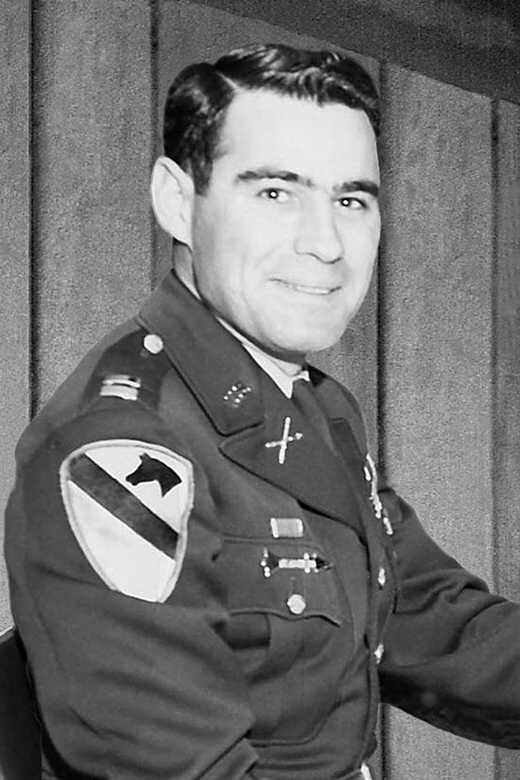
Capt. Mendheim
My first experience with the Captain was on a sizzling hot day when they
were gearing up for a missile launch and things were pretty much going along
as they usually did on any given launch day. The board was extremely
busy, as it invariably was when they were prepping to fire, with phone calls
flying between Range Control, Oscura and all the other critical areas involved
in the operation, so we were totally engrossed in our duties, sealed off in the
small, semi-air conditioned room and, aside from doing our routine
job, bored with it all. We noticed the heavy, distinct, muffled rumble of
a missile being launched in the distance and then not much else.
The other brief time I was exposed to his impressive personality was, again,
at the switchboard, on a similar day when things were beyond frantic.
The board was lit up like the proverbial Christmas tree and we were having
an awful time trying to keep up with the sheer volume of calls. They may have
been firing that day as well, I'm not sure, but I suspect so because it was
non-stop activity and we took turns in the 'hot seat' for as long as we could
handle it, and when we felt it was getting beyond our ability, we would warn the
relief guy to get ready to slide into the chair and clamp
on the headset so there'd be no break in the operation. You had to get a bit
fired up before you were ready to take over because it was plug-in, "operator",
trip the ringer and on to the next call as fast as you could make your hands go.
It literally fried our little draftee brains.
Now, I understand that this isn't on a par with being in a fire fight
in Iraq or anything like that, but they tell me that we handled all communications
between RCRC and pretty much the entire world, so that probably holds some special
minute significance somewhere in the annals of military procedure.
Those of us who ran the switchboard like to think so anyway.
So ok, here we are, racing to keep up with the load and in strolls ( once in a while
he would actually calm down ) Captain Mendheim. ( we knew him simply as "Cap'm-Manhime"
...all one word - I mean that's the way we pronounced his name/title ) He just
walks through the door, kinda John Wayne-like, steps to the board and says "Here,
let me try that thing, I want to see what it's like." And he says "Move over son"
and sits himself in the "hot seat" while we stand around him thinking, "Geeze,
he's gonna blow it - it's running too fast!" and we sure don't want to
miss the show. Well, ( maybe you know what he does already? )
the guy reaches over with both hands and grabs every one of the patch cords
( this is the old fashioned board with pull-out cords, open sockets, toggle ringers etc.
) and he yanks them straight out of the panel! Disconnects every
single connection with one swipe! So now there's nothing but red
lights flashing all over the board! I never saw it lit up so bright
in the shack as at that one time. It was spectacular! Our chins
must have dropped to our polished brass belt buckles and no one knew
quite what to think or how to react. It was ( to me ) like watching a recruit
in boot camp intentionally drop a live grenade on the ground in front of himself
and then look at the Sergeant to see what was going to happen next.
( I did see that )
Does he get flustered? You guys know better than that, right? He sits back and smiles.
SMILES!! And, very slowly, and very methodically he picks up one plug,
slips it into the socket under one flashing light, puts on the headset,
listens a minute and then says in his crisp, quiet, authoritative voice
"This is Captain Mendheim, may I help you? And the light blinks out
- immediately! He proceeds to go right across
the entire board - both banks of lights - one by one by one - and every one
of them goes out - every last one! And then he turns around to us and
with that big handsome smile he says "Heck, this isn't so hard after all" and
he gets up and walks out. So we went from absolute pandemonium
to absolute peace and quiet in the space of maybe ten minutes. Of course,
we were right back to pandemonium in another half hour but we had been
given a memorable lesson in the true value of rank and authority that day. I
never forgot it and if there was any way to convey my thanks to him for making the
long, dry, dreary days at Red Canyon a bit less tedious, I would extend to him
my heartfelt gratitude. Who knows, perhaps, wherever
he is up there, he can take incoming e-mail.. I hope that's the case.
At any rate, that remarkable man, with his inspiring personality and charisma,
gained our respect simply by being himself. We admired
him greatly.
Alan Graham
From Ed Thelen
Hi Craig,
This is a little like Hercules vs. Patriot arguments ;-)

I would do substitutions in the following text

   "turbine" to be replaced by "integrated circuits"
   "round engines" to be replaced by  "tubes"
   "aviation" to be replaced by "rocketry"
;-))
   Ed Thelen
Courtesy of Charlie Oricco:
DEDICATED TO ALL THOSE WHO FLEW BEHIND ROUND ENGINES
We gotta get rid of those turbines, they're ruining aviation and our
hearing...
A turbine is too simple minded, it has no mystery. The air travels
through it in a straight line and doesn't pick up any of the pungent
fragrance of engine oil or pilot sweat.
Anybody can start a turbine. You just need to move a switch from
"OFF"
to "START" and then remember to move it back to "ON" after
a
while. My PC is harder to start.
Cranking a round engine requires skill, finesse and style. You
have to seduce it into starting. It's like waking up a horny mistress.
On
some planes, the pilots aren't even allowed to do it...
Turbines start by whining for a while, then give a lady-like poof
and start whining a little louder.
Round engines give a satisfying rattle-rattle, click-click, BANG,
more
rattles, another BANG, a big macho FART or two, more clicks, a
lot more smoke and finally a serious low pitched roar. We like that.
It's
a GUY
thing...
When you start a round engine, your mind is engaged and you can
concentrate on the flight ahead. Starting a turbine is like flicking on
a ceiling fan: Useful, but, hardly exciting.
When you have started his round engine successfully your Crew
Chief looks up at you like he'd let you kiss his girl, too!
Turbines don't break or catch fire often enough, which leads to
aircrew boredom, complacency and inattention. A round engine at speed
looks and
sounds like it's going to blow any minute. This helps concentrate
the mind !
Turbines don't have enough control levers or gauges to keep a
pilot's attention. There's nothing to fiddle with during long flights.
Turbines smell like a Boy Scout camp full of Coleman Lanterns. Round
engines smell like God intended machines to smell.
Pass this on to an old WWII guy (or his son, or anyone who ever flew
them)
in the "Greatest Generation".
And not every one is equally skilled in things. I was hot on circuits, and many things
mechanical (I had overhauled - new rings, main and rod bearings, ... my car engine while
in the year long Fire Control school in Texas :-)) - but with Dilbert like people skills :-((
I was assigned to C41 between 8/60 and 1/62. When the high pwr radar was brought down from Ft Sheradin the base ( with dish removed ) was hauled on a flat bed. You guessed it, it didnt clear one of the over passes. A SP 5 named Toby Bradshire was a maintenance type assigned to do the report of survey. I moved out for Korea before it was all resolved. I finished up retiring as an SFC E7. All of us who spent long periods in the military could write a book.
I have a story the Nike boys might find amusing-typical Army!
Those of you who were at the US Army's Nike Ajax Missile firing range, Red Canyon Range Camp, New Mexico, remember the harsh desert conditions, rocky caleche soil. The only green to be seen was cholla cacti and low lying brush. In late 57 thru 58 there was a Lt. Westberg assigned to RCRC.
"Westberg was the man assigned to keep the grass
green. I now remember what he did to irk the Colonel. Among his other
jobs Westberg was the Mess Officer. He seized on that as a way not to
pay for his meals. Said he had to sample the food! He was tight as a
tick. Would charge the soldiers to ride with him to El Paso on weekends
and would bitch if the wind was against him as, he claimed, it cut down
on his gas mileage.
Now you know the rest of the story. Does anyone know the purpose of the grassy knoll? Was it for camp mascot Nike the Burro to graze? Maybe some of the camp staff officers had a dog that liked grass? If you can help solve the grassy knoll mystery, lemme know.
When I was at Delta IFC in Korea in 1968/69, we had a GRC-19, but it
was never used . I used to turn on the R-392 receiver once in a while
and listen around sometimes. One day I heard some W6 guys from
California on ten meters and it did make me a bit home sick.
Mr. Thelen,
Richard "Max" Vickroy
from John via
groups.google.com/group/nike-missiles November 25, 2005
Well,
Return to beginning of Nike People Stories