RAMAC 350 Restoration Web Site
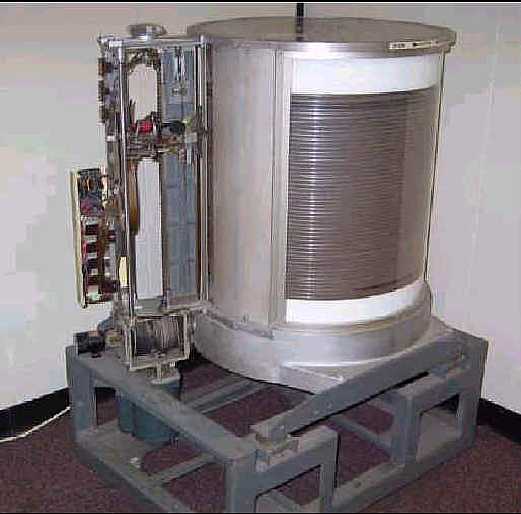
The restoration is now complete.
- The RAMAC 350 can be demonstrated seeking to various disks and tracks.
- Writing to the unit is not part of the restoration.
- The data in the unit has been read and saved.
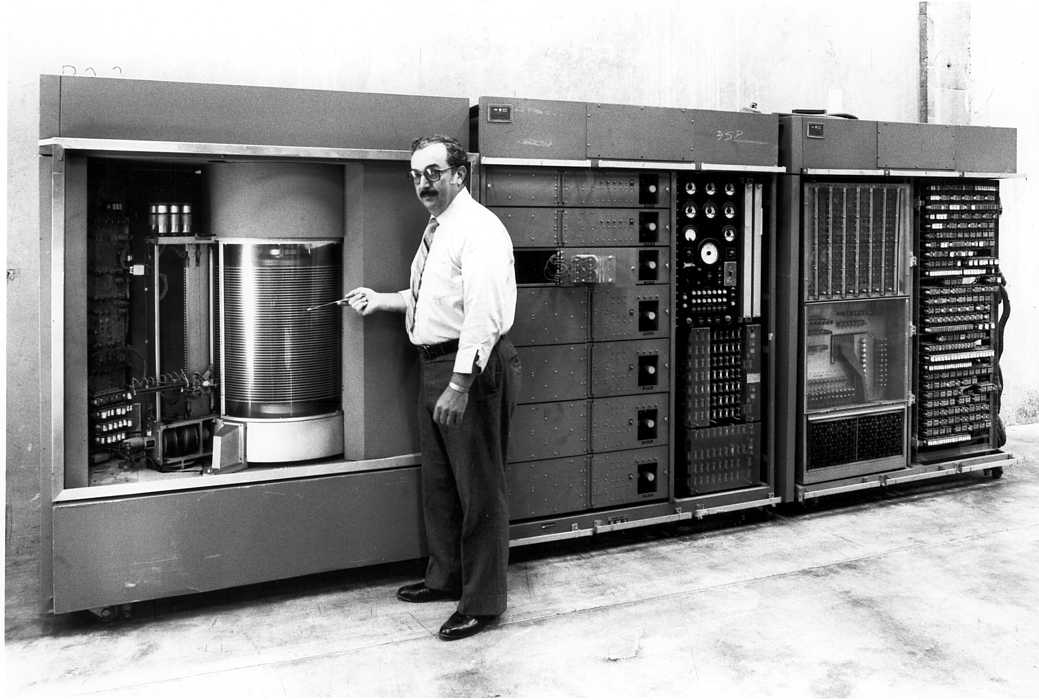
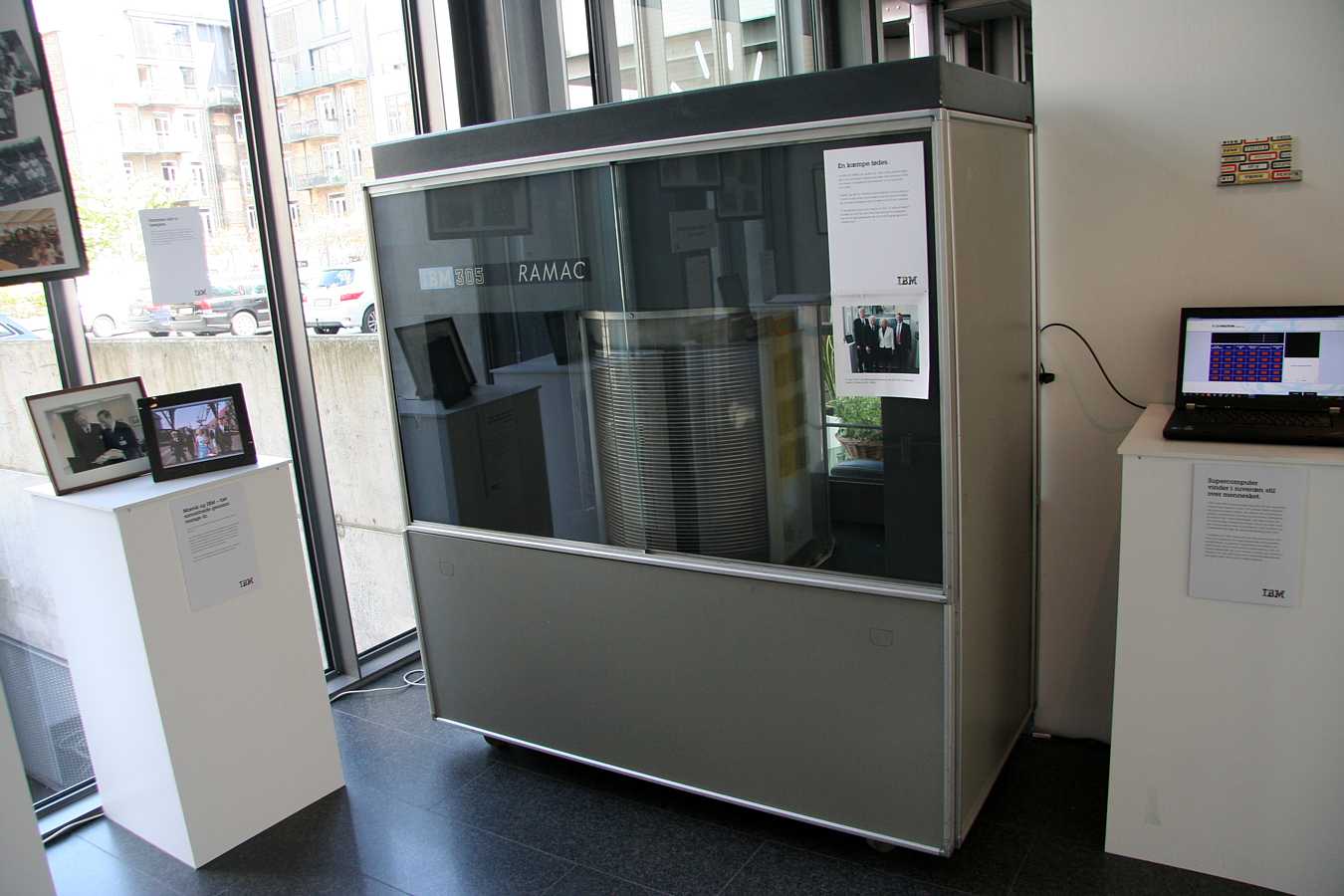
- A "RAMAC 305" is the complete system, includes one RAMAC 350 disk storage unit.
The current location of this RAMAC 350 is the R|EVOLUTION display
in the Computer History Museum,
MountainView, California.
- It is often demonstrated in action on Wednesday afternoons by the restorers.
- Check with the Computer History Museum for current schedule.
A CHM oral history of the RAMAC. Published on Aug 22, 2014.
A video of Rey Johnson, leader of the RAMAC 350 development.
|
Visiting again? New Items and Updates
A little on ownership of this unit
|
From "about the author" in
"
MAGNETIC DISK STORAGE - A Personal Memoir" By Albert S Hoagland
"In 2002 he [Al Hoagland] persuaded IBM to loan SCU [Santa Clara University]
one of the 4 RAMAC disk drives from their archives for
an IIST effort to restore this first disk drive to operational status."
The unit is now on display at the
Computer History Museum in Mountain View, CA,
and I haven't inquired about its current ownership.
|
Table of Contents
Introduction:
|
In the 2018 era we have cheap ($40 for the internal controller and motor, $15 per terra-byte !retail!),
fast (15 milli-second average access time), small (shirt pocket), low power (several watts),
reliable (expect more than 5 years no maintenance service) data storage.
This is after 60 years of hard-to-believe progress.
(In the 1950s, magnetic drums did not have sufficient surface area (data storage) to be much more than program memory.)
To the right is a Burroughs-ElectroData-Datatron 560 "DataFile", an attempt at economical "fast" mass storage.
It was listed in ElectroData Price List #3460 dated April 16, 1956 at $25,000 (average house price $15,000).
It needed a Model 543 Tape Control Unit, which could also control multiple conventional magnetic tape drives.
|
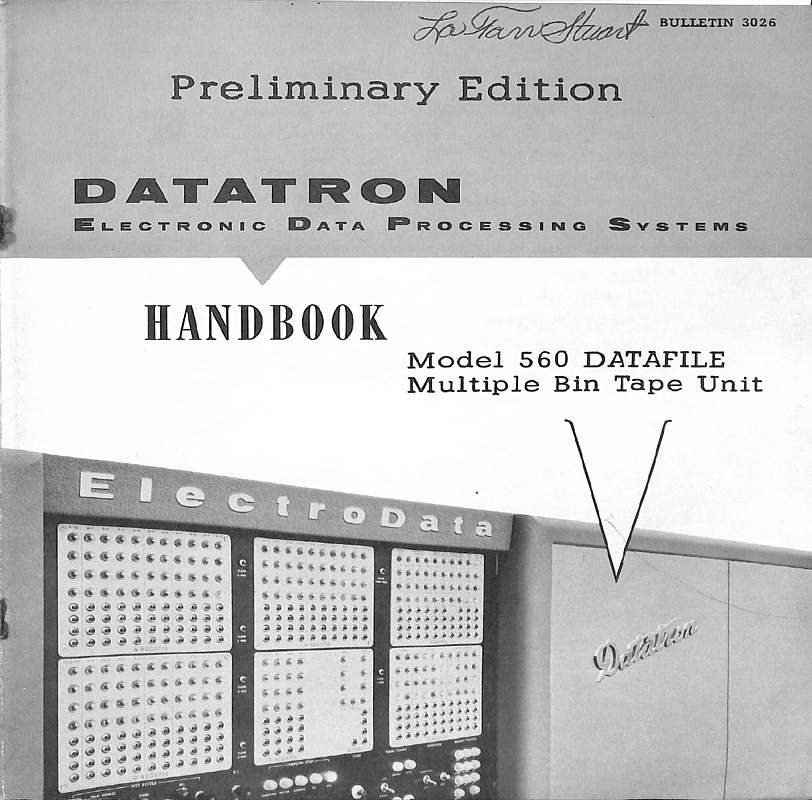
Click here for .pdf of handbook
|

|
Prof. Ron Mak SJSU sent:
"One of my students sent me this link to a very interesting historic video about the RAMAC:
https://m.youtube.com/watch?v=USJGui9yIuA
Have you already seen it? Prof. Mak is getting his students hooked on computing history …
Robert Garner responded:
Ah, THE classic RAMAC development movie.
I carry a copy on my keychain. ;-)
The stoic "humor", enigmatic music, and stultifying acting doesn't distract too much from it's honest attempt to make the engineering process more accessible to the general public.
The old San Jose and Notre Dame scenes are interesting.
|
Log of the 2nd restoration
| 2011 & Succeeding
| March
|
| 2010
| March,
March
|
| 2009
| July,
August,
September,
October,
December
|
| 2008
| January,
July
|
| 2007
| January,
February,
March,
May,
June,
July
|
| 2006
| June, July,
August,
October,
November
|
RAMAC characteristics - and fun facts
- 50 user disks (dummy disks at end to reduce turbulent buffeting)
- 100 sides, 100 user tracks per side (2 test only tracks on inside and outside)
- A RAMAC character has 8 bits: 1 start bit, 6 data bits, and 1 parity bit. - clarification
by Tom Gardner & Joe Feng
- 20 tracks (cylinders) per inch
- 5 sectors per track, 100 characters per sector
- Grand total of 50 disks x 2 sides/disk x 100 user track/side x 5 sectors/track x 100 char/sector
= 5,000,000 characters
- Claimed average access time
0.6 seconds, you define "average" movements ;-))
- However, the "IBM 650 RAMAC - Manual of Operation - Preliminary Edition" (below) states that the worst case seek,
from inner track of top disk to inner track of bottom disk, was 0.8 seconds !!
(I *really* want to see that!! - and maybe help make it happen again :-)) )
- 2 heads, one for tracks on top side of each disk, one for bottom side
- head assembly moves vertically to selected disk, then goes to selected track
- about 200 bits per inch - the magnetic tape density of the period.
- 2 hp drive motor drives the disks at 1200 RPM nominal, (1164 RPM assuming 3% motor slip)
- 1/3 hp motor at 3450 RPM drives clutches at 1000 RPM
- one revolution of fully locked clutch drives arm 6 inches either in/out or up down
- that is 100 inches or 8.3 feet per second
- that is 200 disks per second or 2000 tracks per second
- How about that for stepping right out, moving right along ?!?!
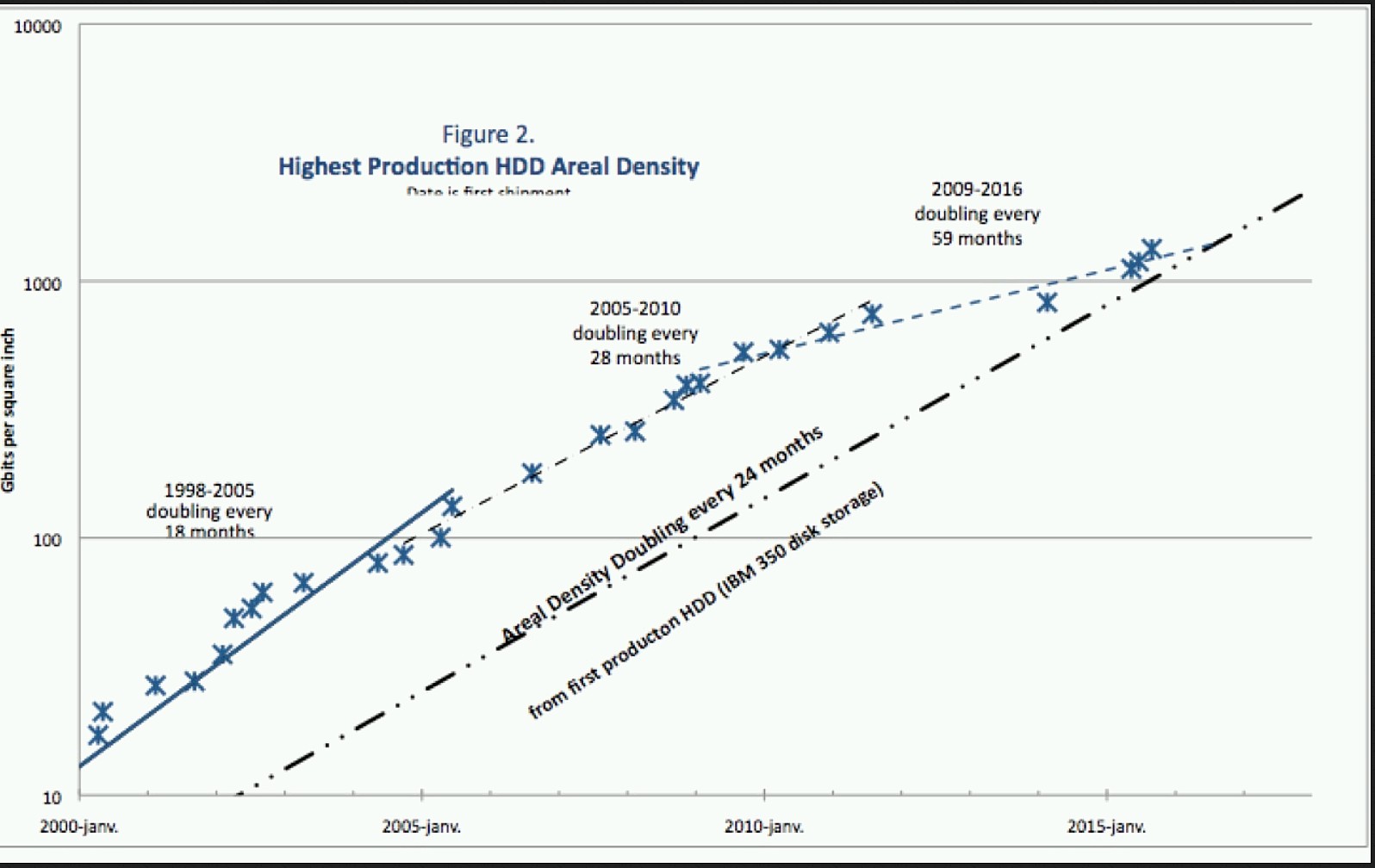
- Compared with current technology (2016)
| Item | RAMAC (1956) technology | 2016 technology
| tracks per inch | 20 tracks/inch | over 30,000 tracks/inch
| | linear density | 100 bits/inch | over 200,000 bits/inch
| | areal density | 2,000 bits/in2 | (Seagate 2015) 1.34x1012 bits/in2
| |
|
A RAMAC Plaque for the Ages - May 2018
|
These Words are intended for a bronze plaque to be displayed near the
RAMAC currently on display at IBM's Almaden Research Laboratory. Robert Garner (retiring manager of General Parallel File System)
wished to wordsmith an accurate text for this bronze plaque. His "advisers" were 17 mostly IBM employees or retirees,
including many here,
who studied and discussed RAMAC history and facts with the same passion as religious scholars translating a sacred book into a language "for the rest of us". This is revision/version number 40, and is likely the final version.
|
Other existing RAMACs and RAMAC restorations
This web site is presented as a learning aid to its owner.
|
I (Ed Thelen) never worked on a RAMAC, but I did install and maintain this
"second generation" product from General Electric Computer Department into the US Steel Tube Mill, Elwood City, PA in 1963.
And, while installing another GE-225 system, did see a working RAMAC at G.E. Large Appliance Division in Louisville, Kentucky in 1963.
|
Documents on line -
- General Documents
- Excellent IBM 305 Wikopedia article, original
host for the RAMAC 350 Disk by Tim Coslet
- 305 RAMAC Manual of Operation - 150 pages 27 megabytes .pdf
- IBM RAMAC 305 Customer Engineering Manual of Instruction - Form 227-3534-0
(undated?) scanned by Joe Feng. See the RAMAC specific pages 63-98 below. 15.5 megabytes .pdf
- RAMAC 305 Maintenance pages 63-98 RAMAC 350
the RAMAC 350 is the storage unit. 4 megabyte .pdf
-
The Disk Drive Story, Chapter 1: IBM's RAMAC Transcript #2 - with
Lou Stevens, Jack Harker, Al Shugart - at CHM, December 2001
-
STARS:Creating Magnetic Disk Storage at IBM Author: Emerson W. Pugh,
suggested by Dave Bennet
- IBM 650 RAMAC - Manual of Operation - Preliminary Edition" (June 1, 1957) lent by LaFarr Stuart,
note, a later edition than on bitsavers.org - placed here for timing of "355 RAMAC" operations - 4.6 megabytes
pages 23-30 for timing information - 400 Kbytes
- Technical Report - Access Mechanism - 350 RAMAC - 1956 1.3 megabyte, .pdf
- IBM RAMAC-350 Parts Catalog Form 12-7756-0 2.3 megabytes
- IBM-305 Form 227-3533-1 CE Reference Manual - mostly RAMAC scanned 8 megabytes
- at bitsavers.org 305 RAMAC Reference Manual - A26-3502
- at bitsavers.org
305 RAMAC - Random Access Method of Accounting and Control - Manual of Operation, 22-6264-1 - April 1957
-
UnlockingTheDiskDriveStory-IBM-AlmadenResearch,
local copy added Jan 2018
-
A Quarter Century of Disk File Innovation from IBM Journal Research Development, Sept 1981,
local copy added Jan 2018
- Access mechanism, clutches,
- Read/Write signals, electronics, ...
- Work done at Santa Clara University
- Wiring, diagrams, restoration
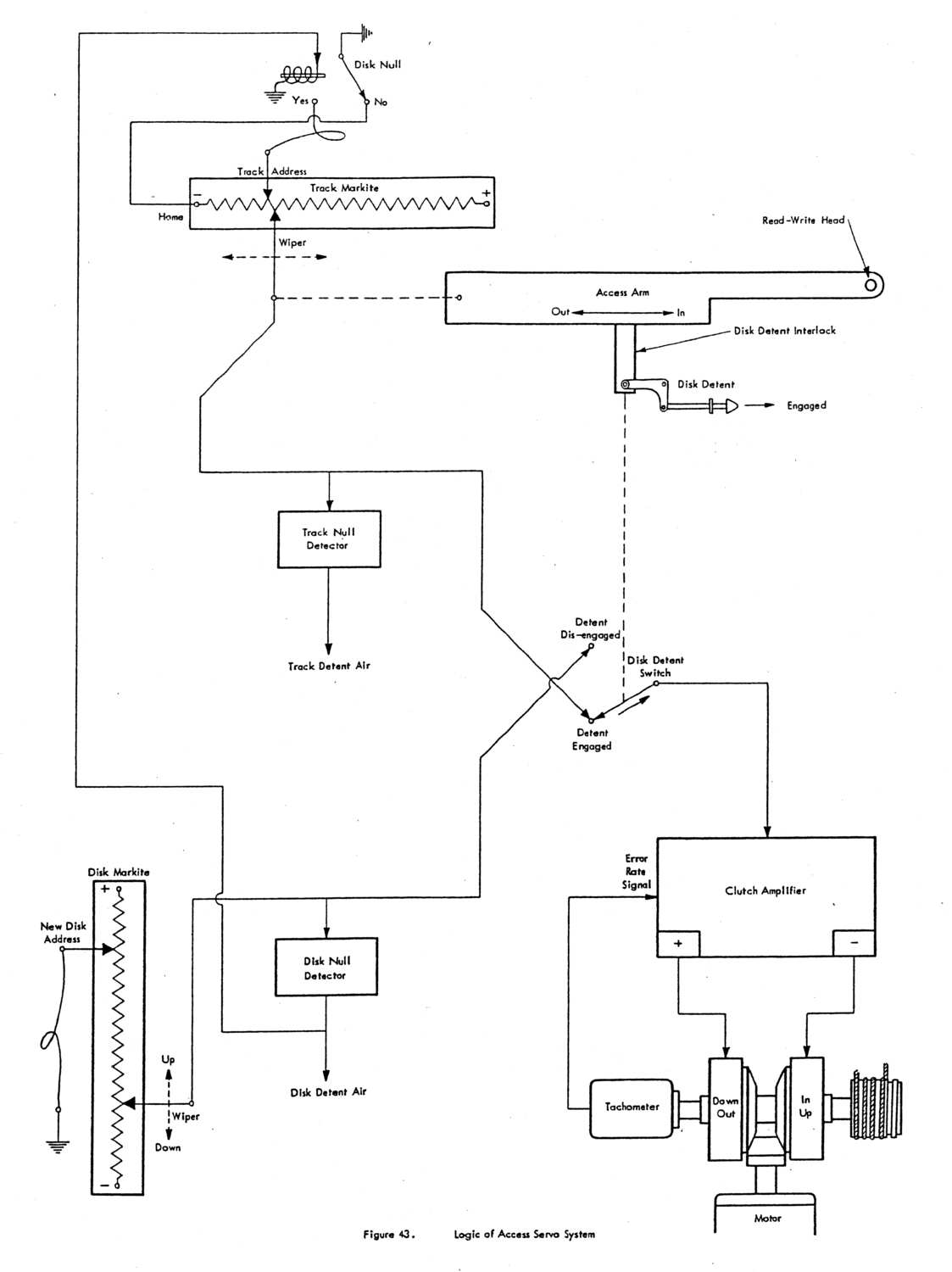
Control Overview
|
- The upper left tapped pot shows the track (horizontal) setpoint and position feedback.
- The arm bearing the read write erase head(s) is upper right, showing a disk detent to prevent
vertical movement while arm is carrying heads onto selected disk.
- The lower left tapped pot shows the disk (vertical) setpoint and position feedback
- The servo/clutch Amplifier, motion select clutches, tach, and drive capstan (for both vertical & horizontal)
is lower right
|
Pictures:
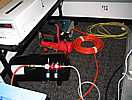
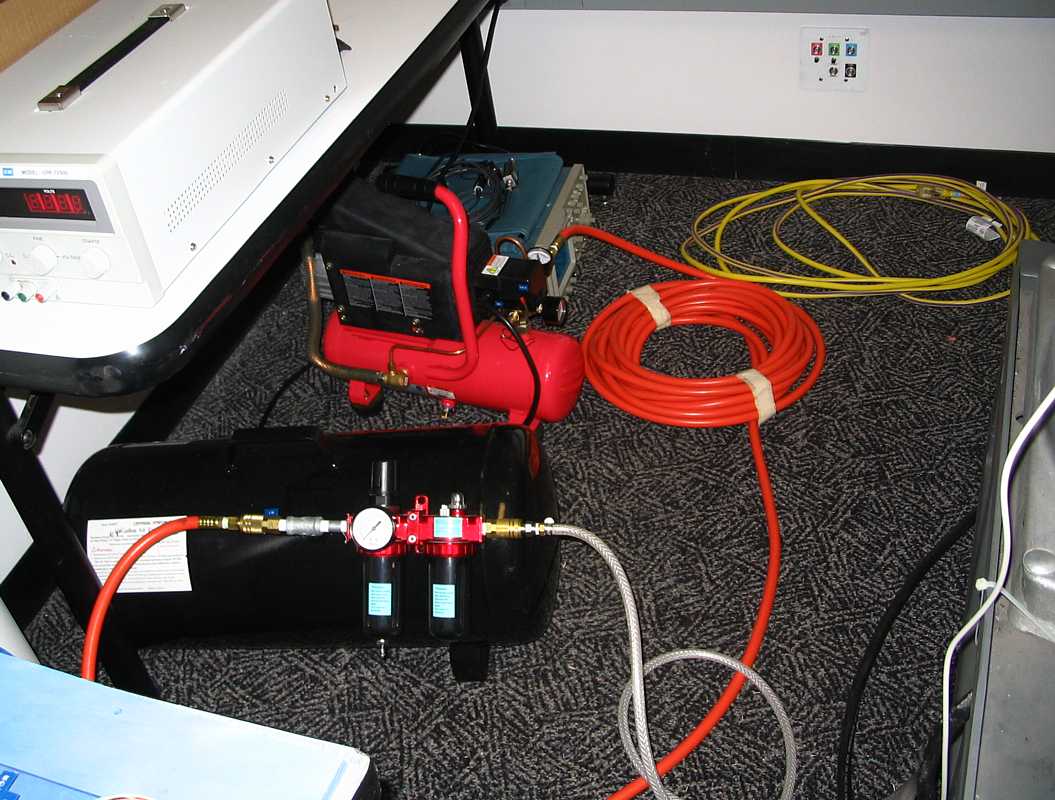
| The red thing is a very noisy aircompressor with regulator. The black tank is an accumulator? to smooth??
50 psi air is used to operate detents, "lower" the heads using 3 little pistons, supply air to the six little holes in the head
to fly the head maybe 0.0003 inch off of the oxide on the disk
|
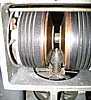
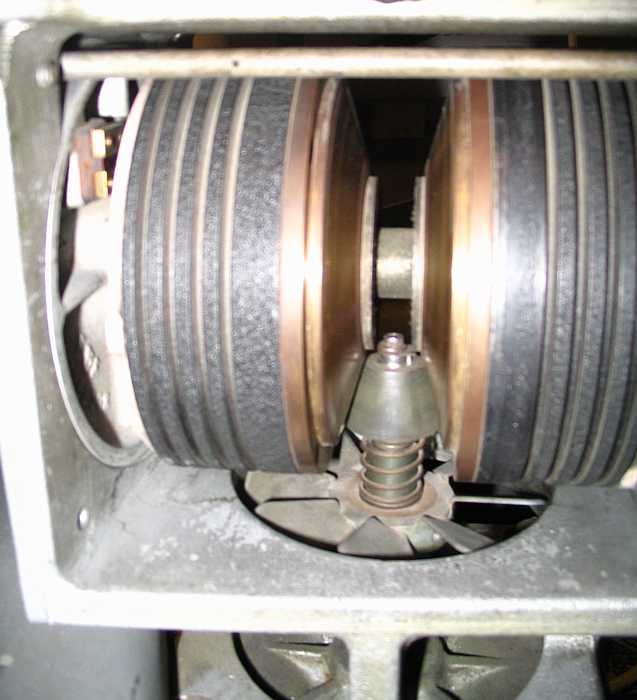
| Part of the drive train to select disk and track.
The left and right cylinders are electro-magnetic clutches to transfer power from the electric motor (not shown - below the
picture, through the hard rubber bevel (like a slippable bevel gear, to drive the selected clutch. The clutches are
counter rotating with a common shaft. If you want the shaft to go in one direction, select one clutch, the other clutch
will drive in the other direction. (The carbon brush assembly to conduct electricity to the internal magnet is visible
in the upper left corner of the left clutch.)

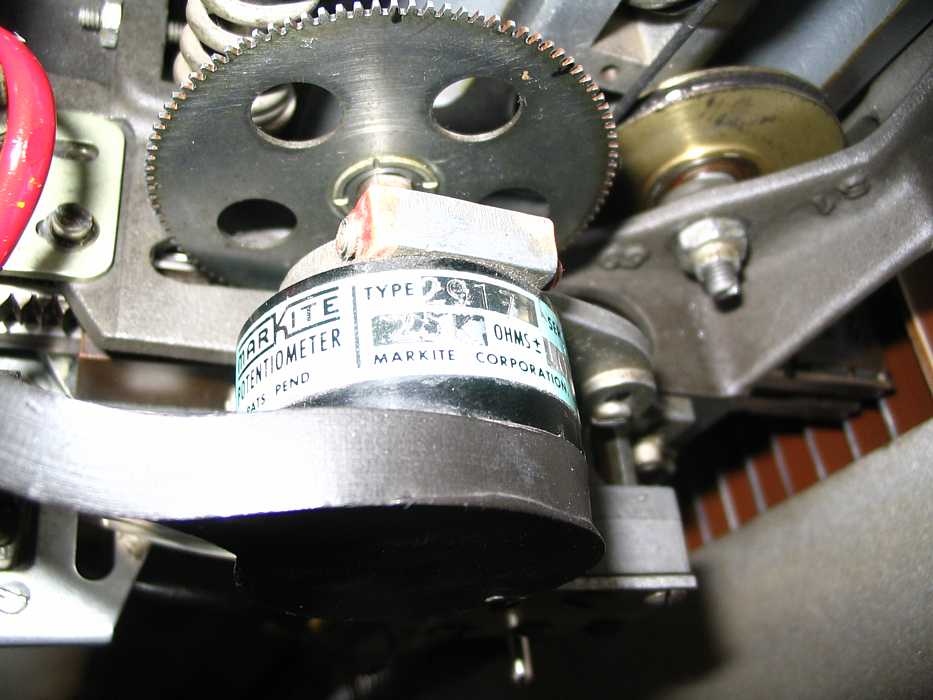
| Potentiometer to sense the position of the arm/head assembly on a disk.
This unit has the normal end taps plus 5 more taps to aid precision location of the head among the 100 data tracks.
Unfortunately, one of the five extra taps is open. "Todd" says "
I worked in the plant in Ramsey, NJ in the 60's. The potentiometers were molded with plastic track and metal connections.
Sometimes the plastic did not make a good contact with the metal.
We would then paint a connection with silver paint and bake for about half an hour.
It you open the unit, you probably will see that the outside of the track has been ground away to make the
exact resistance specs of the unit.
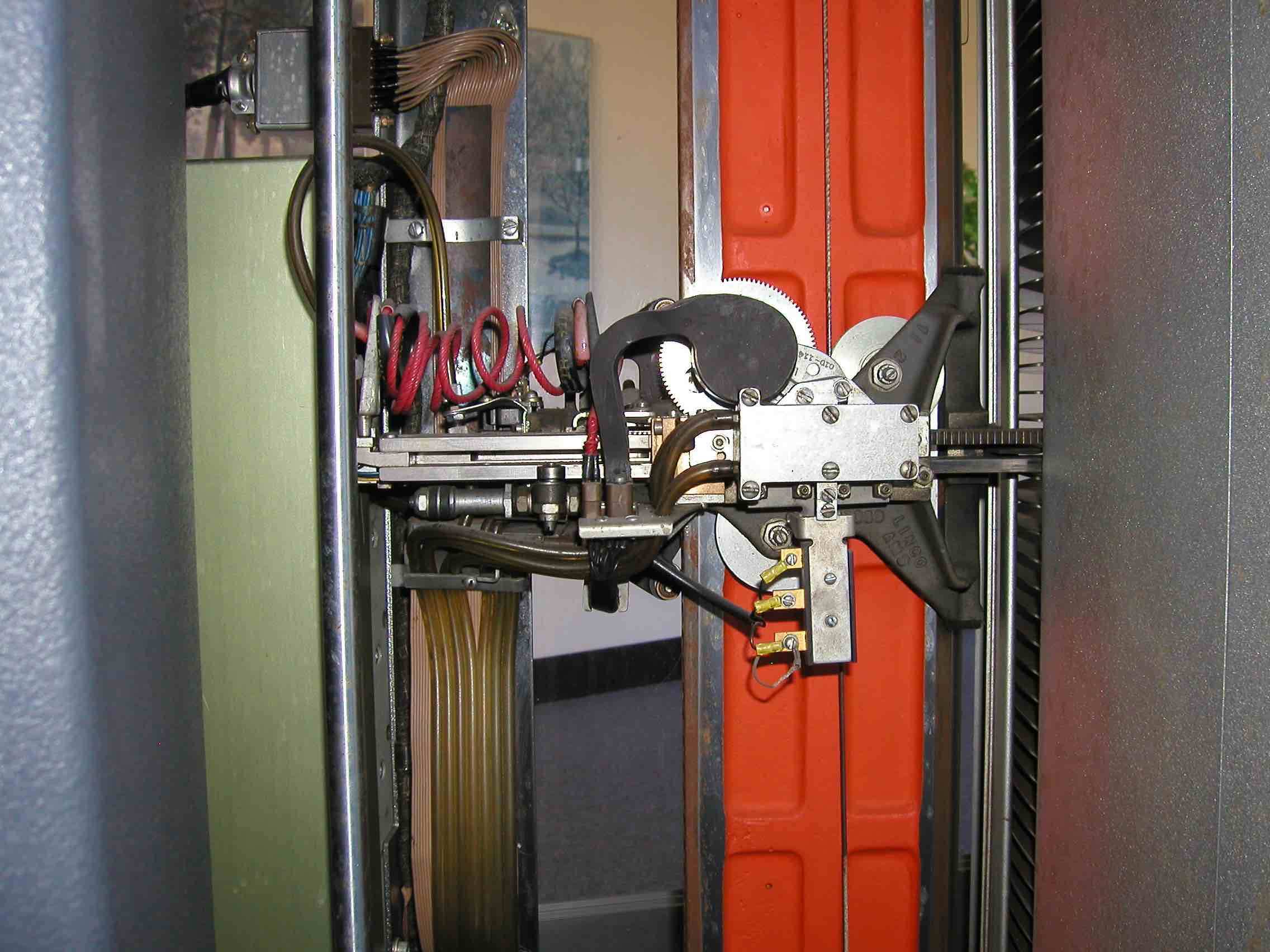
| Another view of the above assembly
from "Photos (RAMAC, etc) taken in Dave Bennett's IBM B28 storage museum, 2004" by Robert Garner
| 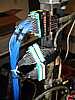
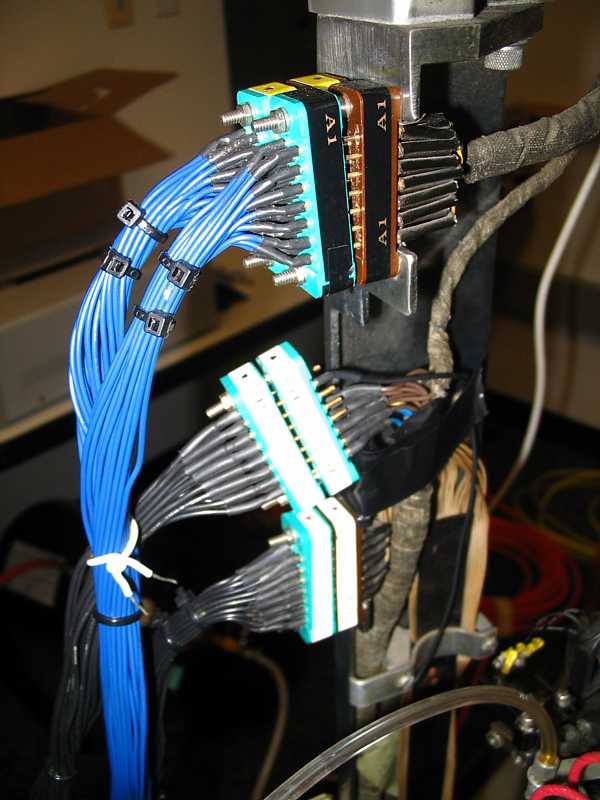
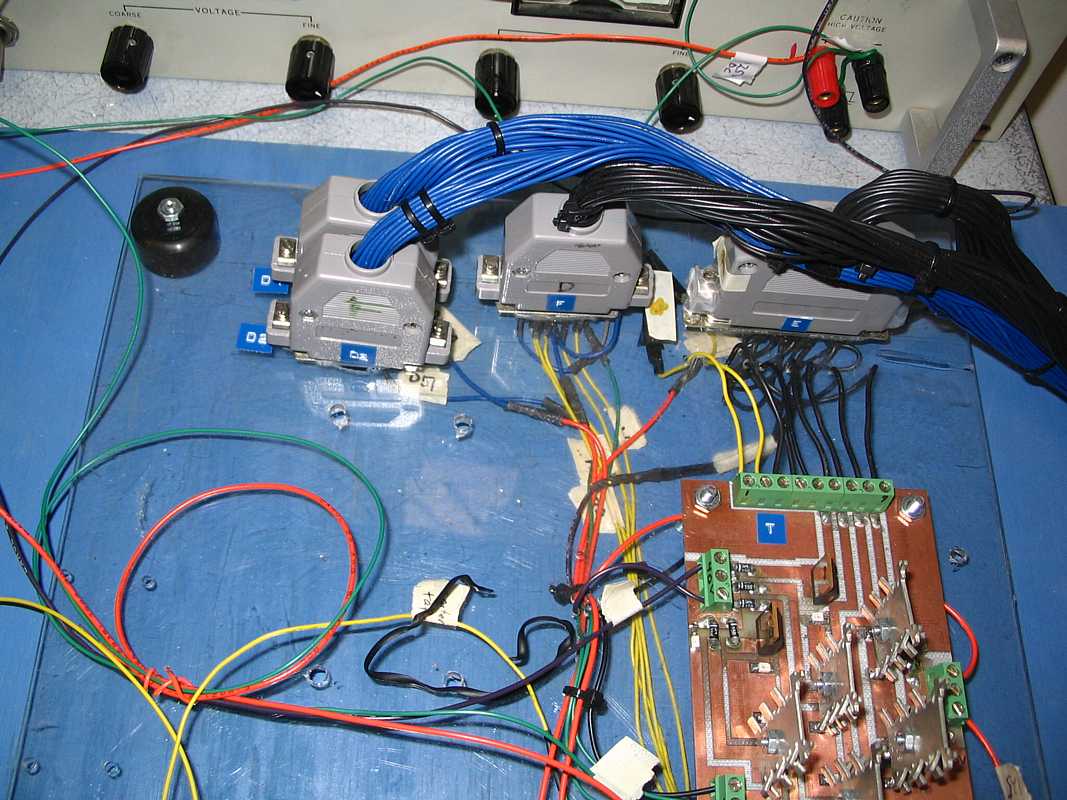
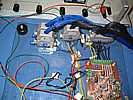
| These are the plugs from the RAMAC, and the sockets and wires the Santa Clara students added to connect their board.
The original RAMAC connectors are used. Apparently finding the matching connectors was a challenge.
| 
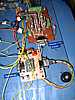
| This is the area of the Santa Clara drive boards with plugs and cables to the RAMAC.
Note that the plugs and sockets are much easier to find than the connectors at the RAMAC end.
| 
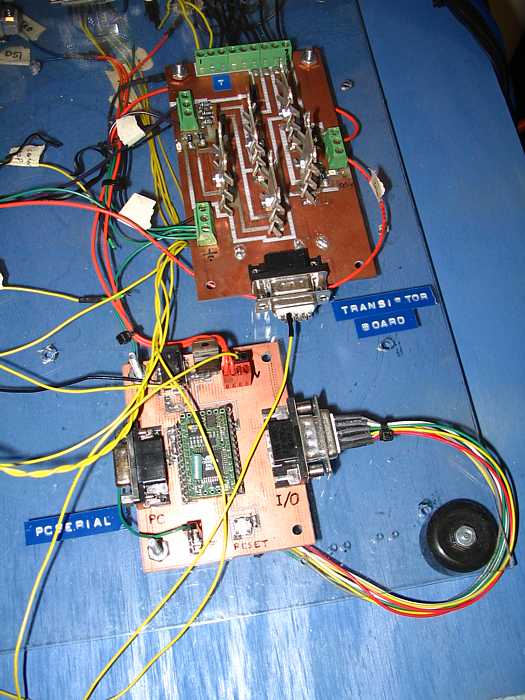
| This is the drive circuitry make by the Santa Clara students, , to drive the RAMAC seek mechanism. A manual switch to
operate the head lowering air switch is off screen. A PIC, running BASIC, was used to:
- compute velocity from successive potentiomenter readings
- "close the servo loop" ie. sense loop error and output corrective voltages (currents) to the clutches
Using this method, they achieved a seek time of about 10 seconds
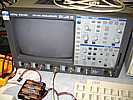
| Joe Feng amplifies the about 80,000 bit rate signal from the RAMAC read head (about 40 millivolts) by 2
and uses this scope to:
- oversample by about 12
- digitize and captures the result
He then down loads the captured result to a PC for analysis, decoding, what ever :-))
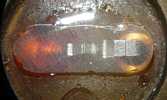
| Joe Feng sent this image "... of ABS of one of the RAMAC heads, taken by Terry Whittier of HGST."
"The scratches are clearly from the fabrication process, and not due to
damage from the disk, since they are at an angle to the direction of
travel. The R/W element is on the left, and the E head is on the
right. The surprise is that the E gap is shorter than the R/W gap."
Ah - the "E gap" is the gap in the erase magnetic structure, on the right.
| | | | |
Interesting Info
from Dave Bennet July 4th 2006
|
There was a 353 and a 355 version of RAMAC. I gather that 355 was the version that went on 650 and if so I'm not sure of the differences from 650. My guess would be that it might have a different data format and whatever other changes were necessary to attach to 650. The 350 data I/O was sequenced by a drum file in the processor unit. 650 may have done it another way.
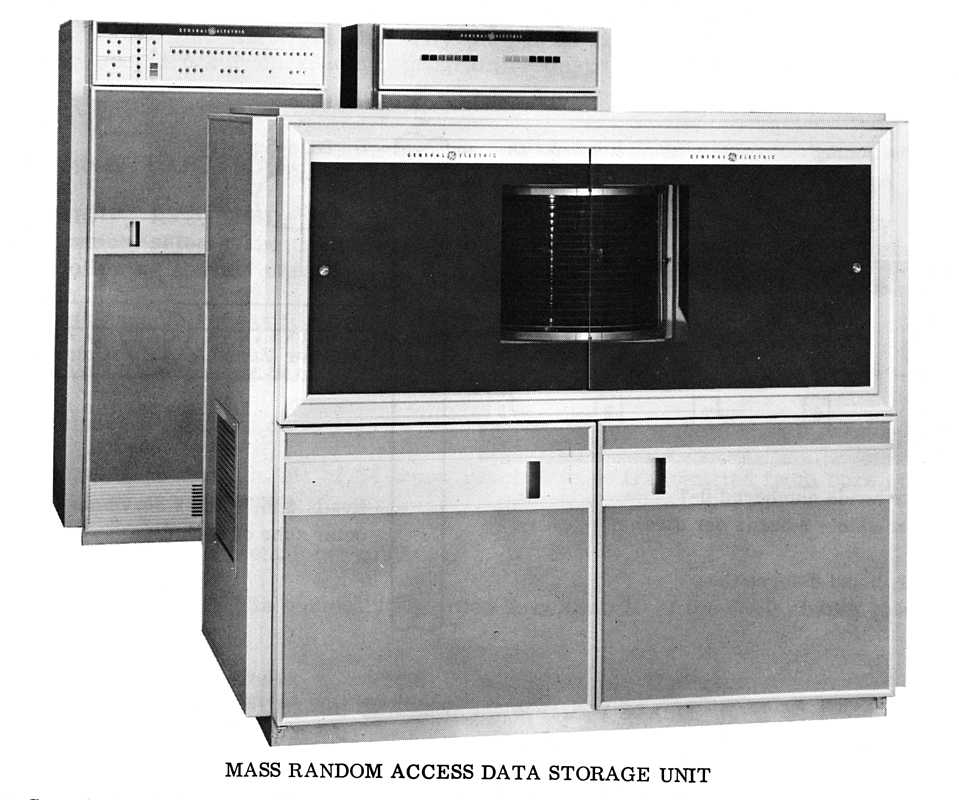
The other version, I guess it was 353, was the STRETCH version, which had one head per disk surface. Early ones still had air pressurized heads, which took a LOT of compressed air. Later ones had flying heads. CHM has a STRETCH RAMAC which came from Livermore Lab, but someone discarded the head arms because they were supposedly rusty. In so doing they discarded the most interesting part of the machine.
Dave
|
from Jim Strickland July 23, 2011
STORIES: Watson Precursor?
Jim Strickland
I was docenting, as is my wont, and I came up to a group of four. “Did you folks come to see anything in particular?” I said.
“Well, perhaps RAMAC,” said a man of 80 or so.
“We have restored a RAMAC”, I said. “Let me show you.”
He indicated they wanted to go through the museum sequentially, so I told them I would see them later in the RAMAC area.
Later, I did find them in the /360 area and asked if they had seen the RAMAC, yet. They had not, so I showed them to it.
“Now, tell me your story,” I said.
“Well, I was with IBM for 45 years. And in 1958, I was working for IBM France when we introduced the RAMAC. Tom Watson Jr. came to Paris for an industrial exhibition and we demo'd the RAMAC.
There were hundreds of people lined up for the demo. When you got to the front of the line you could name a date and the operator would enter it and in a few seconds tell you what happened on that date in history. It was the biggest hit of the whole show!”
Was this the early version the Watson that wowed people on Jeopardy in February?
|
Team Contact Info -
RAMAC patents
"Prior Art"
- 2690913.pdf - Magnetic Memory Device - 500 K Bytes by J. Rabinow - filed March 14, 1951
Robert Garner found an article
"The Notched-Disk Memory" - local copy
by Jacob Rabinow
in the August 1952 issue of the Electrical Engineering magazine.
This can be found in large libraries such as colleges.
Rabinow's patent # 2690913 ,
Filing date: Mar 14, 1951, can be found in
Google's patent repository.
The RAMAC 350 disk is quite different, but the patent shows that a mass storage device with
much quicker access than tape on reels was actively being sought.
- - - - - - - - - - - -
And later came a host of disk systems, including the "hard drive" in most of our PCs ;-))
And the IBM 2321 Data Cell Drive
must be mentioned as a magnetic mass storage device quite unrelated to the 350 and its offspring.
Dave Bennet says that the Data Cell got a bad rap on reliability as most people did not adjust them correctly.
|
How the RAMAC got its name
Letter from Robert Garner to ...
|
Paul,
Per Al Hoagland's email below (hired at IBM San Jose in late 50's), he confirmed that the "Random Access Memory-AC" naming story (as in ENIAC, MANIAC, etc) is incorrect.
Per his email below, the earliest published articles illustrate that RAMAC originally stood for "Random Access Memory ACcounting machine."
Apparently RAM acronym was owned by Potter Instruments, so meaning was changed by marketing to "Random Access Method of Accounting and Control." This from an Al Shugart talk, introduced by Al, recorded at: http://www.mdhc.scu.edu/100th/Progress/Shugart/shugart.html
"We wanted to call the thing RAM, but a fellow named Potter from Potter Instrument Company had already used that name in a product. There may be people here who remember Mr. Potter and the Potter RAM. But probably none here has heard of Bill Goddard. Bill was awarded the fundamental RAMAC patent, assigned to IBM, and received a belated cash award for his efforts. I guess that makes Bill Goddard sort of the grandfather of the industry."
Regards,
- Robert
p.s. In the old computer acronyms like ENIAC, MANIAC, ILLIAC, etc. the AC stood for "and Computer" or "and Calculator." I agree it was likely an "iXX" or "eYY" like phenomena.
|
Early RAMAC shipments
Contributions from Tom Gardner and David Bennet - Summary by Tom- May 21, 2017
Production History
Fourteen prototype systems were built with the first one shipped to Zellerbach Paper Company,
San Francisco CA, in June 1956. The prototypes were designated with an “A” suffix, 305A for
the system unit and 350A for the disk storage unit. One of the prototypes consisting of the
disk drive the computer CPU and the power unit (but not the console or any other components)
still exists and is at IBM Almaden Research Center.
There were a number of changes made been prototype and production disk storage units. All prototype units were ultimately replaced with production units.
The first 305 RAMAC from manufacturing (a dual processor working a single file) shipped to United Air Lines in Denver CO in November 1957. In 1958 the
305 system was enhanced to allow attachment of a second 350 disk storage. Over a thousand 305s were built before production ended in 1961.
In addition to the more than 1000 RAMAC disk storage units attached to 305 system’s variants were attached to the IBM 650 system and the
IBM 1400 system. In “Data Processing Technology and Economics,” Phister, 1979, he estimated about 2500 units were installed.
|
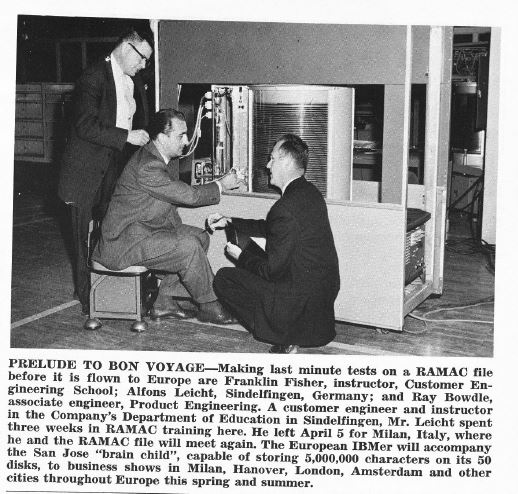
|
April_1957_San_Jose_News_RAMAC
via Robert Garner
|
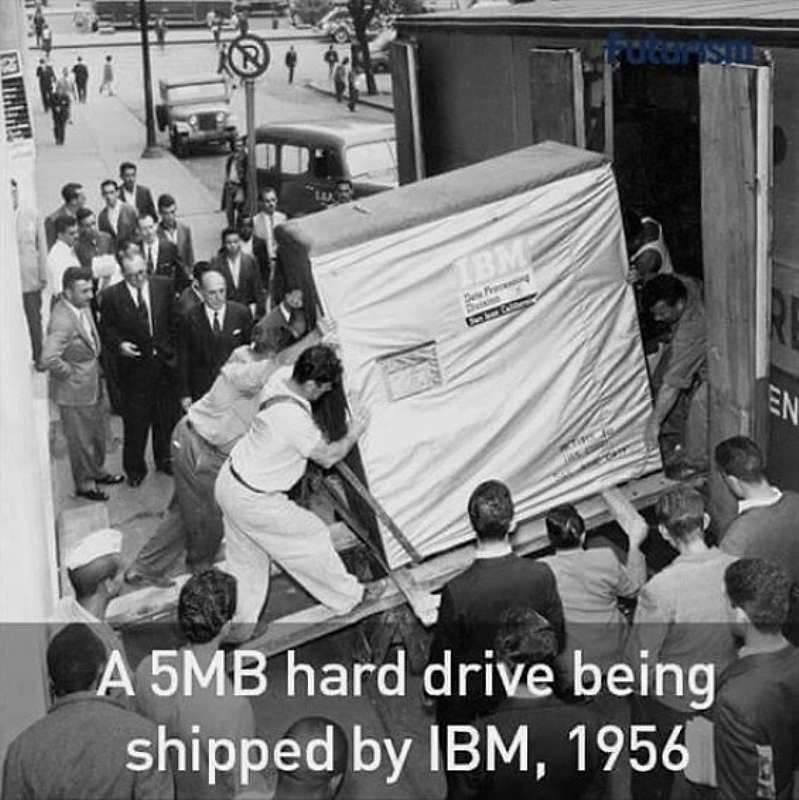
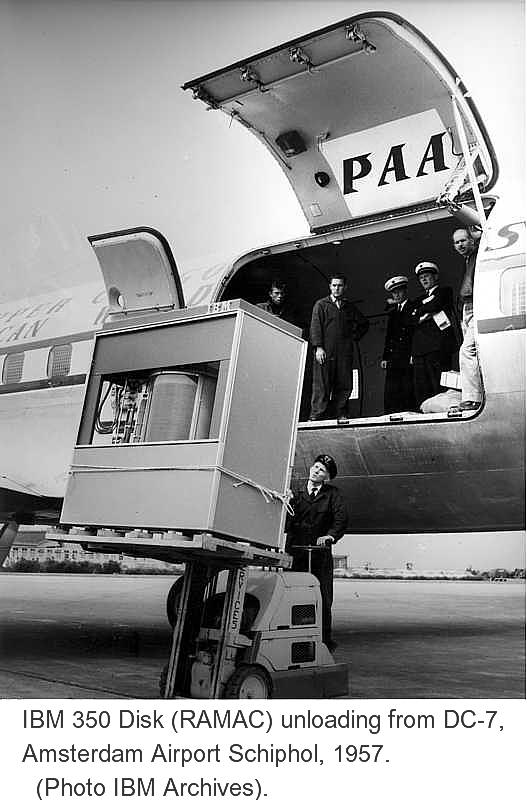
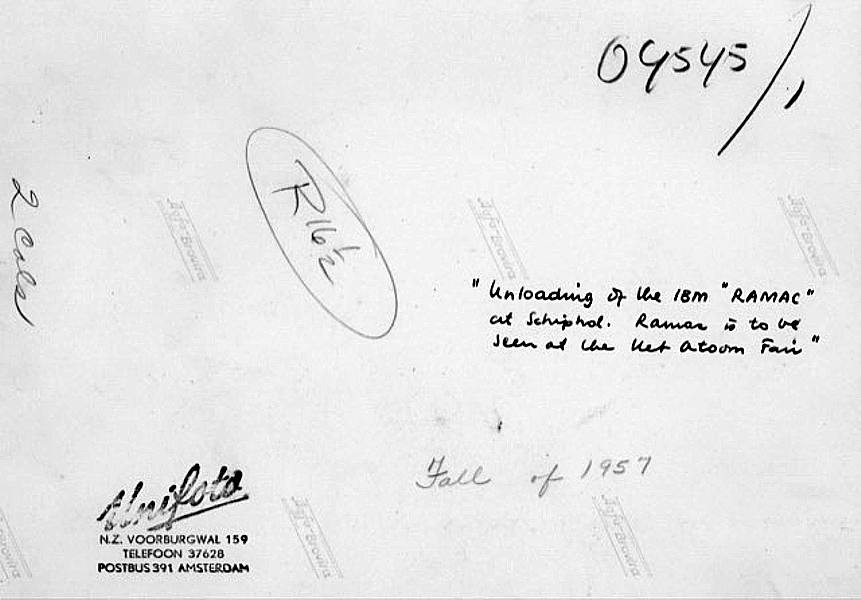
Front and back images of 1957 photo showing 350 disk storage being unloaded from DC7
| 
|
Photo from IBM Archives, preserved by Dave Bennet, scanned by Robert Garner
“RAMAC is to be seen at the Het Atoom Fair”, likely refers to “Tentoonstelling Het Atoom,” [Exhibition of the Atom] held from June 28 thru September 15, 1957 in Amsterdam, showcasing all sorts of impressive looking industrial equipment and exhibits, including models of the atom, a Geiger counter exhibit, radioactive plants, water wheels, pumps, engines, a model nuclear power plant, even hand-actuated remote handling of radioactive liquids (?) and a radioactive materials pool (?) — see
video posted to YouTube.
The same RAMAC drive was likely installed as a part of the RAMAC 305 system exhibited at the 1958 Brussel’s World’s Fair,
Robert Garner
March 11, 2018
| |
|
There was a story circulating that a DC-7 carrying an IBM 350 over the Atlantic Ocean lost a (piston) engine
and had to dump its 350 into the ocean inorder to reach land.
Dave Bennet (March 9, 2018) clarifies this with:
The machine that was shoved out of a plane was the first 50 Hertz 2321 Data Cell mechanical frame on its way to a European customer. It was NOT a RAMAC. DC-7s had very complicated 28 cylinder radial engines that had a nasty habit of failing on long mid ocean flights. I personally helped manufacturing meet a tight schedule for that machine and I took that whoosh personally. I am not aware that any RAMACs met such a fate. I'm sure that if it were a case of survival of the data cell or survival of the airplane and its crew I would have made the same decision.
|
Feb 25, 2018, Larry Blanchard < woodbutcher9876@gmail.com > wrote:
Interesting history note. I helped the CE assembly the prototype. Yep, I *am* that old :-).
Automatic Data Processing
An ADPS (automatic data processing system) test was conducted at the Louisville Medical Depot from 6 May to 30 September 1957. The equipment utilized was an IBM prototype model 305A (RAMAC). After a thorough evaluation of all phases of the test operation, approval was granted for installing a production model 305A. Installation has been completed, and the logistic functions of the Louisville Medical Depot pertaining to data processing are now performed by ADPS.
|
List of known RAMACs
|
Hello Michael [Deichmann - mde at dk dot ibm dot com],
This is in reference to your comment on the RAMAC page of the IBM 100th anniversary package. I am a member of a team of IBM retirees which has restored an original RAMAC mechanical assembly to operating condition at the Computer History Museum in Mountain View, California (USA). We are very interested to hear that you have a RAMAC and would like to know more about it.
The following are the total of IBM 350 RAMACs that we know about:
- RAMAC Prototype (1 of 14 built) at IBM Almaden Research Center lobby, San Jose, California.
- RAMAC on loan from IBM archives to a museum (Ross Perot's Nature&Science Museum ) in Plano, Texas. (IBM 305 which includes the IBM 350)
- RAMAC 5 million character drive at Hitachi Global Storage Technology (purchased IBM's disk drive business) in San Jose, California. - may be going to Western Digital?
- RAMAC IBM 650 version, in partial operation in a private (HzG) museum in Sindlefingen, Germany.
- Our RAMAC 350 complete mechanical assembly, in full operation, at Computer History Museum in Mountain View California, on loan from IBM archives. Demoed Wednesdays at 2:00 PM. Does not have original electronics.
- Possible RAMAC donated to the National Museum of American History, Smithsonian Institution in Washington D.C., which they are unable to locate at the present time.
- And now YOURS in Denmark!
|
Could you please send me a digital photograph of the machine there in Lundofte? Thank you very much!
|
|
Dave Bennet, IBM retiree, Aptos , California
|
Multiple actuators on one RAMAC 350 device
from e-mails collected by Dave Bennet
Background:
|
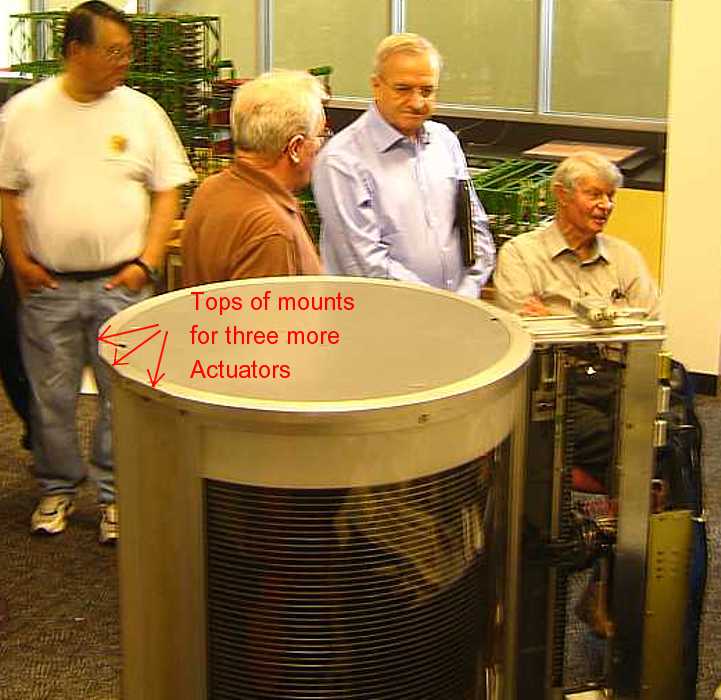
These pictures show that the design on the disc housing casting
allows for the attachment of up to four or six actuators on one spindle of discs.
| 
| 
|
From Mason L. Williams
All,
from reading our copy of the operating instructions manual for the 350,
I find that if multiple actuators were attached, they could all address all disks.
There was a concern for data integrity (to prevent simultaneous attempts to update the same record
from more than one process or thread) that resulted in hardware (relay tree) logic to suppress
responding that a seek request was completed if another actuator has already responded that it
has finished seeking to the the same record. This makes sense only if two actuators can access
the same data. The manual says that it was possible to connect one 350 drive to two 305 processors,
in which case the relay logic must check all 4 access arm access addresses for overlaps. To me,
this implies that the 4 access arm configuration may have only been used for the two 305 case,
because in the single 305 case they discuss only checking one other actuator address request.
There is an exception to the simultaneous seek blocking by a command to turn off that mode but then
block all writing. That would allow faster report generation while preserving data integrity if no
updating of the 350 was required during the report generation. (The drum could still do writes
to handle counting and indexing, for example.) In the normal operation mode, it was possible for
two actuators to seek the same record, but only the first to complete would would be handled,
and the other actuator(s) trying for the same record would have to wait for the first operation to complete
to release the record address by seeking to another record (as I read the tests that are done.)
Although the various actuators were not dynamically servoed, the radial runout of the disks was much smaller
than the tolerance provided by tunnel erase and the method of reinstalling each actuator specified adjusting
radius for maximum signal under conditions of null servo error signal. I suspect that one should have written
each track with one actuator before installing additional actuators, but I did not see this specifically stated.
regards, Mason
|
Information from Bruce Allen, via Dave Bennet
|
Bruce had been a CE at Boeing where they had several RAMACs.
Bruce gave us some insights about RAMAC that were new to me:
- Regarding multiple actuators, he said that multiple actuators were fairly common. At Boeing they had at least one RAMAC with two actuators, each of which was connected to a separate processor. He also said that they had one with four actuators, but he wasn't sure whether or not multiple processors were involved with that one.
- Head crashes were not terribly common but they were not unheard of. The most common cause was the short piece of air tubing attached to the head becoming hard, so that it would not flex properly and the head would become cocked. Also if an air hole on the underside of the head got plugged, it could cause a crash.
- They very often slid the actuator assembly out on the "trolley," to service the heads. They never removed the arm as we would have to do.
- The DeVilbiss air compressor was mounted in its own box, rather than being in the base of the unit. This box is clearly visible in the photo on the reader rail at CHM. It is to the left of the operator console
(Peggy Hoxsie). Bruce wasn't sure that the later Bell & Gosset compressor (10 million character RAMAC) was always in the RAMAC main frame as I observed in Denmark.
- Bruce was a RAMAC system final test technician on the line in Building 5 beginning in 1957. The first system he checked out was #13, which went to Square D Company. In the adjacent test cell at the time was #8, which was the system that went to the Brussels World's Fair. That system had special white covers.
- The RAMAC printer was very slow and not that great, so there was an RPQ that put a 407 accounting machine (big machine) in its place. It was a popular fix.
|
|
Applications
- At Boeing
From Bruce Allen < Bruce @ bballen . com > via Dave Bennet via Robert Garner
I need to start off by stating I was a hardware Tech. I was not in on the Development, of the 350,
nor in on the programming. There are however a number of clues. There were four 305's in the computer room,
running a number of applications.
The ones I remember were
- Employee attendance,
- Parts inventory and
- Production parts manufacturing tracking.
I remember asking the programers if there was some kind of interlocking between the access units,
they said there was. From a hardware point of view there was never a complaint or problem
in this area so I wasn't involved.
At Boeing we had a large IBM 357 Data Collection system, which provided a most of the input
to the 305 systems. There were about 2 dozen 026 Key Punches in the room which were the
output devices for the 357's. As employees came through the gate to go to work they passed
there badges through the 357 reader which produced cards in the computer room. The cards
went into the 305 system then on to payroll. In the manufacturing area employes checked on jobs,
this allowed managers to track parts production as well as cost. When a Boeing customer requested
a part, usually because they had an aircraft grounded, if it was not in the Parts inventory a
search was made in the manufacturing area. The part located there could be expedited to the customer.
Sorry I don't have a more have a better explanation, at the time I figured it was taken care of through program design.
Again I want to thank everyone, especially Dave, for looking after us on our visit it was a wonderful experience.
Bruce Allen
at the Louisville Medical Depot
from Larry Blanchard < woodbutcher9876 @ gmail . com >
Date: Sun, Feb 25, 2018
Interesting history note. I helped the CE assembly the prototype. Yep, I *am* that old :-).
Annual Report of the Surgeon General United States Army Fiscal Year 1958
Automatic Data Processing
An ADPS (automatic data processing system) test was conducted at the Louisville Medical Depot from 6 May to 30 September 1957. The equipment utilized was an IBM prototype model 305A (RAMAC). After a thorough evaluation of all phases of the test operation, approval was granted for installing a production model 305A. Installation has been completed, and the logistic functions of the Louisville Medical Depot pertaining to data processing are now performed by ADPS.
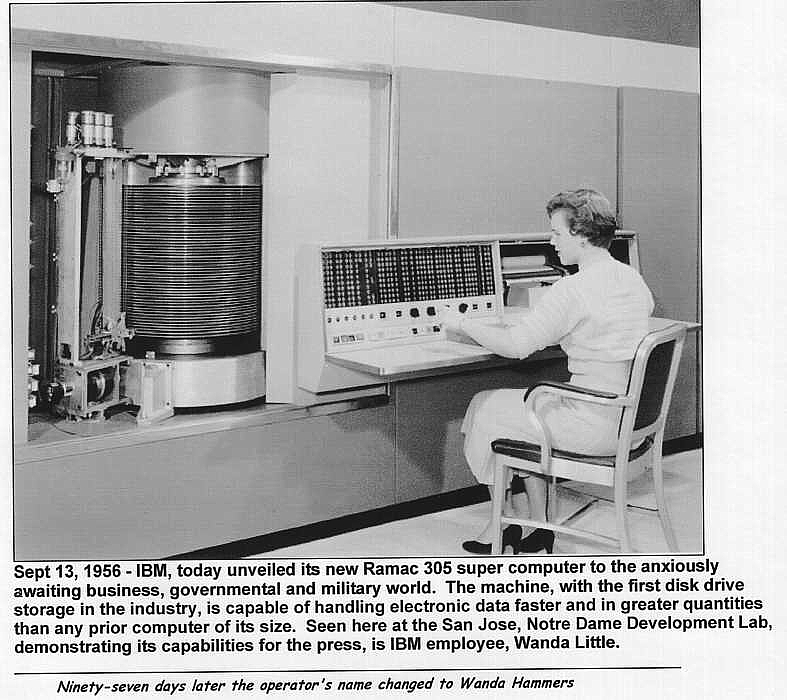
The photo below shows one packaged a bit more neatly than our prototype :-).
|
Successor Not Followup from Al Hoagland - May 17, 2013 - via Brian Beg
|
I just read the recent email from Bruce. He stated he had four RAMAC systems (that's the 305), each 305 RAMAC includes a 350 disk drive. He does talk about tracking information on these four computer systems; however, he doesn't suggest any of these computer systems had an additional access mechanism on any of the disk drives.
I will give you some background on IBM San Jose during the period when the RAMAC developed. In the Summer of 1975, Rey Johnson was given the responsibility of running the Advance Disk File project, to come up with the successor to the RAMAC. This happened before the RAMAC was even announced.
This clearly indicated IBM did not plan any follow up to the RAMAC (which was primarily created to address punch card equipment devices). The ADF program was set up to move IBM ahead of competition in the new electronics computer age, rather than being focused on punch card system improvements, which the RAMAC was essentially designed for.
The program Rey started included a flying head per recording surface, a comb actuator for track selection, with the objective of increasing capacity by a factor of 10 and access time 10 times faster than the RAMAC. A strong motivation was to get IBM in a the leadership position with the new electronic computer technology being developed. A couple of other companies had been looking at flying heads on drums, where very short access times could be provided, although the capacity was very small compared to the RAMAC.
Rey chose to pursue perpendicular recording, rather than the universally used, longitudinal recording (I have written a paper previously on this matter). In January of 1960, a major audit was made of the program, where the committee agreed that the steel disks used for storage (with oxidized surfaces) were of inadequate quality to be used. The consequence was to drop vertical recording, use the RAMAC-type disk head technology, which had been advanced continuously, since it was still involved in the double density RAMAC. This lead to the successful designs for the flying head, and the disk drive identified as the 1301, was announced in June, 1961.
Since then, all disk drives have been characterized by a flying head, per recording disk surface. I will make an observation, that if Rey Johnson were to see a modern disk drive, 50 years after the 1301, (all which are now based on perpendicular recording) he undoubtedly would have thought that this is what he wanted with the ADF. This provides some background as to why I felt IBM had no interest in pursuing advances in the RAMAC. Thus, Rey Johnson played a role in both the rotating disk stack and the head per surface access capabilities that still define basic disk drives.
I am impressed by what Bruce and his team have accomplished by organizing a way to manage four individual RAMACs to work collectively together.
- Al Hoagland
|
Postscript, 1956 -> 2014
The late 1950s brought two great revolutions to the world of computing:
- transistors became cheap enough and robust enough for computers
- magnetic disk storage began to replace magnetic drums then mag tape
With the later transistor integrated circuits, both above caused computing to be millions of times:
- cheaper
- smaller in size
- less power consumption
and replacing the ever present punched card ;-))
The following discusses the reduction in size of a bit of information on a disk relative to the great granddaddy RAMAC:
- IBM 1311 (1962-75) and 2311 Disk Drives (1964-late70s)
-
disk recording in general - seven sections
-
reduction of the size of a bit "Areal Density" in particular - the seventh section
- Serious engineering on creating dense tracks
- like 7,000 to the inch -
Friends, I occasionally lurk at various IEEE presentations, imagining that I can understand and be competitive,
even though retired.
Included in the usual IEEE events is the local
Magnetics Society.
Here is the abstract of the
current (Tuesday, Oct. 14th, 2014) presentation. I can't even fake
understanding most of the technical words - and likely will not go :-((
I also think that Al Hoagland and other RAMAC
magnetics guys would have trouble also. - Likely most of the concepts and techie names/words were not present
when they were active 60 years ago.
|
What was the original magnetic medium?
There have been various theories about the magnetic media used to coat the RAMAC disks.
The following hand written memo from Jon Haanstra on June 3, 1953 be the most authoritive :-))
e-mail from Robert Garner to Tom Gardner, June 17, 2017
Tom,
Over the past couple of years, as Dave Bennet meticulously curated the memos and documents
that Lou Stevens had preserved from the earliest days of the San Jose lab,
I’ve been (sporadically) scanning the important looking ones.
Hopefully I’ll be done “soon," and will distribute a complete CD and Flash stick.
The following report, hand written by Jon Haanstra on June 3, 1953, describes the
“First Magnetic Recording Tests with Air Bearing Head”, attached.
(although photos are missing, there are scans of some of them..)
In this section 1.4, he described the first disk coating:
“The disk was first sprayed with aluminum chromate
primer in a very thin coat. The magnetic
material was 3M red oxide mixed about 50-50
with varnish. This mixture was sprayed
on the primed surface and baked for 45 min at 136 F.”
Here’s a copy of section 1.4, the
full (interesting!) memo attached.
|
Tom Gardner did the interview
Oral History of William "Bill: Crooks which has a magnetic paint story on page nine.
Tom Gardner also contributed to
Golden Gate Bridge Paint Myth.
Gamma (magnetic) phase iron oxide is discussed in
this Wikipedia article.
History of magnetic materials including the
needle-like iron oxide powders invented by Camras in the 1950s
from "Physics and Engineering Applications of Magnetism" by Ishikawa & Mirua
and Tom Gardner spotted
The Little Maghemite Story: A Classic Functional Material
and Joe Feng adds
|
In 2007, Hong-Sik Jung at Komag (now WD on Automation Parkway) characterized a RAMAC disk using modern techniques. Among the things he did was SEMs of the coating. It was clear that the particles were NOT acicular, and that they were randomly oriented. His measured value for the coercivity was 263-266 Oe; somehow, I think the coercivity of particulate gamma Fe2O3 as about 350 Oe, but some of this may have due to the orientation of the acicular particles.
|
|
350 Model Numbers - By Tom Gardner
... but another detail that u might want to consider has to do with the many models of the 350 (and of the 355).
We think of the RAMAC as one drive but the 350 had eight models as follows:
350
Model Number
| Description
| Announced
| Purchase
Price
| Rental Price
per month
| |
-1
| Original model
| Sept 14, 1956
| $35,500 (actual)
| $650
| |
-2
| Second drive on 305
| May 5, 1958
| $36,400 (actual)
| $700
| |
-3
| Dual actuator version of -1
| Sep 15, 1958
|
|
| |
-4
| Dual actuator version of -2
| Sep 15, 1958
|
|
| |
-11
| Double capacity version of -1
| Jan 12, 1959
| $55,700 (estimated)
| $1,050
| |
-12
| Double capacity version of -2
| Jan 12, 1959
| $57,200 (estimated)
| $1,000
| |
-13
| Double capacity version of -3
| Jan 12, 1959
| $82,200 (estimated)
| $1,550
| |
-14
| Double capacity version of -4
| Jan 12, 1959
| $83,200 (estimated)
| $1,600
|
|
Estimated purchase prices based upon actual rental prices of double capacity devices
The 355 probably went thru a similar model evolution; it did start with multiple actuators.
|
Disk drives on IBM 7030 (Stretch) - 353 versus 7303? - involving Tom Gardner - June 2021
The Query from Tom Gardner - June 1, 2021 - { t dot gardner @ computer dot org }
|
Hi Ed:
Can you ping your colleagues to see if anyone knows about the disk drives on Disk drives on IBM 7030 (Stretch) – the 353 versus the 7303, are they the same thing rebadged or is one a follow on to the other or?
This is what I know so far
- The model number 7303 is only found in
7030 system literature
with early dates; I can find no product documentation
- The model number 353 appears in product literature with later dates.
- The earliest literature gives a 7303 capacity of about 1 million words, the later literature states 2.1 million 64-bit words
- The
353 CE manual confirms it used "flying" heads like those in the 1301.
Another document gives the 353 capacity as 2.1 million 72 bit words which probably counts ECC.
- The "air" heads of the double capacity 350 at 7.5 MB could do about 1 million words. The "flying" heads of the 1405 at about 15 MB could do about 2 million words.
- The Stretch drive at the Computer History Museum came from Lawrence Labs, the second 7030 installation (Nov 1961), and is badged as 353.
Any help would be appreciated. Posting an answer at yr RAMAC site would be very helpful
Tom
|
I (Ed Thelen) forwarded the request to more than 10 people who I thought might have info or who might be interested -
David Bennet (June 02, 2021) responded with
|
Tom and all,
The Stretch drive was the first to have one head per surface. The first such drive (I think it went to Los Alamos) actually had air heads. This is because Watson,Jr. decreed that the schedule would be met no matter what. This file was the no matter what. Could you imagine the roomful of compressors that it took to fly all those heads? Later Stretch files had the first "self actuating air bearing heads." I am not sure if there was more than one air head Stretch drive.
The Stretch drive came from LLNL and it came to the museum without head-arms, so I don't know for sure which kind of heads it had, but I have always thought that it most probably had self actuating heads. Dag told me that the head arms were thrown away because they were rusty. Someone at LLNL did not realize their importance, no doubt.
I do know that the Stretch self actuating head arms were different from those on the 1301. The Stretch machine was definitely rushed out the door.
I don't know anything about model numbers for Stretch machines.
I hope that this info is helpful. I spent some time on this subject a while ago and I'm quite certain that the above is correct.
Dave
|
Tom Gardner { t dot gardner @ computer dot org } - responded (June 02, 2021)
Dave
Thanks
There is little question that the very first Stretch File in development had static air heads like the RAMAC
and it is confirmed in Kean’s SJ quarter century:
“Witt named Ralph
Golub to head the Stretch File team and instructed him to drop the gliding head and
revert to pressurized air heads
"because we know they will work and satisfy
Stretch commitments."
The device was announced as the IBM 353
in December
1960, and while it required an air compressor system so enormous it had to be
housed in a separate room, it did resolve the technical problems.”
[IBM San Jose, A Quarter Century of Innovation, p. 53]
Bashe states it did ship that way.
Then, to expedite the parallel version of ADF for the Stretch project, it cut back on recording density
— effectively halving capacity to 2 million words, data rate to one word every 8 microseconds
—and reverted to familiar RAMAC air-fed head techniques.
Although the decision encumbered the Stretch system with air compressors,
Witt was able to ship a parallel disk file to Dunwell in the fall.
90
[IBM’s Early Computers, Bashe et. al., p. 307,
fn 90 references Shugart’s August 1960: “Remarks on Advanced Disk File,” IBM RAMP Conference I minutes.]
Shugart on the other hand much later on states it may not have delivered to Los Alamos.
Al: The Stretch system was for Los Alamos for scientific computing and we
put a head on each surface. Now, talk about air compressors. We had so
many air compressors for all those heads.
Fortunately, before IBM had to
deliver it, the self-acting air bearing head came out and we didn't have to
deliver it.
[The Disk Drive Story Chapter 1: IBM's RAMAC, Transcript #2, December 3,2001, p 12.]
Al: The problem there was that you ended up with a room full of air
compressors. Each head had to be loaded with air pressure and then had to
take the air to form the bearing. All these heads required quite a lot of air. It
just wasn't a practical kind of thing.
I think it was really fortunate that Jack
Harker committed the early ADF to Stretch so we didn't have to produce
that thing.
That would have been a nightmare - an absolute nightmare.
[The Disk Drive Story Chapter 1: IBM's RAMAC, Transcript #3, January 11, 2002, p. 9]
If anyone has the RAMP conference presentations it would be very interesting to see what Al said in 1960
The much later 353 FEMM discloses flying heads which means there must have been a substantial engineering change.
Perhaps the static air head models were shipped as Beta test and recalled?
How the 353 and 354 became the 7303 and 7304 is still a mystery but I’m convinced they are the same with just a different badge.
Tom
|
Tom Gardner { t dot gardner @ computer dot org } - added (June 03, 2021)
| Hi
It has been suggested that the 7303 might have been a bundle of a 353 Disk Storage
and a 354 Storage Control Unit which is consistent with the following:
The disc file system on the Los Alamos STRETCH computer
consists of one disc synchronizer, two disc control units (IBM 354)
and two disc storage units (IBM 353).
Only one disc synchronizer may be connected to the computer, but any number,
up to a maximum of 32, of disc storage units may be connected to the disc synchronizer via disc control units.
[The use of the Disc File on STRETCH]
A high-speed
disk storage system consists of one IBM 7303 Disk Storage
and its associated IBM 7612 Disk Synchronizer.
[7030 Ref manual]
This seems to say that on STRETCH the 354 control unit could only support one 353 disk storage so it could be for
ordering the combination was a 7303, not unlike the original 2314 which was ordered as a 2314 but shipped as four boxes,
2314 SCU, 2x 2313 Disk Storage and a 2312 Disk Storage.
Refresh anyone’s recollection?
Tom
|
|
Website started June 8, 2006
Updated through June 03, 2021
If you have corrections or suggestions, please send e-mail
to Ed Thelen (ed@ed-thelen.org) -